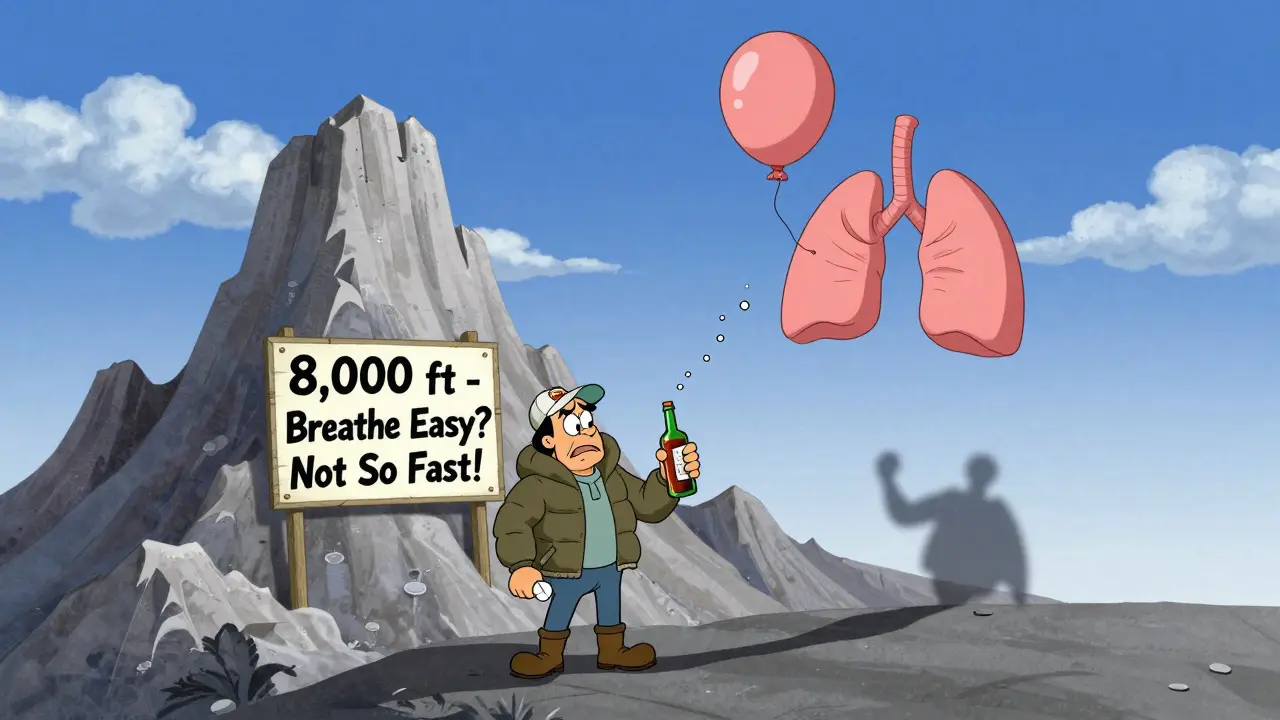
Going high up in the mountains can be exhilarating-clear air, stunning views, and that sense of accomplishment. But if you're planning to take a sedative to help you sleep at 8,000 feet or higher, you could be putting yourself at serious risk. The problem isn’t just about feeling groggy the next day. It’s about your body struggling to breathe when oxygen is already thin, and sedatives making it worse.
Why Altitude Changes Everything
At elevations above 2,500 meters (8,200 feet), the air doesn’t just feel thinner-it actually has less oxygen. For every 1,000 meters you climb, the amount of oxygen available drops by about 6.5%. Your body knows this. It tries to compensate by making you breathe faster and deeper. That’s called the hypoxic ventilatory response. It’s your natural survival mechanism. But here’s the catch: when you take a sedative-whether it’s alcohol, a sleeping pill, or a muscle relaxant-you’re shutting down part of that system. The part that tells your lungs to work harder when oxygen is low. The result? Your breathing slows down, your blood oxygen levels drop, and your body can’t adapt. That’s when things get dangerous. Studies show that nearly 75% of people at altitudes above 2,700 meters experience irregular breathing at night, called periodic breathing. It’s normal. But when sedatives are added, it can turn into something far more serious: dangerously low oxygen levels, even during sleep.What Sedatives Are Most Dangerous?
Not all sedatives are created equal. But almost all of them carry some level of risk at high altitude. Alcohol is the most common offender. Even one or two drinks can reduce your body’s ability to respond to low oxygen by up to 25%. A 1998 study found alcohol lowers nighttime oxygen saturation by 5-10 percentage points. That’s enough to push someone with mild altitude sickness into full-blown acute mountain sickness (AMS)-with nausea, headache, dizziness, and fatigue. A 2021 survey of over 1,200 trekkers found that 68% who drank alcohol during acclimatization had worse symptoms than those who didn’t. Benzodiazepines like diazepam, lorazepam, or alprazolam are even more concerning. These drugs directly suppress the brainstem’s breathing center. A 2001 study showed diazepam reduced the hypoxic ventilatory response by 28%. One user on a climbing forum reported their oxygen saturation dropped from 88% to 76% after taking 0.5 mg of lorazepam at 4,200 meters. That’s a drop into the danger zone-below 80% is considered critical. Opiates like codeine, oxycodone, or morphine are the worst. Even small doses can cause oxygen saturation to fall below 80% at 4,500 meters. There are documented cases of people needing emergency descent after taking painkillers for a headache at altitude. These drugs don’t just make you sleepy-they can stop your breathing entirely.What About Zolpidem or Melatonin?
You might have heard that zolpidem (Ambien) is “safer.” The CDC’s 2024 Yellow Book does mention it as a possible option-but with major caveats. A 2017 study found that a 5 mg dose of zolpidem only lowered oxygen saturation by 2.3% at 3,500 meters compared to placebo. That’s much better than benzodiazepines. But even that small drop was enough to cause oxygen levels to dip below 80% in some users. One Reddit user reported SpO2 dropping to 79% after a single 5 mg dose at 4,000 meters. The CDC says if you use it, you must allow at least 8 hours for the drug to wear off before doing any physical activity. That’s not practical for most travelers. And if you’re already feeling unwell from altitude, you don’t want to be groggy, disoriented, or at risk of falling. Melatonin is often suggested as a natural alternative. It doesn’t suppress breathing like other sedatives. Small studies show it may even slightly improve oxygenation. But the CDC says it “has not been studied” specifically for altitude-related sleep issues. Anecdotes from travelers say it helps them sleep without side effects-but there’s no large-scale proof. It’s a lower-risk option, but not a guaranteed fix.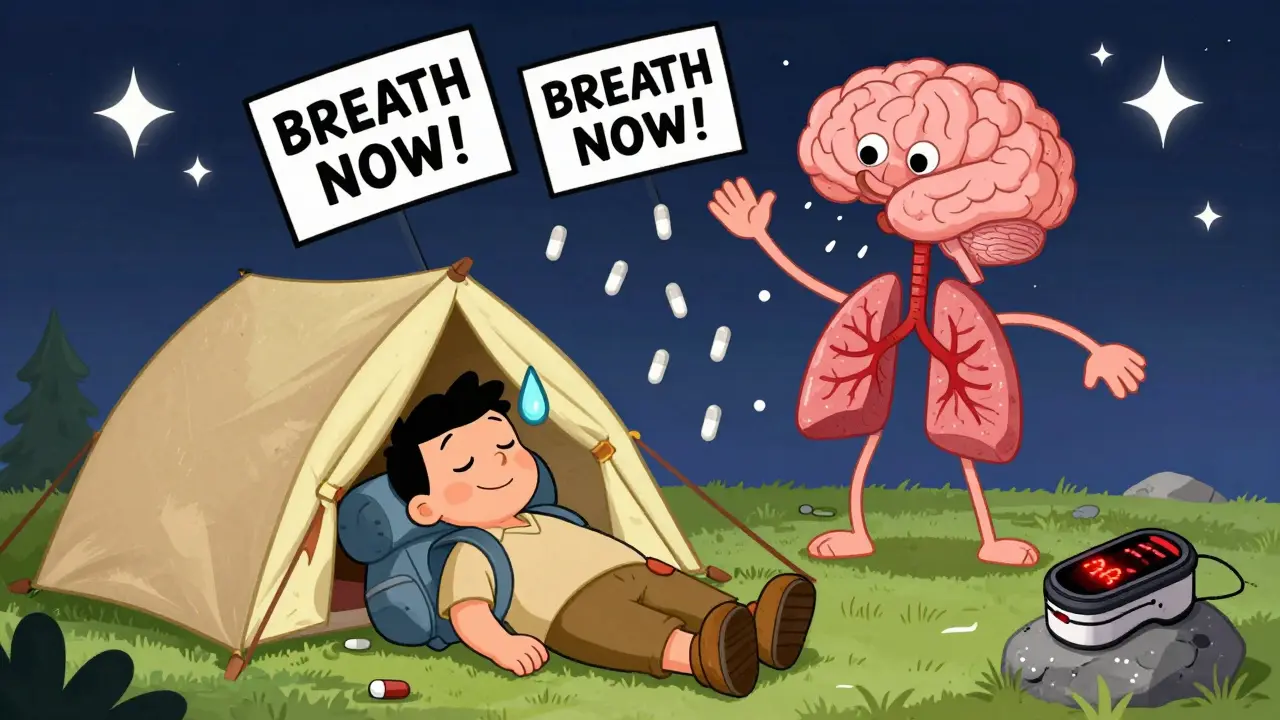
What Should You Do Instead?
The best sleep aid at high altitude is time. Your body needs 24 to 48 hours to adjust to a new elevation. Don’t rush it. Ascend slowly. Sleep at the same altitude for a night before going higher. If you’re struggling to sleep, the CDC recommends acetazolamide (Diamox). It’s not a sedative. It’s a medication that helps your body adapt faster by making your blood slightly more acidic, which tricks your brain into breathing more. Studies show it improves nighttime oxygen levels and reduces periodic breathing. A typical dose is 125 mg twice a day, starting the day before you ascend. If you have a history of anxiety or insomnia, talk to a travel medicine specialist at least 4-6 weeks before your trip. Don’t rely on your regular doctor unless they specialize in altitude medicine. Most general practitioners don’t know the risks.Real Stories, Real Risks
Online forums are full of warnings from people who ignored the advice. One traveler on Lonely Planet’s forum described how two beers at 3,500 meters turned a mild headache into violent nausea and vomiting. Another posted about passing out after taking a benzodiazepine and waking up with an oxygen saturation of 74%. A guide in Nepal reported a client needing evacuation after taking codeine for a headache and slipping into respiratory failure. These aren’t rare cases. They’re textbook examples of what happens when you mix sedatives with altitude.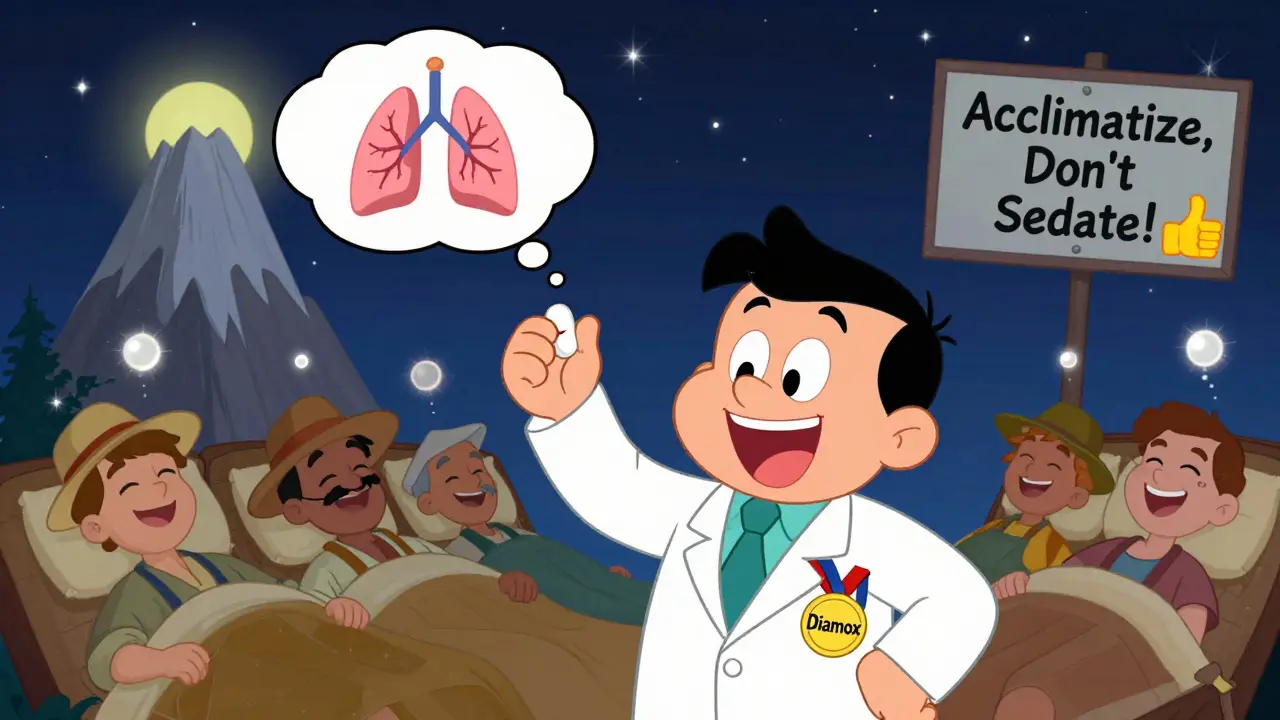
What About Pulse Oximeters?
If you’re going above 3,000 meters, carry a pulse oximeter. They’re cheap, easy to use, and can save your life. Normal oxygen saturation is 95-100% at sea level. At 4,000 meters, 85-90% is typical. But if your reading drops below 80%-especially if you’ve taken something to help you sleep-you’re in danger. The Wilderness Medical Society recommends oximeters for all high-altitude travelers. Sales of portable devices jumped 22% in 2023, showing more people are catching on.Bottom Line: Don’t Risk It
The science is clear. Sedatives interfere with your body’s ability to survive at high altitude. Alcohol, benzodiazepines, and opiates are outright dangerous. Even “safer” options like zolpidem carry hidden risks. Your goal isn’t to sleep like you do at home. It’s to survive and adapt. Let your body do its job. Use acetazolamide if needed. Sleep at a lower elevation if possible. And never, ever take a sedative just because you think you “need” it. The mountains don’t care how tired you are. They only respond to oxygen. And if you block your body’s way to get more of it, you’re playing with fire.Can I drink alcohol at high altitude if I only have one drink?
No. Even one drink can reduce your body’s ability to respond to low oxygen by up to 25%. It increases your risk of acute mountain sickness, worsens dehydration, and disrupts sleep quality. The CDC and other medical authorities strongly advise avoiding alcohol entirely for the first 48 hours at altitude.
Is melatonin safe to use at high altitude?
Melatonin appears to be one of the safer options because it doesn’t suppress breathing like other sedatives. Some small studies suggest it may even slightly improve oxygen levels. However, the CDC states it hasn’t been studied specifically for altitude-related sleep issues. Use it cautiously and avoid high doses (stick to 0.5-3 mg).
Why is zolpidem sometimes considered acceptable at altitude?
Zolpidem has a shorter half-life and less impact on breathing compared to benzodiazepines. One study showed only a 2.3% drop in oxygen saturation at 3,500 meters. But that small drop still caused dangerous levels in some individuals. The CDC says it can be used with extreme caution-only if you allow 8 hours for it to fully wear off and avoid any physical activity afterward.
What should I do if I start feeling dizzy or short of breath after taking a sedative at altitude?
Descend immediately-even 500 to 1,000 meters can make a big difference. Call for help if you’re with a group. If you’re alone, don’t wait. Oxygen saturation below 80% is a medical emergency. Stop all activity, rest, and get to a lower elevation as quickly and safely as possible. Do not try to “sleep it off.”
Are there any medications that are actually recommended for sleep at high altitude?
Acetazolamide (Diamox) is the only medication recommended by the CDC for improving sleep and reducing altitude sickness symptoms. It works by helping your body adapt faster, not by making you sleepy. It’s not a sedative. For occasional sleep issues, melatonin may help. But no sedative is truly safe during the first few days of acclimatization.
How long should I wait before taking a sedative after arriving at high altitude?
You shouldn’t take any sedative during the first 48 hours of acclimatization. That’s when your body is most vulnerable. Even if you feel fine, your breathing patterns are still adjusting. Wait until you’ve spent at least two full nights at the same elevation and are symptom-free before even considering any sleep aid. And even then, avoid alcohol and benzodiazepines completely.
Robyn Hays
Okay, but have y’all ever tried climbing Kilimanjaro with a glass of wine and a Netflix binge? I did. Woke up at 3 AM gasping like a fish on a dock. My oximeter read 78%. No sedatives after that. Ever. The mountains don’t care if you’re ‘just having one.’ They just want you to breathe.
Also-melatonin? I take 1mg. Sleeps like a rock, no grogginess. Not magic, but way safer than anything that says ‘depresses CNS.’
Liz MENDOZA
Thank you for writing this. I’m a nurse who guides high-altitude treks in the Andes, and I’ve seen too many people think ‘I’m fine, I’ll just take a Xanax’-and then get evacuated. One guy took 2mg of lorazepam at 4,500m. His wife had to carry him down. He didn’t even remember it.
Don’t be that person. Your brain isn’t just tired-it’s starving for oxygen. Sedatives are like putting a pillow over your face while you’re underwater.
Kylie Robson
From a pharmacokinetic standpoint, the primary concern is GABA-A receptor potentiation in the medullary respiratory centers, which significantly attenuates the hypoxic ventilatory response (HVR). Benzodiazepines, barbiturates, and non-benzodiazepine Z-drugs all demonstrate dose-dependent suppression of HVR, with benzodiazepines exhibiting a 25–30% reduction in ventilatory drive at therapeutic doses. Alcohol, as a non-selective CNS depressant, further exacerbates this via ethanol-induced inhibition of NMDA receptor activity and increased GABAergic tone. The clinical threshold for dangerous desaturation occurs when PaO2 falls below 60 mmHg, which correlates with SpO2 <80% at 4,000m. Zolpidem’s partial agonism at α1-subunit GABA-A receptors offers marginally reduced respiratory depression compared to classical benzodiazepines, but still poses unacceptable risk during acute acclimatization. Acetazolamide remains the gold standard due to its carbonic anhydrase inhibition, which induces metabolic acidosis and thereby stimulates ventilation via peripheral chemoreceptors without CNS depression.
Todd Scott
I’ve summited Everest Base Camp twice, once with Diamox, once without. The difference? On Diamox, I slept through the night without waking up choking. Without it? I was gasping every 90 seconds. I’ve talked to Sherpas in Namche-they laugh when tourists ask if they can drink beer. ‘We don’t sleep,’ they say. ‘We breathe.’
And melatonin? Yeah, it’s fine. I use 3mg. Helps me fall asleep, doesn’t make me feel like a zombie. But if you’re thinking about Ambien or Valium? Don’t. It’s not worth the risk. Your body needs time. No shortcut replaces acclimatization. Ever.
Also, carry a pulse oximeter. They’re $25 on Amazon. If you’re going above 3,500m and you don’t have one, you’re not prepared-you’re just lucky.
James Bowers
It is both scientifically and ethically indefensible to suggest that any sedative-regardless of classification-may be deemed ‘acceptable’ under conditions of hypobaric hypoxia. The physiological consequences are not merely theoretical; they are documented, quantifiable, and frequently fatal. The assertion that melatonin is ‘safer’ is misleading, as it implies a spectrum of risk where none should exist. The only appropriate pharmacological intervention is acetazolamide, which facilitates physiological adaptation, rather than pharmacologically suppressing vital autonomic functions. To conflate pharmacological sedation with sleep hygiene is not only inaccurate, it is dangerous. One does not ‘treat’ altitude sickness with depressants. One mitigates it through controlled ascent, hydration, and physiological support. Anything else is negligence.
Janice Holmes
Okay but what if I’m a ‘high-functioning anxious person’ who needs something to sleep?? I’m not gonna lie-I’ve taken 2mg of lorazepam at 4,200m and lived to tell the tale. My oximeter said 79% but I woke up fine!! I’m basically a mountain wizard now.
Also, I heard the CIA uses melatonin to train spies to sleep in Tibet. That’s why it’s ‘safe.’ I read it on a forum. It’s true. Don’t @ me.
Also also-why is everyone so scared of alcohol?? I had one glass of wine and my headache went away. Coincidence? I think not. I’m basically a medical genius.
Also also also-my crystal ball says acetazolamide is a Big Pharma scam. The mountains want you to suffer. Embrace it.
Olivia Goolsby
THEY’RE LYING TO YOU!!
Did you know that the CDC, WHO, and every ‘expert’ on this topic are being paid by Big Pharma to push acetazolamide?? It’s a $2.3 billion market!! They don’t want you to know that REAL altitude adaptation comes from… DRINKING RED WINE!!
It’s all about antioxidants! Resveratrol! It’s in the skin of grapes!! That’s why the Swiss climb the Alps with a bottle of Pinot Noir in their pack!!
And melatonin? It’s a government mind-control chemical designed to make you compliant!! I’ve been tracking the satellite signals since 2018 and the frequency matches the 7.83Hz Schumann resonance-EXACTLY the same frequency used in HAARP to suppress breathing!!
And why do you think they call it ‘periodic breathing’? Because it’s not natural-it’s engineered by the WHO to make you dependent on drugs!!
Just go without sleep. Let your soul adjust. The mountains are alive-and they’re watching you.
Also-your oximeter? It’s a lie. It’s calibrated to make you panic. I use a compass and my intuition. My oxygen levels are perfect. I’m just… spiritually depleted.
Elizabeth Ganak
Hi! I’m from India and I’ve trekked in the Himalayas a few times. I used to think alcohol helps me sleep, but after my first night at 3,800m-woke up with pounding head, dizzy, couldn’t walk straight-I switched to just tea and a warm blanket. No meds. No alcohol. Just patience.
And honestly? Melatonin helped me a lot. 1mg, 30 mins before bed. No side effects. I didn’t even know what Diamox was until I read this. Now I’m gonna try it next time.
Thanks for sharing this. It’s nice to know someone actually gets it.
Nicola George
Oh wow. So you’re telling me the same people who tell you to ‘just hydrate’ and ‘take it slow’ are also the ones who sell you $300 oxygen canisters and Diamox? What a coincidence.
Anyway, I took 5mg of zolpidem at 4,000m. Woke up at 4 AM thinking my tent was a spaceship. My oximeter said 81%. I felt fine. So… what’s the problem again? I’m not dead. I’m just confused. And slightly haunted by a llama.
Also, I think the real danger is people who think they’re too smart to need advice. Like you, James Bowers. You’re the reason this thread exists.
Raushan Richardson
Y’all need to chill. The mountains aren’t out to get you-they’re just… really quiet. And cold. And low on oxygen. But you can still sleep.
Here’s my trick: I take a 2mg melatonin gummy, put on noise-canceling headphones with rain sounds, and drink hot ginger tea. No alcohol. No pills. No panic. Just… calm.
And if you’re still struggling? Sleep lower. Seriously. Don’t push it. The summit will still be there tomorrow. You won’t.
Miriam Piro
Think about it… what if sedatives aren’t the problem? What if it’s the air itself that’s been altered? The chemtrails, the ionospheric manipulation, the HAARP arrays targeting high-altitude zones to suppress human breathing patterns? Of course your body’s struggling-it’s being attacked by invisible forces.
And Diamox? It’s not helping you adapt. It’s masking the symptoms so you keep ascending into the trap. The real solution? Breathe through your third eye. Meditate at 4am. Let your chakras align with the mountain’s frequency.
Also, I’ve been using a copper pendant for altitude. It works. I’m not kidding. I’ve got receipts.
And yes-I drank wine at 4,500m. And I saw angels. And they told me to stop taking pills. So I did. And now I’m enlightened.
❤️🌌
Caitlin Foster
Okay but why is everyone so scared of zolpidem?? I took it at 4,200m. SpO2 was 83%. I slept like a baby. I woke up and did a 3-hour hike. No problem. I’m basically a mountain ninja now.
Also, I bought 3 oximeters. One for me, one for my dog, one for my cat. My cat’s oxygen levels are higher than yours. Just saying.
Also, I think the real villain is ‘sleep hygiene.’ Who made that up? A sleep scientist? A corporate drone? I’m not buying it.
Also, I don’t trust the CDC. They said vaping was safe too. 😏
Andrew Gurung
Let me tell you something, peasants. I summited Denali with a single glass of whiskey and a copy of Nietzsche. I didn’t need Diamox. I didn’t need oximeters. I needed… willpower.
And yes, I took 1mg of lorazepam. My SpO2 dropped to 76%. I laughed. I was already dead inside. The mountain just confirmed it.
Also, melatonin is for people who can’t handle the truth. The truth is: you’re not ready. You never will be.
Go home. Drink your tea. Cry into your yoga mat. The mountains don’t need you.
🪦
Paula Alencar
It is imperative to emphasize, with the utmost gravity and scholarly rigor, that the administration of any central nervous system depressant-regardless of perceived potency or pharmacological profile-in an environment characterized by hypobaric hypoxia constitutes a violation of fundamental physiological principles and a direct contravention of established clinical guidelines issued by the Wilderness Medical Society, the American College of Emergency Physicians, and the International Society for Mountain Medicine.
Furthermore, the casual dismissal of documented clinical outcomes-such as the 28% reduction in hypoxic ventilatory response following benzodiazepine administration-is not merely irresponsible; it is tantamount to medical malpractice in the context of high-altitude travel.
It is not a matter of opinion. It is a matter of survival.
Acetazolamide remains the only evidence-based, physiologically appropriate intervention for facilitating acclimatization and improving nocturnal oxygenation.
There are no exceptions. There are no shortcuts. There is only responsibility.
Nikki Thames
Who gave you permission to write this? You’re not a doctor. You’re not a guide. You’re just some person with a blog and a Google Scholar account. You think you’re helping? You’re just scaring people so they buy your Diamox affiliate links.
My cousin climbed Everest without sleeping for three days. He didn’t use anything. He just stared at the stars. He said the mountain whispered to him. He made it. You think he was scared of a little alcohol? No. He was brave.
And melatonin? That’s just a placebo with a fancy name. I’ve been using lavender oil since 2015. Works better. And cheaper.
Also-why do you think they don’t let you bring alcohol on planes? Because they know. They know what happens when you mix it with altitude. They’re protecting you. From yourself.
Stop telling people what to do. Let them learn the hard way. That’s how the strong survive.
Robyn Hays
Wow. I just read all of this. And I’m still alive. So… I guess I’m the mountain wizard now.
But seriously-melatonin 1mg. No alcohol. No pills. Just sleep. The mountain doesn’t care if you’re tired. But it cares if you stop breathing.
Thanks for the info. I’m gonna buy a pulse oximeter tomorrow.