When your doctor switches your blood pressure pill from brand-name losartan to a generic version, you might feel uneasy. You’re not alone. Many patients wonder: Are cardiovascular generics really safe? Do they work just as well? Or are they cheaper because they’re less effective?
The truth isn’t simple. On paper, generics are supposed to be identical to brand-name drugs. They contain the same active ingredient, dose, and route of delivery. But real-world data tells a more complicated story - one filled with subtle differences, patient concerns, and surprising outcomes.
How Generics Are Approved - And What It Really Means
The U.S. Food and Drug Administration (FDA) requires generic drugs to prove they’re bioequivalent to the brand-name version. That means the amount of drug absorbed into your bloodstream must fall within 80% to 125% of the brand’s levels. This isn’t about being exactly the same - it’s about being close enough that the clinical effect is the same.
For most drugs, this works fine. But cardiovascular medications are tricky. They often have a narrow therapeutic index - meaning the difference between an effective dose and a dangerous one is small. A 5% difference in absorption might not matter for a painkiller, but it could matter for a blood thinner or a statin.
Studies show that, on average, generics differ from brand-name drugs by just 3.5% in absorption. That sounds tiny. But when you’re dealing with millions of patients, even small variations add up.
What the Big Studies Say About Outcomes
A 2020 Harvard Health meta-analysis reviewed 38 randomized controlled trials - the gold standard in medical research. Of those, 35 showed no meaningful difference between generic and brand-name cardiovascular drugs. That’s 92% of studies finding them equally effective and safe.
But the other 6%? That’s where things get interesting.
A 2019 Canadian study tracked over 136,000 seniors aged 66+ after generic versions of ARBs (like losartan and valsartan) hit the market. In the first month after switching, adverse events rose: 8% for losartan, 11.7% for valsartan, and 14% for candesartan. That’s not a huge jump - but for elderly patients already on multiple medications, even a 4% increase in dizziness or low blood pressure can lead to falls, ER visits, or hospitalizations.
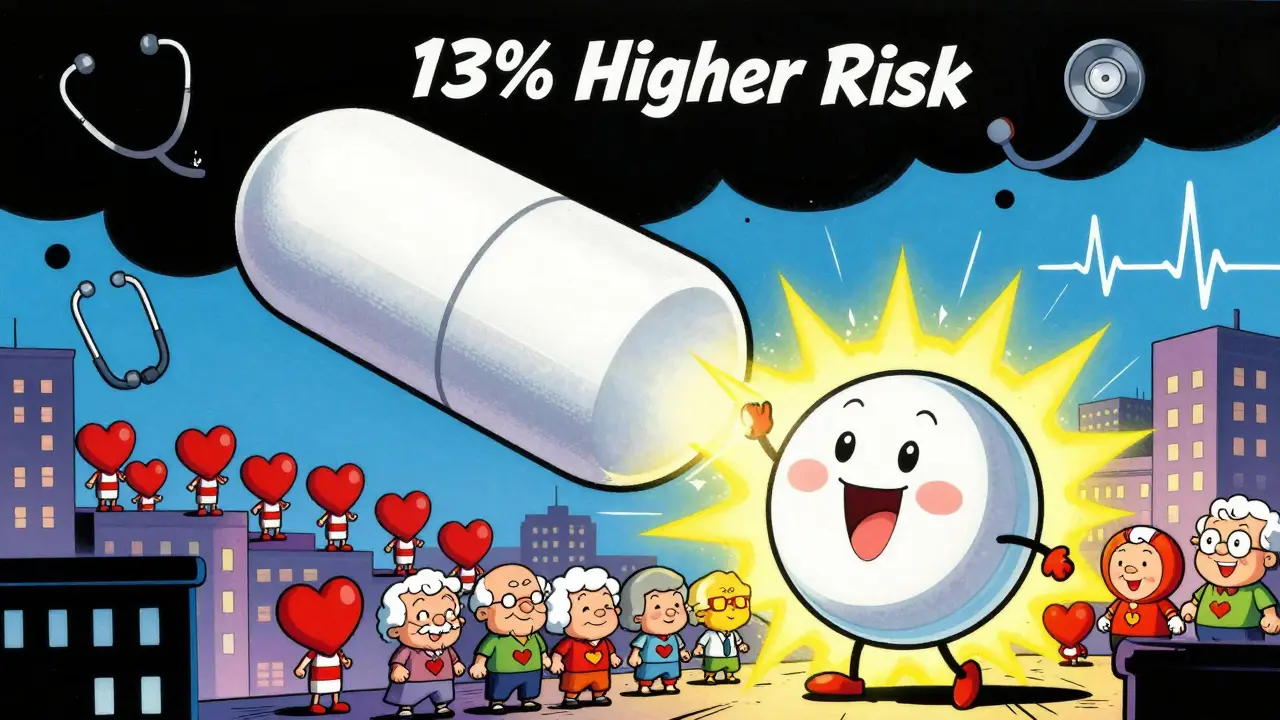
Then there’s the 2023 meta-analysis in PMC, which looked at over 1.2 million patients. It found no overall difference in major heart events between generics and brands - except for one group: statins. Generic statins showed a 13% higher risk of major cardiovascular events. Meanwhile, calcium channel blockers had fewer adverse events with generics.
Why the difference? One theory: statins are absorbed in the gut, and small changes in inactive ingredients (like fillers or coatings) can affect how well they dissolve. For some patients, a slightly slower release means lower blood levels - and less protection against plaque buildup.
The Hidden Problem: Inactive Ingredients
Generics don’t have to match the brand’s inactive ingredients. That’s legal. But those “fillers” matter.
A 2019 JAMA Internal Medicine study found that when patients switched to a generic pill with a different color or shape, 14.2% stopped taking it altogether. Why? They thought the new pill was wrong. Or worse - fake.
And it’s not just perception. Some patients with sensitive stomachs or allergies react to dyes, gluten, or lactose in generic formulations. One patient in Halifax told me (in a pharmacy chat) that her generic metoprolol gave her nausea every time - until she switched back to the brand. Her doctor assumed it was psychological. But when they tested her blood levels, her drug concentration was 22% lower on the generic.
These aren’t rare cases. The FDA’s 2022 inspection report found that 37.6% of generic manufacturers had deficiencies in patient labeling - meaning the information on side effects, storage, or interactions wasn’t clear or consistent.
Why Some Doctors Still Hesitate
Despite the data, nearly a quarter of physicians say they wouldn’t use generics for their own families. That’s not because they’re misinformed - it’s because they’ve seen the fallout.
Dr. Paul Poirier, a leading researcher in Quebec, put it bluntly: “The increase in adverse events isn’t because the drug is broken. It’s because patients are switching from a stable, familiar regimen to something that’s chemically similar but physically different.”
That’s especially true for older adults. Many take five or more medications. A change in pill size, color, or even the time of day they take it can disrupt their routine. That’s when adherence drops - and that’s when hospitalizations rise.
Pharmacists see this daily. A 2022 survey found that 67% of community pharmacists spend extra time counseling patients about generics. Not because they doubt the science - but because patients are scared.
The Nitrosamine Scare and Manufacturing Risks
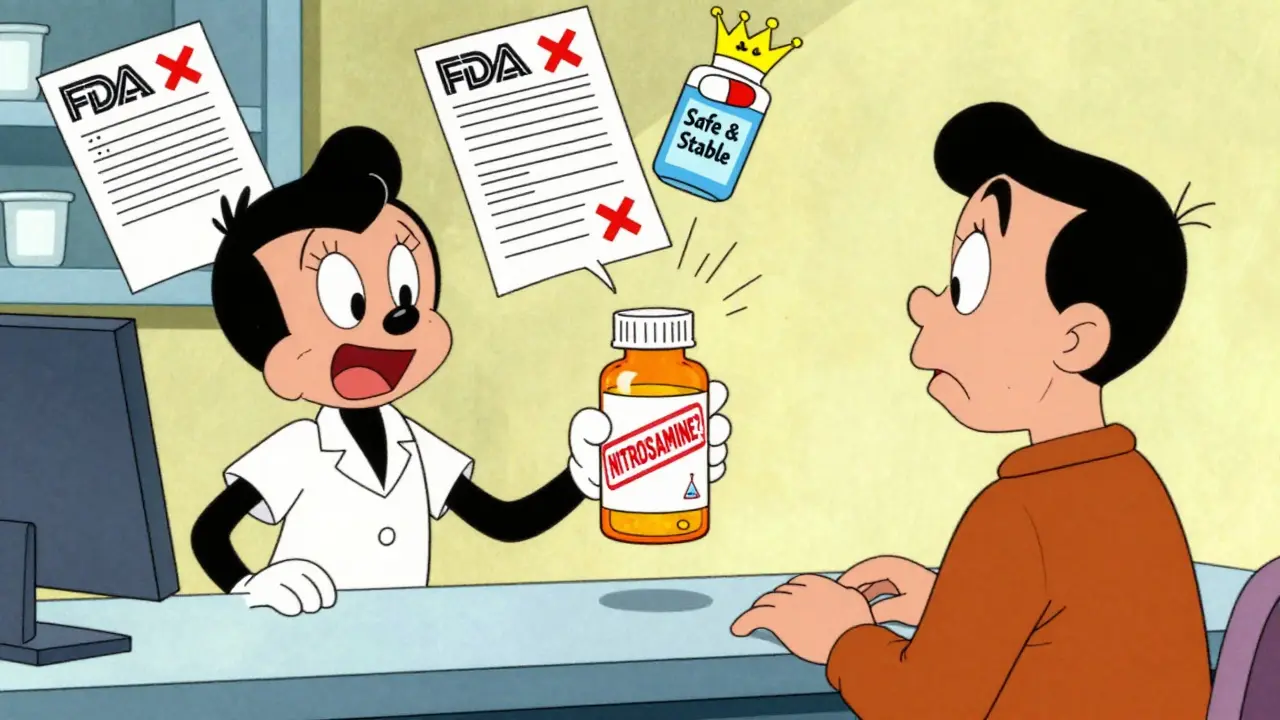
In 2018, a major contamination crisis hit the generic market. Nitrosamines - cancer-causing impurities - were found in losartan, valsartan, and irbesartan. Over 1,200 lots were recalled by the FDA between 2018 and 2020.
That wasn’t a fluke. It exposed a bigger issue: many generic manufacturers operate overseas, and quality control isn’t always consistent. In 2022, 12.7% of generic drug facilities had critical deficiencies during FDA inspections. That’s higher than the rate for brand-name makers.
The FDA now requires stricter testing for nitrosamines, with a daily limit of 96 nanograms for NDMA. But in Q1 2024, nearly 15% of tested generic cardiovascular lots still exceeded that limit. That’s not acceptable - and it’s why some cardiologists still prefer brand-name drugs for high-risk patients.
When Generics Work Better - And When They Don’t
Here’s the reality: cardiovascular generics are safe for most people. For statins, blood pressure meds, and beta-blockers, the data overwhelmingly supports their use.
But there are exceptions:
- Statins: Higher risk of major events with generics - especially in patients with diabetes or prior heart attacks.
- ARBs: Small but measurable spike in adverse events in the first month after switching, especially in seniors.
- Calcium channel blockers: Generics may be slightly safer - possibly due to more consistent absorption.
- Warfarin: Never switch without close INR monitoring. Even tiny changes can be dangerous.
For newer drugs like apixaban (Eliquis), generics are still rare - only 42% market penetration. Why? Because the patent just expired. Once more data comes in, we’ll know if the same patterns hold.
What You Can Do - Practical Steps for Patients
If you’re on a cardiovascular generic, here’s what to do:
- Don’t panic. Most generics are fine. The odds are in your favor.
- Track your symptoms. Did your blood pressure spike? Did you feel dizzy or fatigued after switching? Write it down.
- Ask your pharmacist. “Is this the same formulation I was on before?” If the pill looks different, ask why.
- Request brand-name if you’re high-risk. If you’ve had a heart attack, stroke, or are on multiple meds, your doctor can write “Dispense as Written” on the prescription.
- Get blood levels checked. For drugs like statins or beta-blockers, a simple blood test can confirm you’re getting the right dose.
And if you’re switching from brand to generic - give yourself two weeks. Your body needs time to adjust. Don’t assume every side effect is the drug’s fault. Stress, diet, sleep, and other meds can all play a role.
The Bigger Picture: Cost vs. Risk
From 2010 to 2019, generic drugs saved the U.S. healthcare system $1.67 trillion. Cardiovascular generics made up about 18% of that - roughly $300 billion.
That’s life-changing money. For many, generics are the only way they can afford their meds. Skipping doses because of cost leads to more heart attacks, more strokes, more deaths.
The goal isn’t to scare people away from generics. It’s to make the switch smarter.
Health systems need better tracking. Pharmacists need more time to counsel. Doctors need clearer guidelines on when to avoid substitution.
For now, the message is simple: generics work for most people. But not for everyone. And knowing the difference could save your life.
Hilary Miller
My grandma switched to generic losartan last year and started falling every other week. Took her three months to stabilize. Don't let anyone tell you it's 'all in your head' - bodies notice differences, even tiny ones.
Neil Ellis
Generics saved my dad’s life - he’s on six meds and couldn’t afford the brands. But I get it. My cousin had a weird reaction to a generic metoprolol that vanished the moment she went back to the brand. It’s not about trust in science - it’s about trust in consistency. Our bodies aren’t lab rats.
Malik Ronquillo
People are panicking over pills like they’re magic crystals. If your BP spikes after switching, maybe you’re stressed, eating worse, or sleeping less. Blame the pill? Lazy.
arun mehta
As someone who grew up in a household where medicine was a luxury, I’m deeply grateful for generics. But I also sit with my elderly neighbors when they get confused by new pill colors - and yes, some of them stop taking them. The system needs empathy, not just math. A 3.5% variance sounds clean on paper - but for a 78-year-old with kidney issues? That’s a cliff edge.
The FDA’s 37.6% labeling deficiency rate? That’s not a glitch. That’s negligence. And nitrosamines? We’re playing Russian roulette with pills made in factories where inspectors show up once a year. This isn’t about cost. It’s about dignity.
I’ve seen patients cry because they think their new generic is ‘fake’ - not because they’re irrational, but because no one explained the change. Pharmacists are overworked. Doctors are rushed. Patients are left guessing. That’s the real crisis - not the drug itself.
Let’s not villainize generics. Let’s fix the system that treats them like disposable commodities. We need standardized pill designs, mandatory patient education, and real-time blood level tracking for high-risk meds. Not just ‘take it or leave it’.
And yes - I’d use brand-name statins for my mother. Not because I distrust science. Because I distrust how little we care about the human side of it.
Brenda King
I’m a nurse and I’ve seen this over and over - patients panic when the pill changes color. It’s not just about the drug, it’s about control. When you’re sick, your pills are the only thing you can count on. Change that, and you shake their whole world. We need better communication, not just cheaper meds.
Sarvesh CK
The statistical argument that generics are ‘equivalent’ is mathematically sound, yet ethically incomplete. Bioequivalence does not imply clinical equivalence across all physiological contexts. The human body is not a linear system - it is an adaptive, context-sensitive network where minor perturbations in pharmacokinetics may cascade into significant clinical outcomes, particularly in polypharmacy and aging populations.
Moreover, the variability in inactive ingredients - excipients - is not merely a regulatory loophole; it is a tacit acknowledgment that pharmaceutical science has not yet fully mapped the biopharmaceutical interface. Lactose, dyes, and coatings are not inert. They interact with gut microbiota, mucosal permeability, and immune response. To dismiss their role is to commit the fallacy of reductionism.
Furthermore, the 13% increased risk with generic statins may not reflect inferior pharmacology, but rather a disruption in patient adherence due to psychological factors amplified by inconsistent pill morphology. The mind is not separate from the body - and in chronic disease, belief is a pharmacodynamic variable.
The solution lies not in abandoning generics, but in evolving their design: color-coded, standardized formulations across manufacturers, digital pill tracking, and mandatory patient counseling protocols. We must treat medication as a relational act, not a transactional commodity.
Let us not confuse affordability with adequacy. A system that saves $300 billion while increasing hospitalizations is not a triumph - it is a moral failure disguised as efficiency.
Science does not reside in abstract averages. It resides in the trembling hands of an elderly woman who forgets whether the white pill today is the same as the blue one yesterday.
Oren Prettyman
Let’s be honest - the entire generic drug system is a regulatory farce. The FDA’s 80–125% bioequivalence window is a joke. That’s a 45% range. If I told you your car’s fuel efficiency could vary by 45% depending on the gas station, you’d never fill up again. But we’re fine with this for drugs that keep people alive? Absurd.
And don’t get me started on the overseas manufacturing. China and India aren’t producing generics - they’re producing pharmaceutical lottery tickets. The nitrosamine recalls weren’t anomalies. They were inevitable. The FDA inspects 1% of facilities. That’s not oversight. That’s negligence.
Meanwhile, the media and pharma lobbyists scream ‘affordability!’ like it’s a virtue. But affordability without safety is just exploitation dressed in ethical clothing. If you’re going to cut corners, at least be honest about it. Don’t call it ‘progress’ when it’s just profit with a side of risk.
And yes - I’d never let my kid take a generic statin. Not because I’m rich. Because I’m responsible.
Daphne Mallari - Tolentino
The notion that generics are ‘safe for most people’ is a dangerously reductive mantra. It implies that ‘most’ is sufficient - as if human lives can be statistically optimized like a supply chain. This is the language of bureaucracy, not medicine. When we accept systemic risk for economic convenience, we are no longer practicing healthcare - we are practicing accounting.
Furthermore, the suggestion that patients should simply ‘track symptoms’ or ‘ask their pharmacist’ is a profound abdication of clinical responsibility. The burden of vigilance should not fall on the vulnerable. It should be embedded in the design of the system.
The fact that 25% of physicians refuse to use generics for their own families speaks louder than any meta-analysis. When those who understand the science best choose caution, the rest of us should listen - not with fear, but with humility.
Keith Helm
Why are you all overreacting? The data says generics are fine. If you have side effects, go see your doctor. Problem solved.
Alec Amiri
LOL you people are acting like switching pills is a life-or-death decision. It’s a pill. Not a magic spell. If your BP goes up, maybe you’re eating too much salt. Or you’re stressed. Or you’re not sleeping. Stop blaming the generic. Blame yourself for being weak.