MAOI and Dextromethorphan Interaction Checker
Check Your Medication Safety
This tool helps you determine if your cough medicine contains dextromethorphan (DM) and if you're taking MAOI antidepressants. Dextromethorphan can cause life-threatening serotonin syndrome when combined with MAOIs.
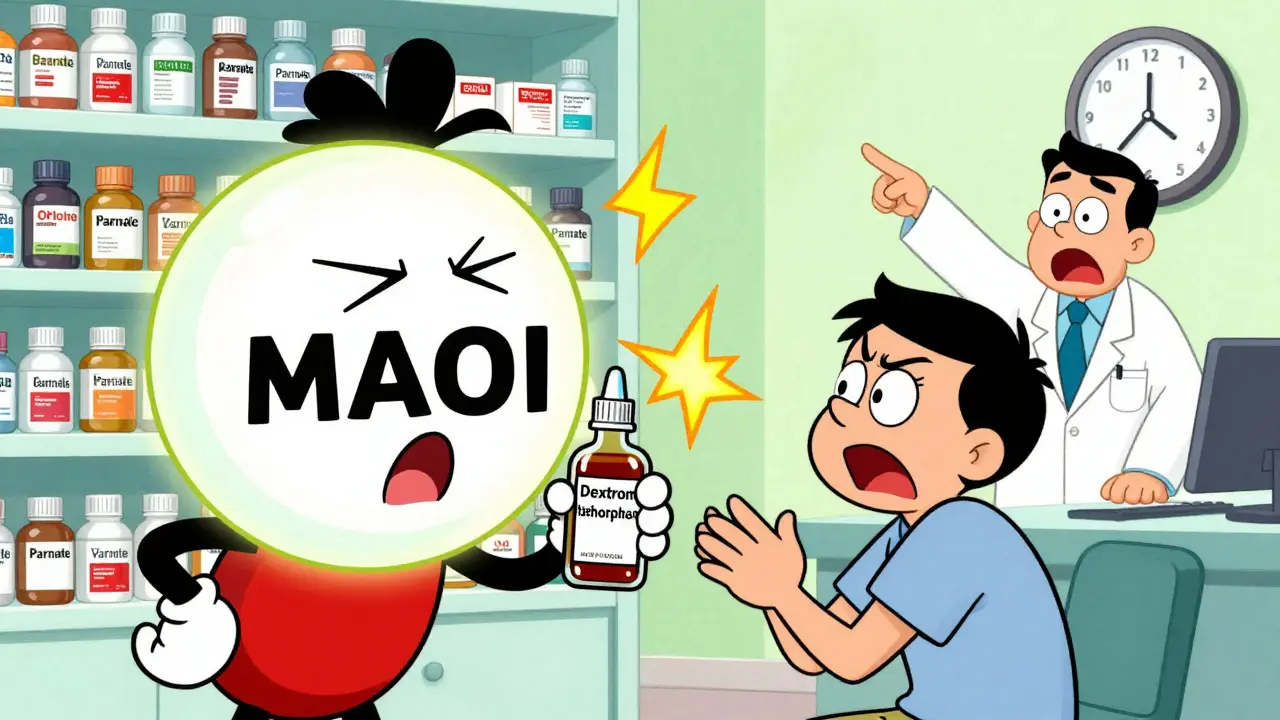
Many people reach for over-the-counter cough syrup when they have a cold. It’s quick, easy, and usually safe-unless you’re taking an MAOI. If you’re on one of these antidepressants, that little bottle of cough medicine could be dangerous. Dextromethorphan, the main ingredient in Robitussin, Delsym, and dozens of other cold remedies, can trigger a life-threatening reaction when mixed with MAOIs like Nardil, Parnate, or selegiline. This isn’t a theoretical risk. It’s happened. And it can kill.
What Happens When Dextromethorphan Meets MAOIs?
Dextromethorphan works by calming the cough reflex in your brain. But it also has a side effect: it blocks serotonin reuptake. That means it makes more serotonin stick around in your brain. MAOIs do the same thing-except even more powerfully. They stop your body from breaking down serotonin at all. When you combine them, serotonin builds up fast. Too fast.
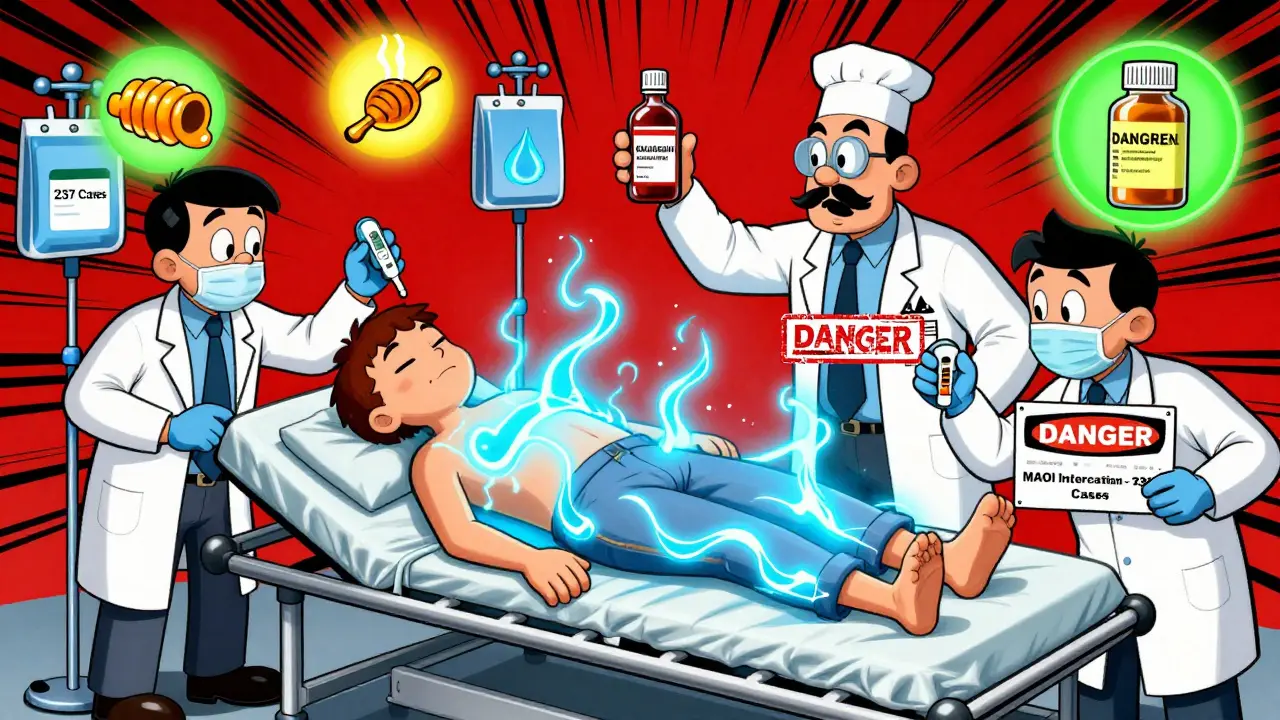
This isn’t just a mild side effect. It’s serotonin syndrome. Symptoms can show up within hours: high fever, muscle stiffness, confusion, rapid heartbeat, shaking, sweating, or even seizures. In severe cases, your body temperature can spike past 104°F. Your muscles lock up. Your organs start to fail. About 2% to 12% of people with severe serotonin syndrome don’t survive, even with hospital care.
The U.S. Food and Drug Administration first warned about this back in 1976. Yet, decades later, people are still getting hurt. Why? Because most don’t know. A 2019 survey found that 78% of people taking MAOIs didn’t realize common cough medicines contained dextromethorphan. That’s not ignorance-it’s a system failure.
The Science Behind the Danger
Dextromethorphan is broken down in your liver by an enzyme called CYP2D6. MAOIs don’t just affect serotonin-they also slow down this enzyme. That means dextromethorphan doesn’t get cleared from your body like it should. Studies show blood levels of dextromethorphan can jump 300% to 400% when taken with an MAOI. You’re not just getting the intended dose. You’re getting three to four times more.
And it’s not just the MAOI. If you’re also taking another drug that blocks CYP2D6-like fluoxetine, paroxetine, or even some heart medications-the risk gets even worse. That’s why some patients end up in the ER after taking just one or two doses of cough syrup. They weren’t trying to overdose. They just didn’t know what was in the bottle.
One patient on PatientsLikeMe described it this way: “I took my nighttime cold medicine while on Parnate. Four hours later, I couldn’t speak. My body was shaking. The ER doctors said I was lucky to be alive.” That story isn’t rare. Between 2010 and 2022, the FDA recorded 237 cases of serotonin syndrome linked to dextromethorphan and MAOIs. Nearly half of those patients needed hospitalization.
Who’s at Risk?
MAOIs are not the first-line antidepressant anymore. But they’re not rare, either. Around 1.2 million Americans use them each year. They’re often prescribed for treatment-resistant depression, anxiety disorders, or even Parkinson’s disease. People on these drugs are usually careful about diet-no aged cheese, no red wine. But they’re not thinking about cough medicine.
And it’s not just adults. Teens sometimes misuse dextromethorphan for its hallucinogenic effects. Parents might not realize their child is on an MAOI for depression or OCD. A teenager taking cough syrup for a cold could be in serious danger without anyone knowing why.
Even newer MAOIs aren’t always safe. While reversible ones like moclobemide carry lower risk, traditional irreversible MAOIs-still widely used-remain deadly when mixed with dextromethorphan. The European Medicines Agency now requires that every MAOI prescription come with a printed list of dangerous OTC drugs, including brand names like Delsym and Coricidin HBP Cough & Cold.
What Should You Do?
If you’re on an MAOI, here’s what you need to do:
- Never take any cough medicine unless your doctor or pharmacist says it’s safe. Don’t assume “natural” or “non-drowsy” means safe.
- Check the label. Look for “dextromethorphan” or “DM.” It’s in more than 120 products. Some are labeled as “cough suppressant,” others as “multi-symptom relief.”
- Wait at least two weeks. If you’ve stopped your MAOI, wait 14 days before using dextromethorphan. The drug stays active in your system longer than you think.
- Ask your pharmacist. A 2021 study showed pharmacist counseling reduced accidental interactions by 67%. That’s not a small number. It’s life-saving.
And if you’re a caregiver or family member of someone on an MAOI? Don’t assume they know. Help them check labels. Keep a list of safe alternatives handy.
Safe Alternatives for Cough Relief
You don’t need dextromethorphan to calm a cough. Here’s what works:
- Guaifenesin (Mucinex): This thins mucus. It doesn’t suppress coughing, but it helps your body clear the airway naturally. Just make sure it doesn’t have dextromethorphan added.
- Honey: A teaspoon of honey before bed is as effective as dextromethorphan for nighttime coughs, according to multiple studies. But be careful-some honey products contain tyramine, which can also interact with MAOIs. Stick to plain, unflavored honey.
- Steam and hydration: Warm tea, humidifiers, and drinking water help soothe irritated throats and loosen phlegm.
- Saline nasal sprays: If your cough comes from postnasal drip, clearing your nose can make a big difference.
And if you’re feeling sick? Don’t just reach for the nearest bottle. Call your doctor. Talk to your pharmacist. It’s better to be safe than sorry.
Why This Keeps Happening
The problem isn’t just patient ignorance. It’s labeling. A 2021 review found that only 38% of dextromethorphan products display the MAOI warning in a clear, noticeable way. Many labels bury the warning in tiny print on the back. Others don’t mention it at all.
The FDA proposed stronger labeling rules in 2022. The changes are expected to roll out by late 2024. But until then, you can’t rely on the bottle to protect you.
And there’s another gap: education. Only 43% of patients starting MAOI therapy get proper counseling about OTC risks. That’s not enough. If you’re prescribed an MAOI, you should walk out with a printed list of dangerous drugs-not just a prescription slip.
What to Do If You Think You’re Having a Reaction
If you or someone you know takes dextromethorphan and an MAOI and develops:
- Fever above 101°F
- Shaking or muscle rigidity
- Confusion, agitation, or hallucinations
- Rapid heartbeat or high blood pressure
-go to the ER immediately. Tell them you took cough medicine and an MAOI. Don’t wait. Don’t hope it’ll pass. Serotonin syndrome can kill faster than you think. Some patients die before the drugs leave their system.
There’s no antidote. Treatment is supportive: cooling the body, stopping the drugs, and managing symptoms. But early action saves lives.
Final Warning
Dextromethorphan is not a harmless cough suppressant. It’s a drug with serious risks-especially when combined with MAOIs. That’s why the American Psychiatric Association explicitly lists it among medications to avoid in MAOI users. This isn’t a footnote. It’s a red flag.
If you’re on an MAOI, treat every OTC cough medicine like a loaded gun. Read the label. Ask your pharmacist. Wait two weeks after stopping the MAOI. And if you’re unsure-don’t take it. Your life isn’t worth the risk.
Can I take dextromethorphan if I stopped my MAOI a week ago?
No. Even after you stop taking an MAOI, the drug stays active in your body for up to two weeks. Taking dextromethorphan before then can still trigger serotonin syndrome. Wait the full 14 days-even if you feel fine.
Is it safe to use dextromethorphan with other antidepressants like SSRIs?
No. SSRIs like sertraline, fluoxetine, and escitalopram also increase serotonin. Combining them with dextromethorphan raises the same risk of serotonin syndrome. This interaction isn’t limited to MAOIs-it applies to nearly all antidepressants.
What if I only took one dose of cough syrup?
One dose can be enough. Serotonin syndrome doesn’t require a large overdose. Even a single 30mg dose of dextromethorphan has triggered severe reactions in people on MAOIs. Don’t assume small amounts are safe.
Are there any cough medicines that are definitely safe with MAOIs?
Guaifenesin (without dextromethorphan) and plain honey are generally considered safe. But always check the full ingredient list. Some products labeled as “guaifenesin only” still contain hidden dextromethorphan. When in doubt, ask your pharmacist.
Why don’t pharmacists always warn me about this?
Many don’t know the full risk. A 2021 study found that only 32% of pharmacists routinely screen for MAOI use when selling cough medicine. Even if they do, patients often don’t mention they’re on an MAOI unless asked directly. Always volunteer that information.
Can I use herbal cough remedies like elderberry or licorice root?
Some herbal remedies can also affect serotonin or interact with MAOIs. Licorice root, for example, may raise blood pressure. Elderberry has not been studied in combination with MAOIs. Unless your doctor approves it, avoid all herbal supplements when on an MAOI.
Madhav Malhotra
Man, I never knew cough syrup could be this dangerous with antidepressants. I just gave my uncle some Robitussin last week-he’s on Parnate. Holy crap. Gonna call him right now and make sure he stops it. Thanks for the wake-up call.
Matthew Miller
This is why people die from dumbass OTC meds. The FDA’s been screaming about this since the 70s and yet every pharmacy shelf is packed with DM bottles that look like candy. Someone’s getting rich off people’s ignorance. Wake the fuck up, America.
Roshan Joy
Wow, this is so important. I’m on selegiline for Parkinson’s and I had no idea cough meds could be this risky. I always thought it was just food like cheese and wine. 🙏 Thanks for the detailed breakdown. Gonna print this out and stick it on my fridge next to my med list.
Michael Patterson
So let me get this straight-some guy takes a cough drop, doesn’t read the tiny print, and suddenly his body turns into a toaster? And we’re surprised? I mean, c’mon. People think ‘natural’ means safe. Natural poison is still poison. Also, why are we still using MAOIs? They’re like the flip phone of antidepressants.
Priya Patel
OMG I just checked my cabinet-my ‘cold relief’ bottle has DM in it 😱 I’ve been on Nardil for 3 years and never thought to look. I’m so grateful for this post. Sending hugs to everyone who’s been scared to ask about this. You’re not alone!
Priscilla Kraft
As a pharmacist, I can tell you-this is a massive gap in patient education. We’re trained on drug interactions, but when someone walks up and says ‘I need something for my cough,’ we rarely ask if they’re on an MAOI unless they volunteer it. Patients need to speak up. And pharmacies need better signage. 🤝
Sam Davies
How is it that in 2024, a man can buy a bottle of dextromethorphan with the same ease as buying a pack of gum, while a psychiatrist has to write a 3-page justification for prescribing lithium? The system is broken. We treat coughs like emergencies and mental health like a hobby.
Christian Basel
Pharmacokinetic inhibition via CYP2D6 blockade is a well-documented mechanism. The 300-400% plasma concentration increase is clinically significant. The real issue is lack of pharmacovigilance in OTC labeling. Regulatory capture at the FDA is why this persists.
Adewumi Gbotemi
I’m from Nigeria and we don’t have much of this medicine here, but my cousin in the US told me this story. He almost died. I told him: if you’re not sure, don’t take it. Simple. This post saved lives. Thank you.
Jennifer Littler
My sister’s on an MAOI and she told me she took a ‘non-drowsy’ cold pill last winter. She didn’t tell me until months later. I freaked out. This is why we need mandatory pharmacist counseling. Not optional. Mandatory. This isn’t a suggestion-it’s a safety protocol.
Jason Shriner
So let me get this straight... the same people who tell you to ‘trust your gut’ are the ones who sell you a bottle labeled ‘for cough and congestion’ that’s basically a serotonin bomb? We live in a dystopia where the cure is more dangerous than the disease. 🤡
Alfred Schmidt
STOP. STOP. STOP. I’ve seen this. I’ve seen the ER reports. I’ve held someone’s hand while their body shook like a leaf and their temperature hit 106. This isn’t a ‘maybe.’ This is a ‘you will die if you don’t listen.’ Read the label. Ask your pharmacist. Wait 14 days. Don’t be the reason someone’s family is crying at a funeral.
Sean Feng
One dose is enough. Just don't take it.