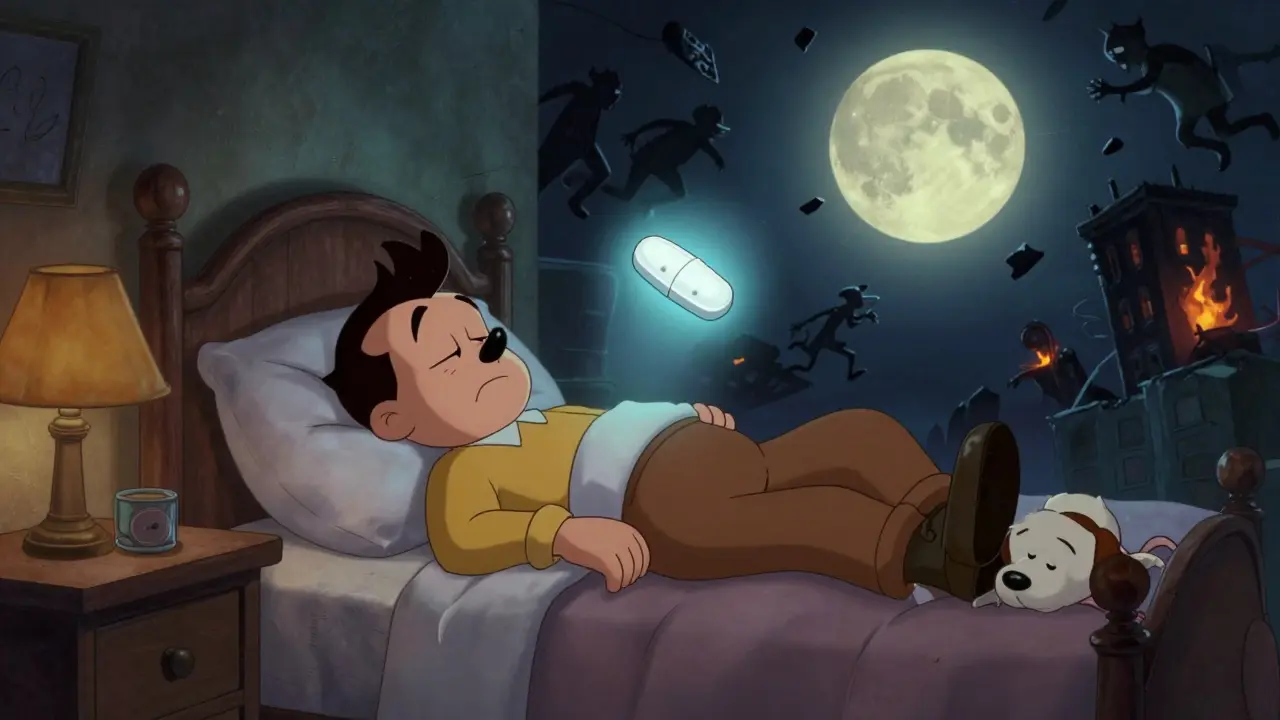
For many people living with PTSD, the worst part isn’t the memories-it’s what happens when they close their eyes. Nightmares don’t just disturb sleep; they keep trauma alive. You wake up drenched in sweat, heart racing, convinced you’re back in the moment you tried to forget. And then the fear starts: Will I go through it again tonight? This isn’t just bad dreams. It’s a clinical symptom, and it affects up to 90% of veterans and more than half of civilian trauma survivors. The good news? There are real, evidence-based ways to break the cycle-without relying on pills alone.
Why Prazosin Became the Go-To Medication for PTSD Nightmares
Prazosin wasn’t designed for nightmares. It was created in 1976 to lower blood pressure. But in 2003, Dr. Murray Raskind at the VA noticed something strange: veterans on prazosin for hypertension were sleeping better. Their nightmares? Gone. Or at least quieter. That led to a shift. Today, prazosin is used off-label for PTSD nightmares more than any other medication, even though the FDA has never approved it for this use.The science behind it is simple: PTSD floods the brain with adrenaline, especially at night. That surge triggers fear responses during REM sleep-the stage where dreams happen. Prazosin blocks alpha-1 receptors, which helps calm that overactive stress signal. Dosing usually starts at 1 mg at bedtime, slowly increasing by 1 mg each week until the nightmares ease. Most people find relief between 3 and 15 mg. It’s not magic. But for many, it’s the difference between terror and rest.
Still, it’s not perfect. About 44% of users report side effects: dizziness, low blood pressure, nasal congestion. Some even experience rebound nightmares when they stop taking it. A 2018 Department of Defense trial found no benefit over placebo-sparking major debate. But experts like Raskind argue those trials used too-low doses or included people who didn’t even have frequent nightmares. The latest study in 2023 showed a 32% reduction in nightmare distress with 6 mg nightly, compared to 18% with placebo. That’s not a cure. But it’s meaningful for someone who hasn’t slept through the night in years.
The Real Power of Sleep Therapy: CBT-I and IRT
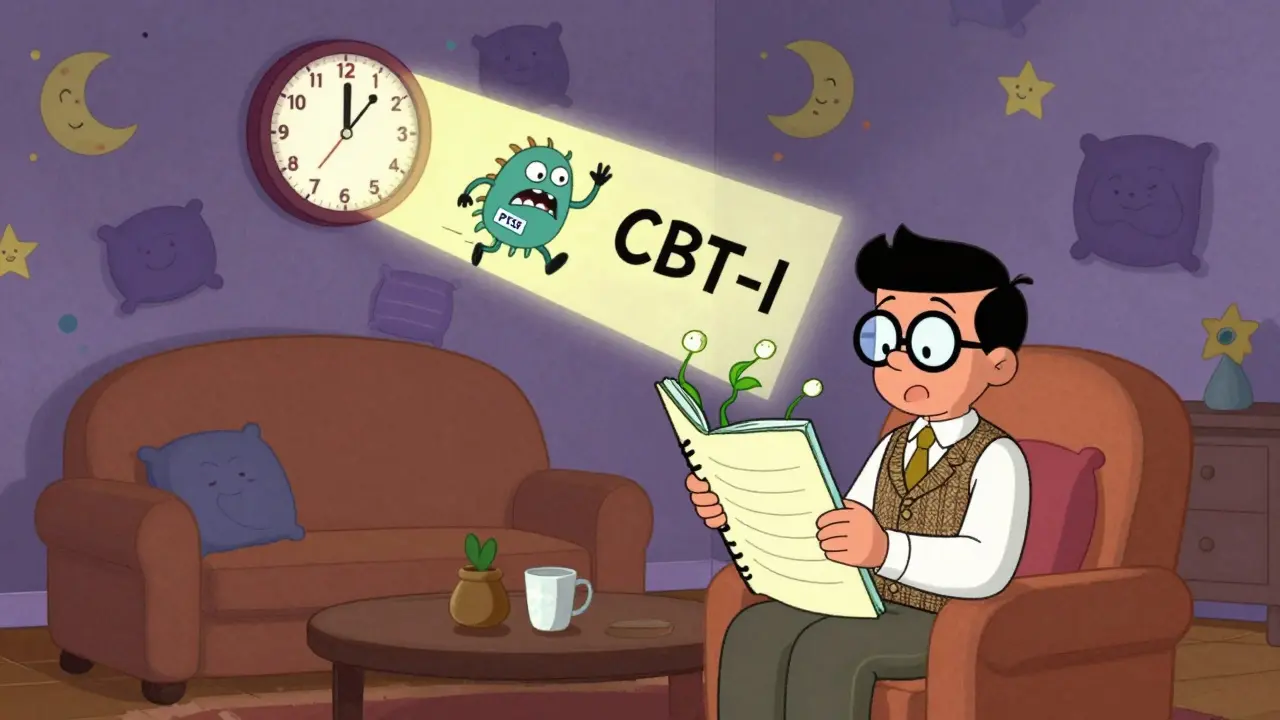
Medication helps some. But the most durable results come from therapy. Two approaches stand out: Cognitive Behavioral Therapy for Insomnia (CBT-I) and Imagery Rehearsal Therapy (IRT).CBT-I isn’t about counting sheep. It’s a structured 6- to 8-week program that rewires your brain’s relationship with sleep. You learn to get out of bed if you’re awake for more than 20 minutes. You limit time in bed to match actual sleep (no more lying there for hours). You challenge thoughts like, “If I don’t sleep tonight, I’ll collapse tomorrow.” And you track everything in a sleep diary. The results? A 2021 review showed CBT-I reduced insomnia severity by 1.35 standard deviations-massive for any treatment. It also cut PTSD symptoms by 62%. Why? Because better sleep calms the amygdala-the brain’s fear center. Imaging studies show it literally quiets the overactive alarm system.
IRT is even more targeted. You take a recurring nightmare-say, being chased in a burning building-and rewrite it while awake. Maybe you turn the fire into a calm river. Maybe you become the rescuer instead of the victim. Then you rehearse the new version for 10-20 minutes every day. In one study, 85% of PTSD patients reported less distress after just three sessions. The brain starts treating the new script as real. Nightmares lose their grip.
Combining Treatments: Why the Best Results Come Together
The strongest data doesn’t come from using prazosin or CBT-I alone. It comes from combining them.A 2022 VA study compared two groups: one got standard sleep hygiene plus Prolonged Exposure therapy (a trauma-focused treatment). The other got CBT-I plus Prolonged Exposure. The results? The CBT-I group gained 78 extra minutes of sleep per night. The other group? Only 22. Insomnia severity dropped by 12.4 points for the CBT-I group-nearly triple the improvement of the other. Sleep efficiency jumped 15.3% versus 3.1%. This isn’t coincidence. Treating sleep isn’t just a side project-it’s central to healing.
Even the VA now pushes what they call the “Sleep SMART” initiative: screening every PTSD patient for sleep issues, starting with brief behavioral therapy (BBTI), and moving to full CBT-I if needed. They’ve rolled it out across 143 facilities. Completion rates? 74%. That’s higher than most mental health programs.
What Works for Whom? Real-Life Trade-Offs
There’s no one-size-fits-all. Your life, your trauma, your access to care-all matter.For a veteran living far from a specialist, prazosin might be the only option. It’s cheap, widely available, and doesn’t require weekly appointments. But if you’re someone who prefers not to take meds long-term, CBT-I gives you tools that last. One patient said, “I finally feel like I’m in control of my sleep, not the nightmares.”
But CBT-I isn’t easy. The sleep restriction phase? It’s brutal. You’re told to stay in bed only 5 hours-even if you’re exhausted. Many quit. Shift workers struggle. People with chronic pain find it harder. And if you’re not ready to face trauma memories during therapy, you might avoid it altogether.
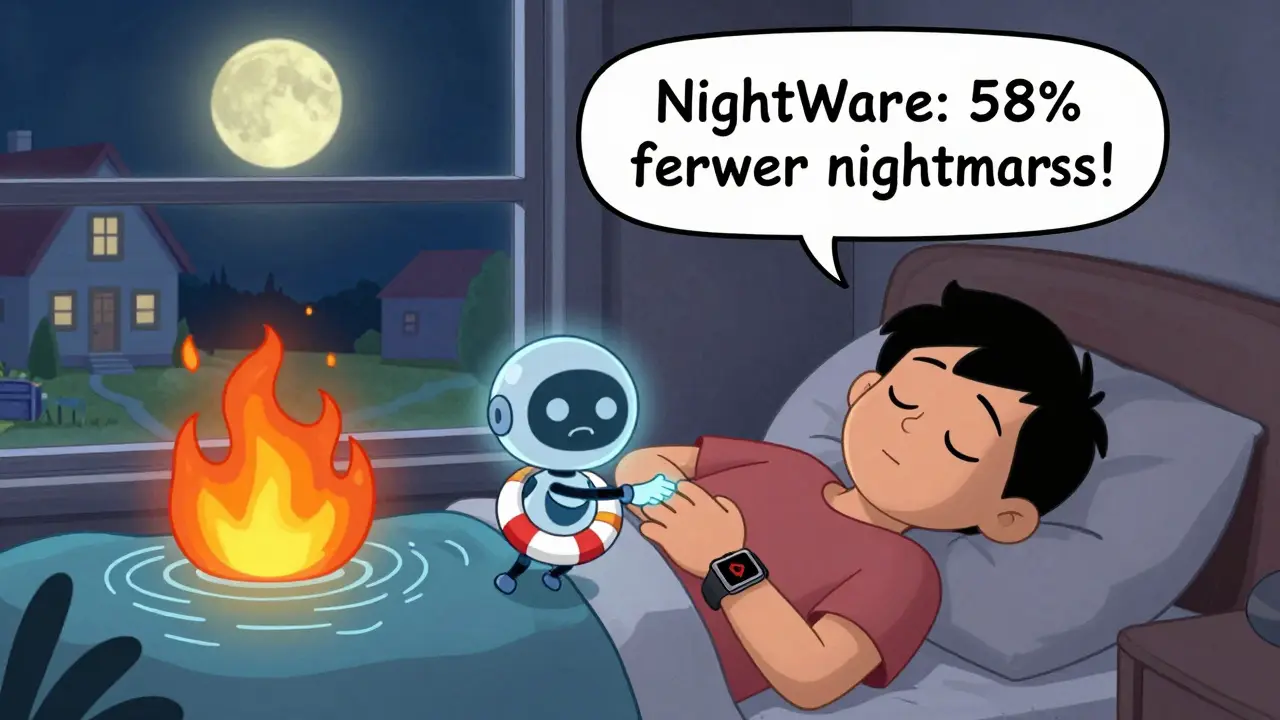
That’s where newer tools come in. The NightWare app, approved by the FDA in 2020, uses your Apple Watch to detect signs of a nightmare-increased heart rate, movement-and sends a gentle vibration to interrupt it before you fully wake up. No pills. No talking. Just tech helping your brain reset. In trials, it reduced nightmares by 58%.
Why the System Is Still Failing Too Many People
The science is clear. But access? Not so much.Only 32% of veterans in VA care get evidence-based psychotherapy. Nearly 78% get medication. Why? Because therapy takes time. It takes trained clinicians. And there aren’t enough. As of 2023, only 412 providers in the U.S. are certified in CBT-I. Rural veterans are 47% less likely to get it than those in cities.
Insurance won’t cover more than 6 sessions of CBT-I, even though 8 are proven to work. Prazosin is generic and cheap, but drug companies have no incentive to fund new nightmare-specific drugs-the patent expired in 2000. So progress stalls.
And yet, the demand is growing. The PTSD treatment market hit $1.27 billion in 2022 and is expected to keep rising. More people are speaking up. More providers are learning. The American Academy of Sleep Medicine upgraded its recommendation for CBT-I in PTSD from “conditional” to “strong” in 2023. That’s a big deal.
Where to Start If You’re Struggling
If nightmares are wrecking your sleep, here’s your roadmap:- Track your nightmares for two weeks. Write down what happens, how often, and how you feel afterward.
- Ask your doctor about prazosin. Start low (1 mg), go slow. Monitor your blood pressure.
- Look for a CBT-I therapist. The Society of Behavioral Sleep Medicine has a directory. VA patients can ask for the Sleep SMART program.
- Try IRT on your own. Rewrite one nightmare into a calmer version. Practice it daily for 10 minutes.
- Consider NightWare if you have an Apple Watch. It’s FDA-approved and works silently.
Don’t wait for the perfect solution. Start with one step. Even small changes-like getting out of bed after 20 minutes awake-can break the cycle. Sleep isn’t a luxury. For people with PTSD, it’s survival.
Can prazosin cure PTSD nightmares permanently?
No. Prazosin helps reduce nightmare frequency and intensity for many people, but it doesn’t cure PTSD. Symptoms often return if you stop taking it, especially without therapy. It’s a tool to buy time and stability-not a long-term fix.
Is CBT-I effective for people who avoid talking about their trauma?
Yes. CBT-I focuses on sleep behaviors and thoughts, not trauma details. You don’t need to relive the event to improve sleep. Imagery Rehearsal Therapy (IRT) also works without discussing trauma-just rewriting the nightmare script. Many people find relief this way before they’re ready for deeper trauma therapy.
How long does it take for prazosin to start working?
Most people notice a difference in 1 to 2 weeks, but full effects can take 4 to 6 weeks. Dosing is increased gradually-usually by 1 mg per week-until the nightmares lessen. Don’t rush the process. Too high a dose too soon can cause dizziness or fainting.
Can I use prazosin and CBT-I together?
Absolutely. In fact, studies show the combination works better than either alone. Prazosin reduces nightmare intensity quickly, while CBT-I builds lasting skills to prevent them from coming back. Many VA clinics now offer both as part of standard care.
Are there alternatives to prazosin for PTSD nightmares?
Yes. While prazosin is the most studied, some clinicians use other medications like clonidine or topiramate, though evidence is weaker. Non-drug options include IRT, CBT-I, and FDA-approved digital tools like NightWare. For many, these are safer and more sustainable long-term.
Why isn’t prazosin FDA-approved for PTSD nightmares?
Because clinical trials have shown mixed results. Some found strong benefits; others, like the 2018 DoD trial, found no difference from placebo. The FDA requires consistent, large-scale proof of effectiveness across diverse populations. Until then, it remains off-label-used by doctors, but not officially approved for this purpose.
Katie Mccreary
Prazosin gave me nightmares so bad I started sleeping in the bathtub. Not a joke. Then I quit and tried IRT. Rewrote my nightmare as a cat chasing a laser pointer. Now I fall asleep laughing. Weird, but it works.
SRI GUNTORO
People just want quick fixes instead of facing their trauma. Medication is a crutch. Real healing means sitting with the pain, not chemically numbing it. You think sleeping better fixes the root? That’s not therapy-that’s avoidance.
Kevin Kennett
Look, I get why people hate prazosin-it’s not magic. But if it lets someone get 4 hours of sleep instead of 0, that’s a win. And CBT-I? It’s brutal, yeah, but I’ve seen guys come back from the edge because they finally slept through the night. Stop pretending one-size-fits-all. Do what works for you, then build from there.
Jess Bevis
NightWare on my Apple Watch saved my life. No pills. No therapist. Just a gentle buzz when my heart spikes. I didn’t even know it was working until I woke up and realized-I didn’t scream. That’s the first time in 8 years.
Rhiannon Bosse
Anyone else think the VA is just pushing prazosin because it’s cheap and the drug companies don’t care? Meanwhile, the real solution-therapy-is buried under 3-year waitlists and bureaucrats who think ‘sleep hygiene’ means drinking chamomile tea. This isn’t medicine. It’s triage with a PowerPoint.
doug b
Try CBT-I for a week. Sleep restriction is hell-you’ll hate it. But after day 5, your body starts to trust sleep again. No meds. No magic. Just your brain learning it’s safe to shut down. I did it. You can too.
Linda O'neil
Combining prazosin and IRT is the real MVP move. I used prazosin to get through the first month so I could even *try* IRT. Once I started rewriting my nightmares, the meds became optional. Now I’m off them and still sleeping. It’s not about the pill-it’s about reclaiming your mind.
Robert Cardoso
The entire PTSD treatment model is a capitalist farce. We have evidence-based therapies that work, but they require human interaction, time, and care-none of which are profitable. So we sell pills, apps, and vague ‘sleep hygiene’ tips while real trauma goes untreated. The system isn’t broken-it’s designed this way. Healing isn’t scalable. And that’s why we’re all still suffering.