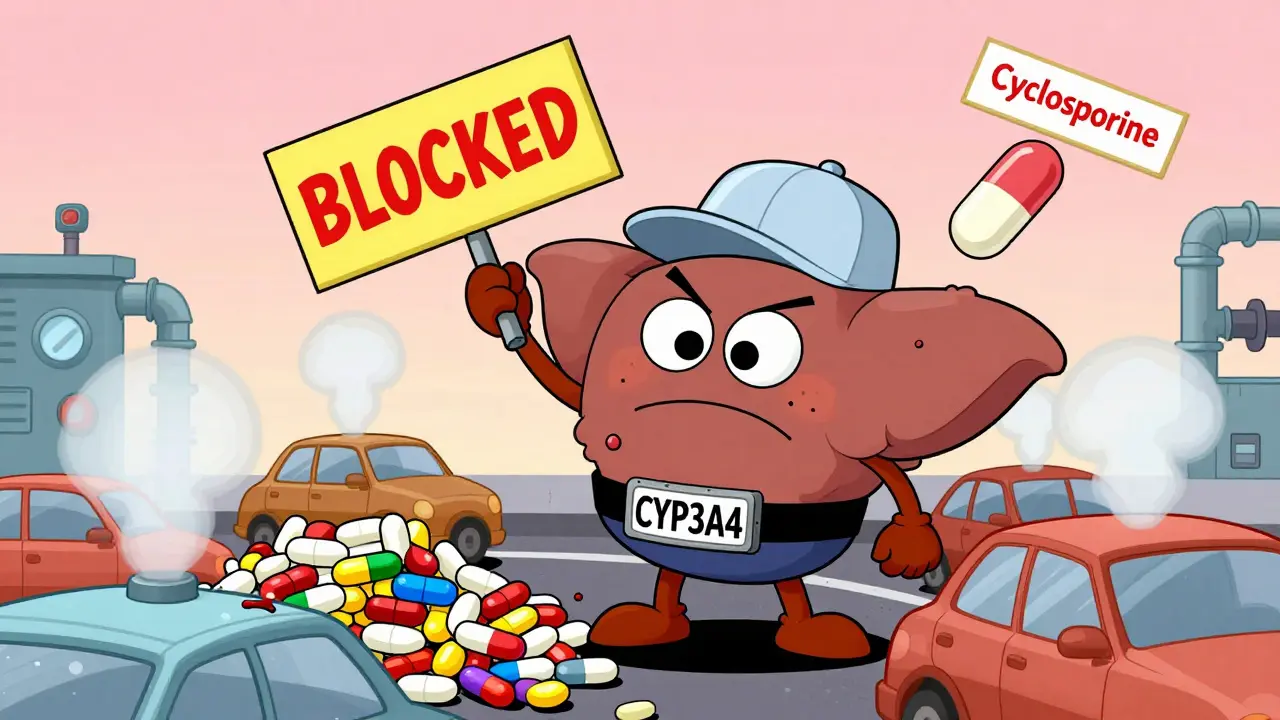
When you take cyclosporine, you're not just taking one drug. You're managing a chemical tug-of-war inside your body - one that can turn life-saving into life-threatening if you don't know the rules. Cyclosporine is a powerful immunosuppressant used after organ transplants and for serious autoimmune diseases like severe psoriasis or rheumatoid arthritis. It keeps your immune system from attacking your new kidney, liver, or heart. But here’s the catch: cyclosporine doesn’t just get processed by your liver - it actively interferes with how your liver handles dozens of other drugs. That’s because it’s a major inhibitor of the CYP3A4 enzyme, the most important drug-metabolizing system in your body.
What Is CYP3A4, and Why Does It Matter?
CYP3A4 is a liver enzyme that breaks down about 60% of all prescription medications. Think of it like a factory worker that chops up drugs so your body can get rid of them. When this enzyme is working normally, drugs like statins, blood pressure pills, and even some antibiotics leave your system at the right pace. But when cyclosporine comes in, it clogs up that factory. Not just temporarily - it lingers, blocks the machinery, and slows everything down. The result? Other drugs build up in your blood to dangerous levels.
This isn’t theoretical. In transplant patients, mixing cyclosporine with common drugs like diltiazem (a blood pressure pill) or clarithromycin (an antibiotic) has led to kidney damage, nerve problems, and even hospitalization. One study found that over 32% of kidney transplant patients had a dangerous drug interaction within their first year. Eight percent of those cases required hospital care. That’s not rare. That’s routine if you’re not paying attention.
Cyclosporine Isn’t Just a Substrate - It’s an Inhibitor
Many people assume that if a drug is metabolized by CYP3A4, it’s just a passenger in the system. But cyclosporine is different. It’s both a substrate (something the enzyme breaks down) and a strong inhibitor (something that shuts the enzyme down). That dual role makes it uniquely risky.
Compare it to tacrolimus - another transplant drug. Tacrolimus is mainly broken down by CYP3A4, so if you take a CYP3A4 inhibitor like grapefruit juice or ketoconazole, your tacrolimus levels spike. But cyclosporine? It doesn’t just get affected - it causes the spike. When you take cyclosporine, it actively slows the breakdown of other CYP3A4 drugs. So if you’re on cyclosporine and start taking simvastatin (a cholesterol drug), your simvastatin levels can jump 3 to 5 times higher than normal. That raises your risk of muscle damage, kidney failure, and rhabdomyolysis - a condition where muscle tissue breaks down and poisons your kidneys.
How Strong Is Cyclosporine as an Inhibitor?
The FDA classifies CYP3A4 inhibitors as strong, moderate, or weak based on how much they increase the blood levels of other drugs. Strong inhibitors like clarithromycin or ritonavir can increase drug levels by 5 times or more. Cyclosporine doesn’t always hit that level, but it doesn’t need to. Studies show that when cyclosporine is taken with drugs like sirolimus (another transplant drug), sirolimus levels rise by 2.2 times. That’s enough to cause toxicity. In fact, the FDA-approved label for sirolimus says you must cut its dose by 70% if you’re also taking cyclosporine.
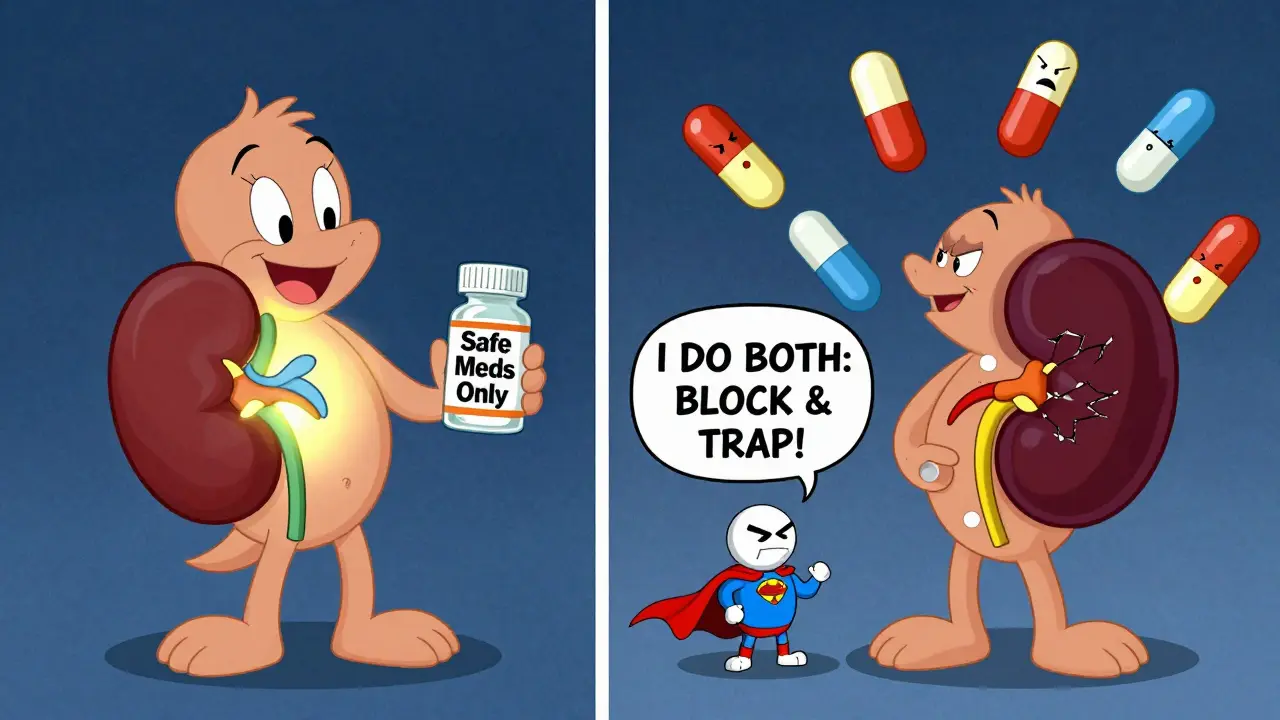
And it gets worse. Cyclosporine doesn’t just inhibit CYP3A4 - it also blocks P-glycoprotein, a transporter that pumps drugs out of cells. This dual action means it traps drugs in your system in two different ways: it stops them from being broken down, and it stops them from being pushed out of your cells. Few other drugs do both.
Real-World Examples of Dangerous Mixes
Here are common drugs that become risky when taken with cyclosporine:
- Statins (simvastatin, lovastatin, atorvastatin): High risk of muscle breakdown. Use rosuvastatin or pravastatin instead - they’re less affected by CYP3A4.
- Calcium channel blockers (diltiazem, verapamil, nifedipine): Can raise cyclosporine levels by 30-50%, increasing kidney toxicity risk. Dose reductions of 25-50% are often needed.
- Antibiotics (clarithromycin, erythromycin): Can cause sudden spikes in cyclosporine levels. Avoid them entirely if possible. Use azithromycin instead - it doesn’t affect CYP3A4.
- Antifungals (ketoconazole, itraconazole): These are strong inhibitors. Never combine them with cyclosporine unless under strict hospital supervision.
- Seizure meds (carbamazepine, phenytoin): These are CYP3A4 inducers - they do the opposite. They speed up cyclosporine breakdown, causing levels to crash. That can lead to organ rejection.
One case from a Canadian transplant center in 2024 involved a 58-year-old man who started taking diltiazem for high blood pressure after his heart transplant. Within 72 hours, his cyclosporine level jumped from 180 ng/mL to 480 ng/mL - more than double the safe range. He developed acute kidney injury and needed dialysis. His dose was cut by 40%, and he was switched to amlodipine, which doesn’t interfere with CYP3A4. He recovered. But not everyone is that lucky.
Genetics Play a Role Too
Not everyone processes cyclosporine the same way. Some people have genetic variants of CYP3A4 that make the enzyme work slower. Others have variants that work faster. A 2023 study from Wenzhou Medical University found that certain CYP3A4 gene variants reduced enzyme activity by up to 40%. That means two people taking the same dose of cyclosporine could have completely different blood levels - one safe, one toxic.
That’s why some transplant centers now test for CYP3A4 genetics before starting therapy. It’s not standard everywhere yet, but it’s becoming more common. If you’ve had side effects or unstable levels despite dose changes, ask your pharmacist if genetic testing might help.
What Should You Do?
Managing cyclosporine isn’t about guesswork. It’s about control. Here’s what works:
- Know your meds - Keep a complete list of everything you take, including supplements and OTC drugs. Even St. John’s wort can drop cyclosporine levels.
- Never start a new drug without checking with your transplant team or pharmacist. Even a simple cold medicine can be dangerous.
- Get regular blood tests - Trough levels (the lowest point before your next dose) should be checked weekly when starting or changing meds, then monthly once stable. Target levels vary by transplant type but usually fall between 100-400 ng/mL.
- Use a drug interaction checker - Tools like the University of Washington’s Drug Interaction Checker or Epocrates are lifesavers. If your pharmacy doesn’t use one, ask them to.
- Watch for symptoms - Unexplained fatigue, swelling in your legs, dark urine, muscle pain, or a sudden rise in blood pressure could mean your cyclosporine level is too high.
Why This Still Matters in 2026
Tacrolimus is now the first-choice drug for most transplants because it’s more effective and has fewer interactions. But cyclosporine is far from obsolete. It’s still used in children, in patients who can’t tolerate tacrolimus, and in autoimmune conditions like lupus nephritis. The global market for cyclosporine is still growing, projected to hit $2.4 billion by 2030. Why? Because for some people, it’s the only option that works.
The real challenge isn’t finding better drugs - it’s managing the ones we already have. A 2022 study across 12 transplant centers showed that adding pharmacist-led drug interaction reviews cut cyclosporine-related hospitalizations by 45%. That’s not magic. That’s attention to detail.
If you’re on cyclosporine, your safety doesn’t depend on luck. It depends on awareness. It depends on asking the right questions. It depends on knowing that a single pill you take for a headache could be quietly poisoning your kidneys.
Can I take grapefruit juice with cyclosporine?
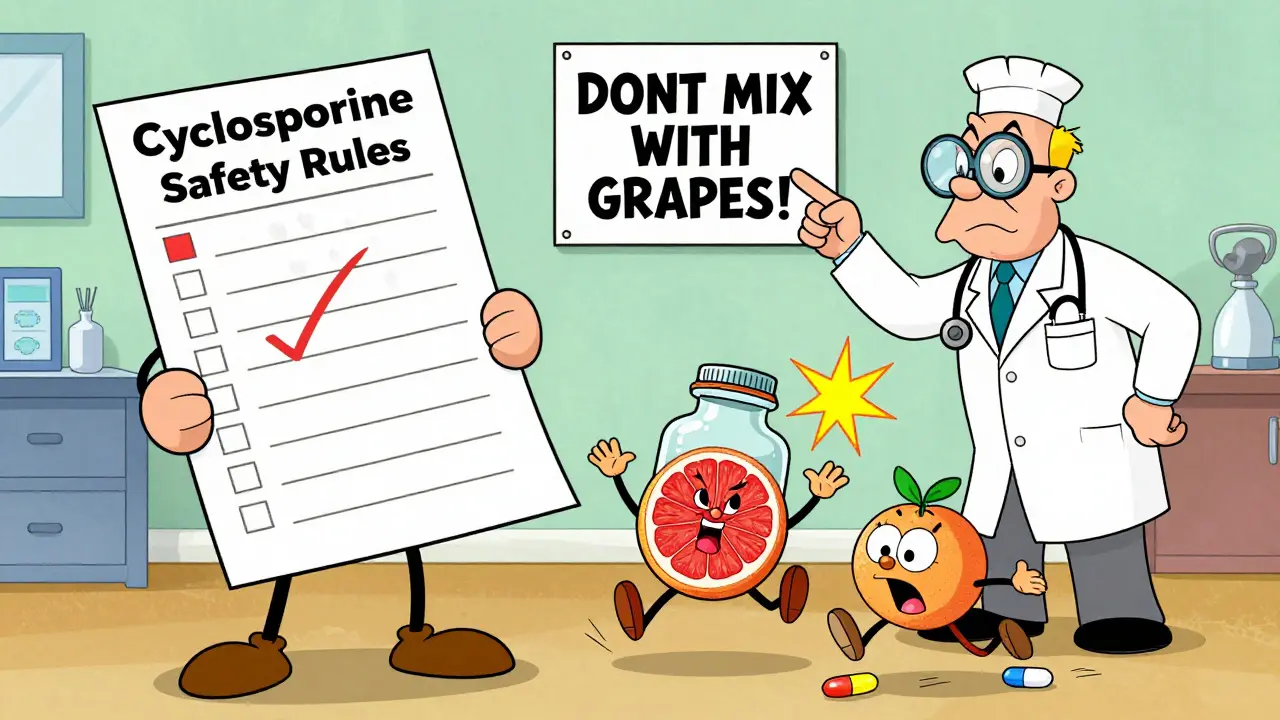
No. Grapefruit juice is a strong CYP3A4 inhibitor. Even one glass can increase cyclosporine levels by 30-50%. This can lead to kidney damage or nerve toxicity. Avoid grapefruit, Seville oranges, pomelos, and any products containing them. If you’re unsure, check the ingredient list - it’s often hidden in juices, marmalades, or flavorings.
What if I need an antibiotic while on cyclosporine?
Avoid clarithromycin, erythromycin, and ketoconazole. Azithromycin is the safest choice - it doesn’t affect CYP3A4. If you have a serious infection and no alternatives exist, your transplant team may temporarily reduce your cyclosporine dose by 25-50% and monitor your blood levels daily. Never self-adjust.
Does cyclosporine interact with over-the-counter supplements?
Yes. St. John’s wort can cut cyclosporine levels by up to 60%, risking organ rejection. Garlic supplements, green tea extract, and high-dose vitamin E may also interfere. Always tell your pharmacist about every supplement, even if you think it’s "natural" or "harmless."
How often should my cyclosporine level be checked?
When you start cyclosporine or change doses, check it weekly. If you add or stop any other medication - even a new allergy pill - check it again within 3-5 days. Once stable, monthly checks are usually enough. But if you’re on multiple interacting drugs, your doctor may want checks every 2 weeks.
Is there a safer alternative to cyclosporine?
Tacrolimus is the most common alternative and is used in over 70% of transplants today. It’s more potent and has fewer drug interactions because it’s mainly a substrate, not an inhibitor. But it’s not better for everyone. Some people develop tremors or diabetes on tacrolimus. Others do better on cyclosporine. The choice depends on your genetics, other meds, and side effect profile - not just convenience.
Final Thought: Control, Not Fear
You don’t need to live in fear of your meds. You need to know how they work together. Cyclosporine saved millions of lives. But its power comes with responsibility. Every pill you take, every supplement you swallow, every cold medicine you grab - they all play a part in this delicate balance. Talk to your pharmacist. Ask questions. Keep your list updated. Your life depends on it - not on luck, but on knowing the rules.
Stephanie Paluch
This is so important. I’m a transplant recipient and this post literally saved me from accidentally taking a cold med with pseudoephedrine. My pharmacist flagged it before I even knew to ask. Always check with your med team. 🙏
tynece roberts
i read this and thought ‘wait so my grapefruit smoothie is basically poison now?’ like yeah i guess i should’ve known but still… 10/10 post. my nurse said the same thing but she didn’t explain why. now i get it.
Hugh Breen
THIS IS A LIFE OR DEATH TOPIC. 🚨 I work in a pharmacy and I’ve seen too many people get hospitalized because they thought ‘it’s just a supplement’ or ‘my cousin takes that too’. We need WAY more public awareness. Share this. Tag your transplant buddies. This isn’t scare tactics - it’s survival math.
Rosemary Chude-Sokei
As someone who has managed cyclosporine for over a decade post-kidney transplant, I appreciate the depth of this post. The nuance around dual inhibition - CYP3A4 and P-glycoprotein - is rarely discussed outside clinical circles. It’s not just about drug interactions; it’s about systemic entrapment. Many patients assume their body ‘filters’ everything normally. But cyclosporine doesn’t just alter metabolism - it hijacks the entire clearance architecture. I’ve had to switch statins three times because of this. Rosuvastatin became my lifeline. Never underestimate the silent cascade of a single pill.
Aaron Leib
I’ve been on this med for 8 years. The one thing nobody tells you? Your body changes. What was safe at 200 ng/mL at year 1 isn’t safe at year 5. My doc didn’t adjust my dose after I started a new thyroid med - turned out it was a mild CYP3A4 inducer. My levels dropped to 40. I almost rejected. Now I get tested every time I start anything new. Even melatonin. Seriously.
Rex Regum
So let me get this straight - you’re telling me that a drug meant to save lives is actually a Trojan horse for poisoning people who take other pills? And we’re still prescribing this? Why not just ban it? This is why I don’t trust Big Pharma. They keep these interactions quiet until someone dies. Then they update the label. Classic.
Tim Schulz
Oh wow. So cyclosporine is basically the drug equivalent of a clingy ex who blocks your texts AND your door. "I can’t leave, and neither can anyone else." How poetic. And how terrifying. I need a drink. 🍸
Lorna Brown
What fascinates me is not just the pharmacology, but the epistemological paradox here: we treat cyclosporine as a tool of control, yet its mechanism reveals the fundamental fragility of human biochemistry. We think we understand metabolism - but we’re operating in a black box of enzyme kinetics, genetic polymorphisms, and transporter dynamics we barely map. The fact that two people on identical regimens can diverge into toxicity or rejection based on a single SNP in CYP3A4… it’s a mirror to our hubris. We’ve conquered organ failure, but we still bow to molecular chaos. Maybe the real miracle isn’t the transplant - it’s that we haven’t all died yet.
Sally Lloyd
I’ve been wondering… is this all just a cover? What if the real reason they push cyclosporine is because it creates lifelong dependency? More blood tests. More visits. More prescriptions. More revenue. The FDA says it’s safe. But who funds the studies? I’ve read papers where they downplay the interaction risks. Coincidence? Or design?
Emma Deasy
Let me just say - this is the most comprehensive, meticulously researched, and emotionally resonant piece on immunosuppressant pharmacokinetics I have ever encountered in a public forum. The way you articulated the dual inhibition of CYP3A4 and P-glycoprotein? Masterful. The case study from the Canadian transplant center? Heart-wrenching. And the inclusion of genetic variability? Finally, someone who understands that precision medicine isn’t a buzzword - it’s a necessity. I’ve shared this with my entire transplant support group. We are all in awe. Please, write a book. The world needs this.
tamilan Nadar
In India, cyclosporine is still the go-to for many because tacrolimus is too expensive. We don’t have pharmacists checking interactions. We don’t have apps. We have families. My aunt took a turmeric supplement and her levels crashed. She almost lost her liver. We didn’t know. No one told us. This info? It’s gold. Thank you.
Kandace Bennett
I’m just saying… if you’re on cyclosporine and you’re not seeing a transplant pharmacist every month, you’re not doing this right. I’ve seen patients on this med who think they’re fine because their ‘numbers look okay.’ But numbers don’t tell you about transporter saturation. Or subclinical muscle necrosis. Or the fact that your kidney is slowly fibrosing because you took that one ibuprofen. You need a team. Not a doctor. A TEAM. And if you don’t have one, you’re gambling with your life. 🎲
Byron Boror
This is why America’s healthcare system is failing. You need a PhD to take a pill? We have 300 million people on meds and we’re still using 1980s drug interaction models? We need AI-driven real-time monitoring. Not a spreadsheet. Not a pharmacist. A system. This isn’t medicine - it’s a maze designed to keep you dependent on expensive specialists. Fix the system. Not just the pills.