Essential tremor isn't just shaky hands. For millions of people, it's the inability to hold a coffee cup, write a signature, or button a shirt without the whole world seeing it. It’s not Parkinson’s. It’s not caused by stress or caffeine. It’s a neurological condition that affects the brain’s ability to control movement - and it’s more common than most people realize. About 10 million Americans live with essential tremor (ET), and globally, that number jumps to 50-70 million. It’s the most common movement disorder out there, yet many still confuse it with something else - or worse, ignore it until it starts to take over their daily life.
What Exactly Is Essential Tremor?
Essential tremor is a chronic neurological condition marked by involuntary, rhythmic shaking. It most often hits the hands, but it can also affect the head, voice, arms, or even the trunk. The tremor usually shows up when you’re doing something - like reaching for a glass or writing - and gets worse with stress, fatigue, or caffeine. It doesn’t usually show up when you’re resting. That’s one key difference from Parkinson’s disease, where shaking happens mostly at rest.
ET often runs in families. In fact, 50-70% of people with ET have a relative who also has it. That’s why doctors now recommend genetic testing for people with a strong family history. The tremor typically appears in two age groups: teens and people over 50. But it can start at any age. The older you get, the more likely you are to develop it - nearly 1 in 7 people over 90 have some form of essential tremor.
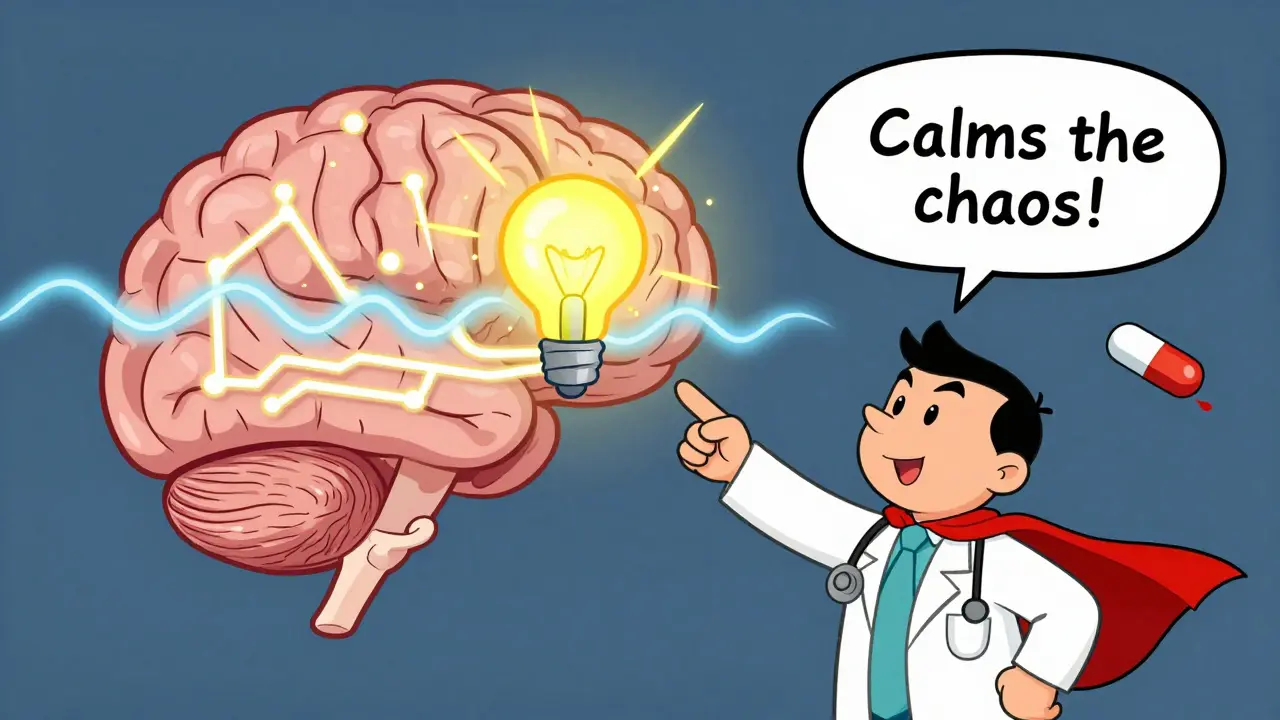
What’s happening inside the brain? Research points to a breakdown in the cerebellar-thalamo-cortical circuit. That’s a fancy way of saying the part of the brain that coordinates movement isn’t sending the right signals. Post-mortem studies show a loss of GABA-producing neurons in the cerebellum. GABA is the brain’s main calming chemical. When it drops, the tremor kicks in.
Why Beta-Blockers Are the First Line of Defense
Back in 1960, doctors noticed something odd. Patients taking propranolol for high blood pressure were shaking less. That led to a breakthrough: propranolol, a beta-blocker, became the first drug shown to reduce tremor. By 1967, it was approved for essential tremor - even though it was originally designed for heart conditions.
Today, the American Academy of Neurology says propranolol and primidone are the two best first-choice treatments. But here’s the twist: only primidone has full FDA approval for ET. Propranolol is used off-label - yet it’s prescribed in 90% of clinical guidelines. Why? Because it works. Studies show it reduces tremor by 50-60% in about half of users. For many, that’s life-changing.
Propranolol doesn’t cure ET. It doesn’t stop the disease. But it calms the shaking. And for people who rely on fine motor skills - musicians, surgeons, writers - that’s everything.
How Propranolol Works (and Doesn’t Work)
Here’s the weird part: no one’s completely sure how propranolol reduces tremor. It blocks beta receptors - mostly in the heart - but studies show the tremor improvement happens even when the drug doesn’t affect heart rate. That suggests it’s acting somewhere in the brain, not just the body. Some researchers think it’s blocking beta-2 receptors in the cerebellum. Others believe it’s calming overactive nerve signals. The truth? It’s still a mystery.
Dosing matters. Most people start with 10-20 mg twice a day. The dose is slowly increased every week - usually by 20-40 mg - until the tremor improves or side effects show up. The sweet spot? Between 60 and 320 mg per day. Blood levels between 30-100 ng/mL seem to work best. Extended-release versions (like Inderal LA) help avoid the peaks and crashes, reducing dizziness and fatigue.
It takes time. Don’t expect results in a week. Most people need 4-8 weeks to see the full effect. Patience is part of the treatment.
Who Shouldn’t Take Beta-Blockers?
Propranolol is safe for many - but not everyone. There are hard rules:
- Asthma or COPD: Absolute no. Beta-blockers can trigger life-threatening bronchospasm. About 32% of people with lung disease have severe reactions.
- Heart rate below 50 bpm: If your heart’s already slow, this drug can push it too far.
- Heart failure that’s getting worse: It can make fluid buildup worse.
- Severe low blood pressure: Propranolol lowers BP. If you’re already at 90/60, you might faint.
Stopping propranolol suddenly is dangerous. It can cause heart attack or dangerously high blood pressure. Always taper off under a doctor’s supervision.
Side Effects: The Real Talk
Most people tolerate propranolol well. But side effects are common - and sometimes enough to make people quit.
- Fatigue: 32% of users report feeling drained. It’s often worse in the first few weeks.
- Dizziness: 28% feel lightheaded, especially when standing up. This is why doctors check blood pressure and heart rate during titration.
- Slow heart rate: Below 50 bpm? That’s a red flag. Some patients report heart rates as low as 45 bpm - which led them to switch to primidone.
- Depression or nightmares: Less common, but real. Some people report mood changes.
For elderly patients, the risk of falls doubles. A 2018 JAMA study found people over 65 on doses above 120 mg/day had a 3.2-fold higher risk of falling. That’s why many doctors avoid high doses in older adults.
How Propranolol Compares to Other Treatments
Propranolol isn’t the only option - but it’s the most widely used. Here’s how it stacks up:
| Treatment | Tremor Reduction | Response Rate | Discontinuation Rate | Key Risks |
|---|---|---|---|---|
| Propranolol | 50-60% | 50-60% | 22% | Slow heart rate, fatigue, dizziness |
| Primidone | 60-70% | 60-70% | 38% | Brain fog, nausea, dizziness, balance issues |
| Topiramate | 33-50% | 30-40% | 30-40% | Cognitive slowing, memory problems, kidney stones |
| Gabapentin | 22-49% | 25-45% | 15-20% | Drowsiness, swelling, weight gain |
| Botulinum Toxin | 50-70% (voice) | 50-60% | 10-15% | Hand weakness (65%), pain at injection site |
| Deep Brain Stimulation (DBS) | 70-90% | 70-80% | 5% | Surgery risks: infection, bleeding, speech issues |
Primidone is slightly more effective - but more people quit because of brain fog and nausea. Topiramate? It works for some, but the cognitive side effects are a dealbreaker for older adults. Gabapentin? Mixed results. Botulinum toxin? Great for voice tremors, but if you’re trying to hold a pen, you might end up dropping it. DBS is powerful - but it’s brain surgery. Not for everyone.
Real Stories, Real Results
On Reddit’s r/tremor community, users share what works. One man, u/TremorWarrior, said: “120 mg propranolol XR lets me hold a coffee cup without spilling - couldn’t do that before.” Another, u/ShakyHandsMD, tried 240 mg - and crashed to 45 beats per minute. He had to switch to primidone despite the brain fog.
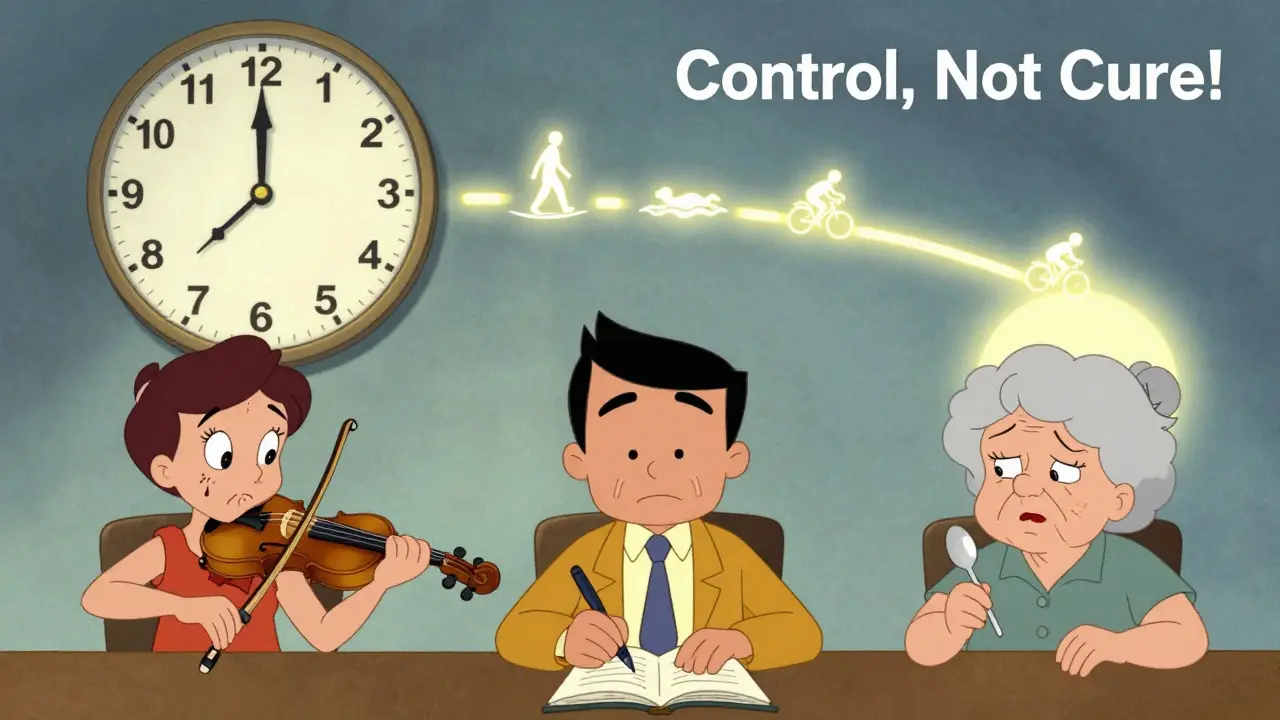
A 52-year-old violinist in a 2022 case study went from a tremor score of 18 down to 6 on propranolol. Her playing returned. Another patient, 67, tried 320 mg and saw no improvement. He ended up with DBS.
For elderly patients, the story is harder. On AgingCare.com, 68% of seniors over 75 reported dizziness or falls. One 78-year-old said: “I fell twice after standing too quickly on 90 mg propranolol.” For them, the risks sometimes outweigh the benefits.
What’s New in 2026?
The field is changing. In 2023, the FDA approved Focused Ultrasound Thalamotomy - a non-invasive procedure that uses sound waves to target the brain area causing tremor. Early results show 47% improvement at three months. It’s not a cure, but it’s a promising alternative for those who can’t take meds.
Gene therapy is also in the pipeline. A 2024 Phase 3 trial for NBIb-1817 showed 35% improvement in over 60% of patients. It’s not available yet, but it’s a sign we’re moving toward treatments that target the root cause - not just the symptom.
And here’s something surprising: exercise. A 2024 University of California study found that people who combined propranolol with regular aerobic activity saw tremor reduction jump from 45% to 68%. Movement helps the brain. Who knew?
What Should You Do?
If you or someone you know has essential tremor, here’s what to do:
- See a neurologist - preferably one who specializes in movement disorders.
- Get a proper diagnosis. Other conditions (like Parkinson’s or thyroid issues) can mimic ET.
- Start low with propranolol: 10-20 mg twice daily. Increase slowly.
- Monitor heart rate and blood pressure daily during the first month.
- If side effects hit hard, talk to your doctor. Switching to extended-release or lowering the dose often helps.
- Don’t quit without medical guidance.
- Consider combining therapy with exercise - walking, swimming, cycling - even 30 minutes a day.
Essential tremor won’t kill you. But it can steal your independence. The good news? You don’t have to live with it. Propranolol works for many. And if it doesn’t, there are other paths. The goal isn’t perfection - it’s control. To hold your coffee. To write your name. To live without shame.
Is essential tremor the same as Parkinson’s disease?
No. Essential tremor happens during movement - like holding a cup or writing. Parkinson’s tremor usually occurs at rest. Parkinson’s also includes stiffness, slow movement, and balance problems. Essential tremor is mostly just shaking. They’re different conditions with different causes and treatments.
Can beta-blockers cure essential tremor?
No. Beta-blockers like propranolol reduce tremor symptoms but don’t stop the disease from progressing. They’re a management tool, not a cure. Researchers are still searching for treatments that target the underlying brain changes.
Why is propranolol used off-label for essential tremor?
Propranolol was originally approved for heart conditions. Its use for tremor was discovered later. Although it’s not FDA-approved specifically for ET, decades of research show it’s effective. That’s why it’s recommended in nearly all clinical guidelines - even if it’s technically off-label.
How long does it take for propranolol to work for essential tremor?
It usually takes 4 to 8 weeks to see the full effect. Some people notice improvement in 2 weeks, but the dose often needs to be increased gradually. Don’t give up if you don’t feel better right away.
Are there non-drug treatments for essential tremor?
Yes. Focused ultrasound thalamotomy is a non-invasive procedure approved in 2023 that targets the brain area causing tremor. Deep brain stimulation (DBS) is a surgical option for severe cases. Lifestyle changes like reducing caffeine, managing stress, and doing aerobic exercise can also help reduce tremor severity.
Can I take propranolol if I have asthma?
No. Beta-blockers like propranolol can trigger severe bronchospasm in people with asthma or COPD. This is a life-threatening risk. If you have lung disease, your doctor will likely recommend primidone, topiramate, or another alternative instead.
What’s the best way to monitor side effects from propranolol?
Check your heart rate and blood pressure twice daily during the first month. Keep a log. If your heart rate drops below 50 bpm or your systolic blood pressure falls below 100 mmHg, contact your doctor. Also watch for dizziness, extreme fatigue, or fainting - especially when standing up. These are signs the dose may be too high.
Why do some people stop taking propranolol?
The most common reasons are fatigue (32%), dizziness (28%), and slow heart rate (19%). Some people also report depression or nightmares. For others, the side effects outweigh the benefit - especially if the tremor reduction is only mild. That’s why doctors often try primidone or other options if propranolol doesn’t work well or causes too many problems.
Is essential tremor hereditary?
Yes. About 50-70% of people with essential tremor have a family history of it. This is called familial tremor. Genetic testing is now recommended for people with a strong family history, especially if symptoms started before age 40.
Can exercise help reduce essential tremor?
Yes. A 2024 study found that combining propranolol with regular aerobic exercise - like walking, swimming, or cycling - increased tremor reduction from 45% to 68%. Exercise may improve brain function and reduce stress, both of which can lessen tremor severity. Even 30 minutes a day can make a difference.
kirti juneja
I'm from India and my grandma had ET. She couldn't hold her tea cup for years, but after starting propranolol, she started knitting again. I cried when I saw her make a scarf for me. It's not just a drug-it's a return to dignity. 💕
Steven Pam
Honestly? This post saved my life. I thought I was just clumsy until I found out it was ET. Propranolol didn't fix everything, but it let me hold my kid’s hand without shaking. That’s worth every side effect. Keep moving. Keep trying. You’re not broken.
Gabrielle Conroy
I’m a nurse who’s been on propranolol for 5 years! I started at 20mg, went up to 160mg, and now I can write patient notes without my hand looking like a leaf in a storm!! 🙌 Side effects? Yeah, I get tired and dizzy sometimes-but I trade that for being able to button my shirt. Worth. It. Always talk to your doc about extended-release-it’s a game changer!
John Smith
Beta blockers for tremors? Wow. So the medical industry finds a drug meant for hearts and slaps it on a neurological condition because it kinda works. Brilliant. Meanwhile the real cause? Still ignored. We’re just patching symptoms like it’s a leaky boat with duct tape
Spenser Bickett
so like... propranolol is basically a heart drug that accidentally fixed shaking? lmao. we're just throwing pills at problems and calling it science. also why is it off label? because the pharma bros didn't pay for the right paperwork. classic.
Nick Hamby
The neurological underpinnings of essential tremor are profoundly misunderstood. The cerebellar-thalamo-cortical circuit disruption isn't merely a dysfunction-it's a misalignment of temporal signal processing. GABAergic neuron loss in the Purkinje layer suggests not just chemical imbalance, but structural degradation. This isn't a pharmacological inconvenience; it's a systemic neurological reconfiguration. Propranolol's efficacy, despite its lack of CNS specificity, implies compensatory modulation of aberrant oscillatory activity-perhaps via beta-2 receptor blockade in the dentate nucleus. The fact that tremor reduction occurs independently of cardiovascular effects underscores the need for targeted neuromodulation research.
Christopher Wiedenhaupt
i read this whole thing. propranolol works for some. primidone works for others. no one knows why. side effects suck. surgery is scary. exercise helps. thats the whole story. dont overthink it. just see a neurologist and try one thing at a time. no need for philosophy.
Shalini Gautam
In India, we don’t have access to this level of care. Most people with tremors just suffer silently. No doctors, no meds, no awareness. This post is great for Americans with insurance. But what about the 80% of the world who can’t afford a neurologist? You talk about 70 million people-where’s the global solution?
Natanya Green
I tried propranolol. I felt like a zombie. My heart was ticking like a metronome. I cried in the shower because I couldn’t hold my toothbrush. I switched to primidone. Then I got brain fog so thick I forgot my own birthday. I’m now on DBS. It’s scary. It’s expensive. But when I wrote my daughter’s name for the first time in 12 years? I screamed. I didn’t care about the risks. I wanted to feel human again.
Timothy Haroutunian
I read the whole damn thing. Too long. Too many numbers. Too many fancy words. Here's the bottom line: if you shake, try the pill. If it makes you tired, try a different one. If nothing works, get the surgery. Or don't. Life goes on. You'll figure it out. I'm just here to say: stop writing novels about hand tremors.
Brandice Valentino
i mean... propranolol? really? its like using a hammer to fix a watch. and why is it off label? because the big pharma companies dont wanna pay for the extra studies. its all about money. also, i heard the FDA is corrupt. like, really corrupt. so yeah. trust no one. just go vegan and meditate. that worked for my cousin.
Erin Pinheiro
I tried propranolol and it made me so dizzy I fell down the stairs. My dog had to lick my face to wake me up. Then I tried primidone and I forgot my own name for three days. I think the real treatment is just... accepting you’re gonna shake. Maybe I’ll start a support group. ‘Shaky and Proud.’ I’ll wear a t-shirt that says ‘I’m not broken, I’m just vibing.’
Haley Gumm
You say 90% of guidelines recommend propranolol. But 38% of people quit primidone due to brain fog. So what? You’re just comparing side effects like it’s a grocery list. No one talks about the emotional toll. The shame. The years of hiding your hands. The jobs you lost. The dates you canceled. The life you gave up. This isn’t a medical chart. It’s a grief journal.
Michael FItzpatrick
I'm a former musician with ET. I used to play violin professionally. Propranolol didn't fix everything-but it let me play again. Not perfectly. But enough. And when I combined it with daily yoga and walking? My tremor dropped another 20%. Movement isn't just therapy-it's rebellion. You're not just fighting tremors. You're reclaiming your body. One step. One note. One breath at a time.