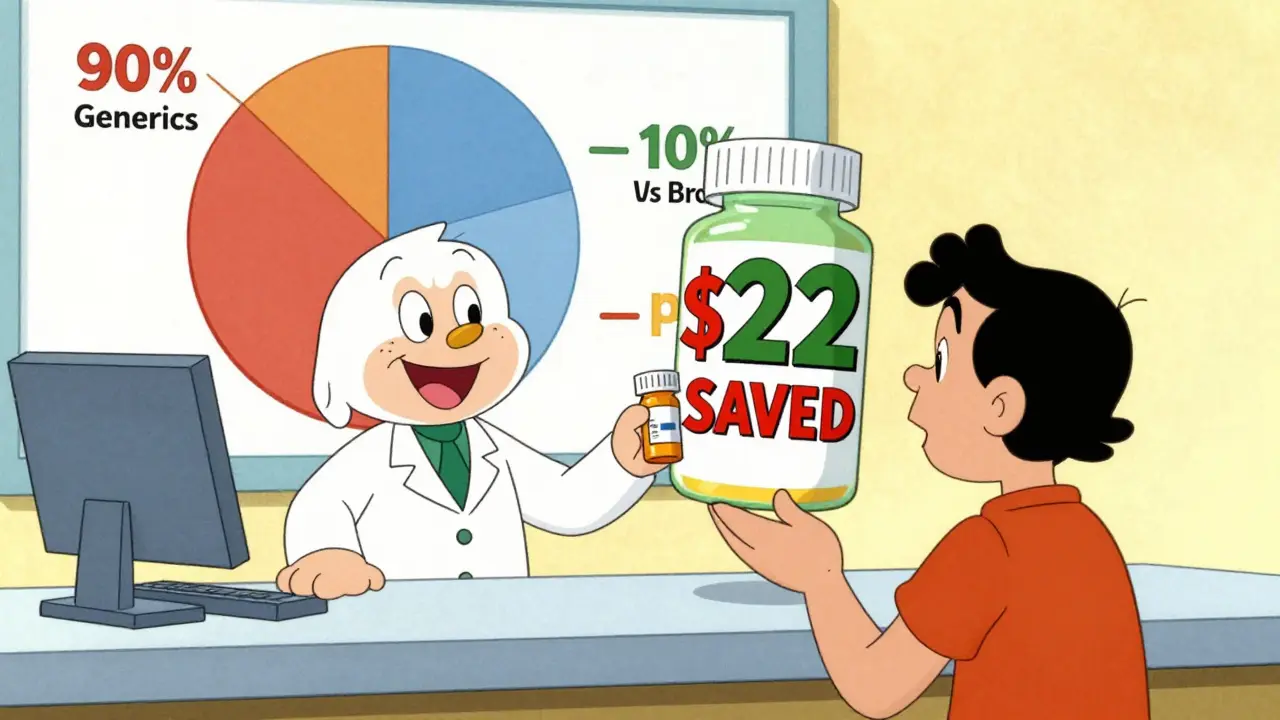
When you pick up a prescription at the pharmacy, you might not realize you’re saving money just by choosing the generic version. But the numbers don’t lie: in 2024, generic and biosimilar drugs saved the U.S. healthcare system $467 billion. That’s not a guess. It’s a fact from the 2025 U.S. Generic & Biosimilar Medicines Savings Report, backed by IQVIA and the Association for Accessible Medicines. And over the last decade, those savings have added up to more than $3.4 trillion.
What You Pay vs. What the System Pays
Most people don’t know the difference between what a brand-name drug costs and what a generic costs - until they see the receipt. In 2024, the average out-of-pocket cost for a generic prescription was $6.95. For a brand-name drug? $28.69. That’s almost five times more. If you’re uninsured, the gap gets even wider. Brand-name drugs cost uninsured patients an average of $130.18 per prescription - up 50% since 2019. Meanwhile, generic prices actually dropped by 6% over the same period.Here’s the kicker: generics made up 90% of all prescriptions filled in 2024 - nearly 3.9 billion prescriptions. But they only accounted for 12% of total drug spending. Brand-name drugs? Just 10% of prescriptions, but 88% of the money spent. That’s the power of competition. When a brand-name drug loses its patent, multiple generic makers jump in. Prices drop fast. And they keep dropping.
The Rise of Biosimilars
Biosimilars are the next wave. They’re not exact copies like traditional generics - they’re highly similar versions of complex biologic drugs used for conditions like rheumatoid arthritis, cancer, and diabetes. In 2024, biosimilars saved $20.2 billion, nearly double what they saved the year before. Since they entered the market in 2015, they’ve saved the system $56.2 billion. And here’s the surprising part: about 60% of those savings happened in just the last two years. That means adoption is accelerating.Patients have received biosimilars for over 3.3 billion days of therapy. Not a single unique safety issue has been reported. They work. They’re safe. And they’re cheaper. Yet, many people still don’t know they exist - or their doctor doesn’t offer them.
Why Generic Prices Keep Falling - Even When More Are Sold
You’d think more prescriptions = higher spending. But with generics, it’s the opposite. Since 2019, the total amount spent on all generic drugs in the U.S. has dropped by $6.4 billion - even though the number of pills sold went up from 167 billion to 197 billion. That’s a 15% increase in volume, but less money spent. That’s deflation in action.It’s not magic. It’s competition. When five companies make the same generic pill, they fight for shelf space. One drops the price. Then another. Then a third. Retailers pass it on. Pharmacies compete. Even Medicaid saw $17 million in net savings in June 2025 alone - because more generics were priced lower than inflationary drugs.
Brand-Name Drugs Are Getting More Expensive
While generics keep getting cheaper, brand-name drugs keep getting pricier. In January 2025, major pharmaceutical companies raised prices on 250 drugs by a median of 4.5%. That’s almost double the overall inflation rate. Some drugs jumped even higher. One drug, Vasostrict, saw its list price drop 76% after generic competition hit - but that’s rare. Most brand-name drugs don’t face that pressure.Specialty drugs - the high-cost, complex treatments for rare or chronic diseases - are the biggest cost drivers now. They make up a small share of prescriptions but are projected to consume 60% of total drug spending by 2025. That’s why generics matter more than ever. They’re the only part of the drug market that consistently lowers costs.
How Much You Save - Per Person
If you’re on Medicare, you’re already benefiting. In 2024, generics saved Medicare $142 billion. That’s $2,643 saved per beneficiary. For someone taking three or four prescriptions a month, that adds up to hundreds - sometimes thousands - of dollars a year.And it’s not just about what you pay at the counter. Those savings ripple through the whole system. Lower drug costs mean lower insurance premiums. Fewer people skip doses because they can’t afford them. Fewer hospitalizations from untreated conditions. The economic impact is massive.
The Hidden Threat: Generic Manufacturers Are Struggling
Here’s the problem no one talks about: the companies making these cheap drugs are barely surviving. The prices have dropped so low that many can’t make a profit. The Biosimilars Council warns that this could lead to drug shortages - or even entire drugs disappearing from the market.It’s not about greed. It’s about economics. Making a generic pill costs money - raw materials, labor, FDA approval, quality control. When the price drops below what it costs to produce, companies shut down production. And when one company leaves, the competition shrinks. Prices can spike again.
That’s why some drugs - like insulin or antibiotics - keep disappearing from shelves. It’s not because no one needs them. It’s because no one can make them profitably anymore.
What’s Holding Back More Savings?
There are policies blocking even bigger savings. Pay-for-delay deals - where brand-name companies pay generic makers to delay launching cheaper versions - cost the system nearly $12 billion a year. Banning them could save $45 billion over 10 years.Another problem: patent thickets. Brand-name companies file dozens of minor patents to block generics for years longer than they should. The Congressional Budget Office estimates fixing that alone could save $1.8 billion over a decade.
And then there’s the role of pharmacy benefit managers (PBMs). They negotiate prices, but often take a cut of the savings instead of passing them to patients. Some states are starting to regulate them - but nationwide reform is still slow.
What You Can Do
You don’t need to wait for policy changes to save money. Here’s what works right now:- Always ask if a generic is available - even if your doctor didn’t prescribe one.
- Use mail-order pharmacies or discount programs like GoodRx - they often have lower generic prices than local pharmacies.
- If you’re on Medicare, check your plan’s formulary. Some plans have lower copays for generics.
- Ask your pharmacist if a biosimilar is an option for biologic drugs like Humira or Enbrel.
- Don’t assume brand-name is better. Generics have the same active ingredients, same effectiveness, same safety standards.
The Bigger Picture
Generic drugs are the unsung heroes of American healthcare. They’re not flashy. They don’t get TV ads. But they’re the reason millions of people can afford their medicine. In 2024, they saved more than the entire federal budget for education or transportation. And they’re still saving billions every year.The challenge now is keeping them affordable - for patients, for pharmacies, and for the companies that make them. If we want to keep these savings going, we need to support policies that encourage competition, stop anti-competitive practices, and ensure manufacturers can stay in business.
For now, the choice is simple: choose the generic. It’s not just cheaper. It’s the smarter, safer, and more sustainable option - backed by real data, real savings, and real results.
How much can I save by switching to a generic drug?
On average, you save about $22 per prescription by choosing a generic over a brand-name drug. For someone taking multiple prescriptions monthly, that can mean $200 to $500 in annual savings. Uninsured patients save even more - sometimes over $100 per prescription.
Are generic drugs as safe and effective as brand-name drugs?
Yes. The FDA requires generics to have the same active ingredient, strength, dosage form, and route of administration as the brand-name version. They must also meet the same strict manufacturing standards. Studies show they work the same way in the body. The only differences are in inactive ingredients - like fillers or dyes - which don’t affect how the drug works.
Why are some generic drugs hard to find?
Some generics are discontinued because the price is too low for manufacturers to make a profit. This often happens with older drugs or those with low demand. When only one company makes a generic, they can raise prices - which sometimes leads to shortages. The FDA tracks these shortages, but there’s no quick fix without policy changes to support manufacturer profitability.
What’s the difference between a generic and a biosimilar?
Generics are exact copies of small-molecule drugs - like pills for high blood pressure or cholesterol. Biosimilars are highly similar versions of complex biologic drugs - like injections for arthritis or cancer. Biosimilars aren’t exact copies because biologics are made from living cells, not chemicals. But they’re proven to work the same way and are significantly cheaper - often 15% to 35% less than the original biologic.
Do insurance plans cover generics better than brand-name drugs?
Yes. Most insurance plans have lower copays for generics. Some even require you to try a generic first before covering the brand-name version - a practice called step therapy. Medicare Part D plans also have lower cost-sharing for generics. Always check your plan’s formulary to see which drugs are covered at the lowest tier.
Can I trust generic drugs from other countries?
Only buy generic drugs from U.S.-licensed pharmacies. Drugs imported from other countries aren’t regulated by the FDA and may be counterfeit, expired, or contaminated. Even if they’re cheaper, the risk isn’t worth it. Stick to FDA-approved generics sold in the U.S. - they’re safe, legal, and cost-effective.
siva lingam
So generics save $467 billion... and yet my insulin still costs $300. Cool story. 🤡
Phil Maxwell
I’ve been switching to generics for years. Never had an issue. My blood pressure med? Same pill, $5 instead of $80. Why wouldn’t you?
Shelby Marcel
wait so generics are 90% of prescrptions but only 12% of spending?? that sounds like a typo but idk im not a pharma bro 🤷♀️
Tommy Sandri
The economic implications of generic drug adoption are profound. The deflationary pressure on pharmaceutical pricing represents a rare market correction in an otherwise inflationary sector. One must consider the systemic stability such mechanisms afford.
Sushrita Chakraborty
I'm from India, and we've been using generics for decades. We call them 'copy drugs'-but they work. The FDA standards are strict, and the savings are real. Why is this even a debate in the U.S.?
Josh McEvoy
Biosimilars saved $20B last year?? 😱 I didn’t even know those existed. My aunt takes Humira and just switched-said it felt the same but her copay dropped from $1200 to $180. Like, what even is life?? 🤯💸
Heather McCubbin
The system is rigged and you all just accept it because you’re too lazy to fight back. Brand names are for suckers who think expensive = better. You’re not saving money-you’re just surviving capitalism
Sawyer Vitela
90% prescriptions, 12% spend. That math checks out. 10% prescriptions, 88% spend. Pharma = monopoly rent extraction. End of story.
Elizabeth Cannon
Hey if you’re on meds and haven’t asked your pharmacist about generics or GoodRx-you’re leaving money on the table. Seriously. Just ask. No shame. It’s not a big deal. I did it last month and saved $200. You can too.
Gina Beard
Competition drives prices down. But when profits vanish, production stops. It’s not complicated. It’s just not sexy.
blackbelt security
This is the quiet revolution no one talks about. Generics aren’t just cheaper-they’re the reason millions aren’t choosing between food and medicine.
Patrick Gornik
Let’s be real: Big Pharma doesn’t make drugs to heal people. They make them to extract rent from the state, the insurer, and the gullible patient. Generics? They’re the anarchist uprising of pharmacology. Biosimilars? The revolution’s second wave. Pay-for-delay? That’s collusion with a lab coat.
Kat Peterson
I mean… I get it. But what if I just… *like* the brand? The pill looks nicer. The bottle feels more premium. Isn’t that worth something? 🫠
Himanshu Singh
In India, we call this 'samajhdaari'-wisdom. Why pay more for the same thing? My dad takes a generic statin for 10 rupees. He’s alive at 78. The brand version? 300 rupees. He laughs at the price difference. 😊
Jamie Hooper
I read this and thought ‘cool’ then checked my last script… yep, I’m on the generic. Also used GoodRx. Paid $4. Felt like a financial wizard. 🧙♂️💰