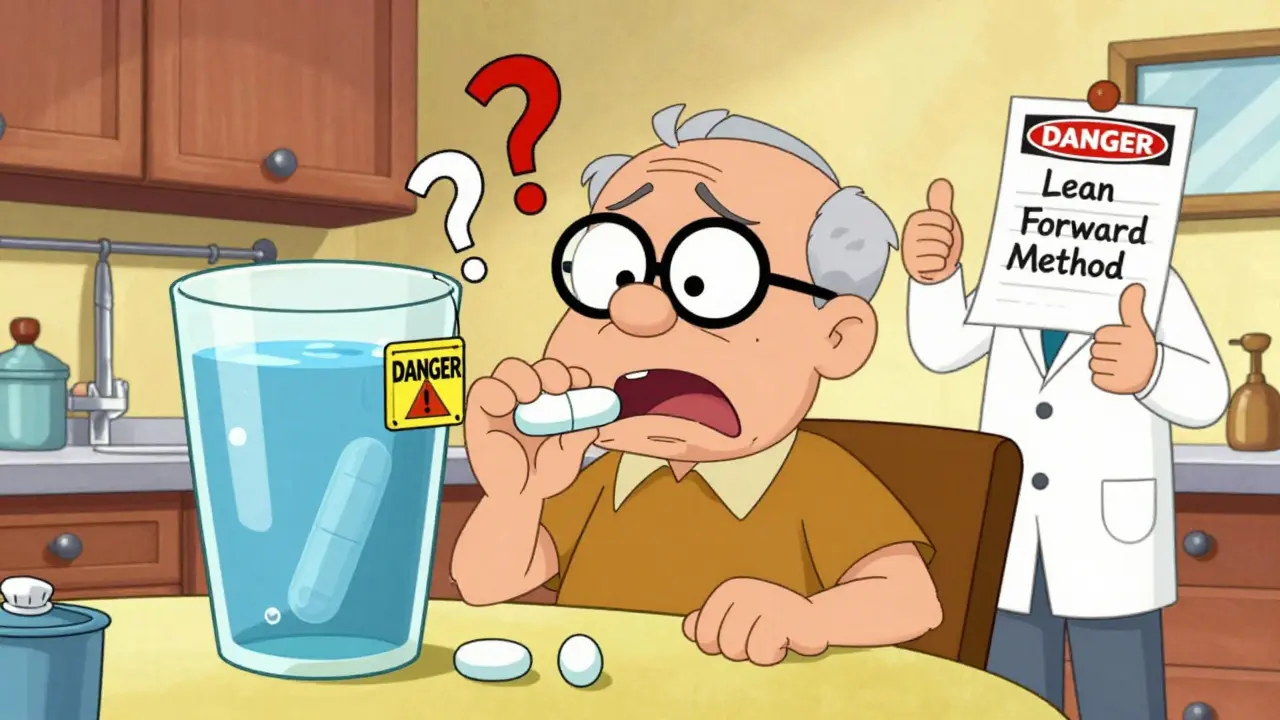
Swallowing pills can feel impossible for some people-especially older adults, those recovering from stroke, or anyone with a neurological condition. It’s not just about being nervous or having a sensitive gag reflex. Swallowing difficulties, or dysphagia, affect up to 15% of older adults living at home and as many as 68% of people in nursing homes. When you can’t swallow, taking your daily medicine becomes a daily battle. And skipping doses doesn’t just hurt your health-it can land you back in the hospital.
Why Swallowing Pills Is Harder Than You Think
It’s not just the size of the pill. A tablet coated in wax might slide down easier than a rough, uncoated one. A large round pill can get stuck where a torpedo-shaped capsule slips right through. Some people can swallow liquids fine but choke on solids. Others can handle soft food but panic when something hits the back of their throat. The problem isn’t always physical. Taste matters. Crushed pills mixed into applesauce can taste bitter or metallic. If your medicine tastes bad, you’re less likely to take it-even if you know you need it. And if you’ve had a bad experience once-like choking or coughing-your body learns to avoid it. That’s called behavioral aversion. It’s real. And it’s common.Don’t Crush Pills Without Checking First
Many people think crushing pills or opening capsules is harmless. It’s not. A 2023 review found that nearly half of all medication modifications-like crushing or mixing into food-were inappropriate. In 13% of those cases, it could lead to overdose or toxicity. In 8%, the medicine stopped working at all. Take extended-release tablets. Crush them, and you release the whole dose at once. That’s like taking ten pills at once. Blood pressure meds, opioids, and antidepressants are especially risky. Some capsules contain tiny beads designed to release slowly. Open them, and you lose that protection. Even if your pill looks like it should be crushed, don’t assume. Always ask a pharmacist. The European Medicines Agency now requires drug labels to say whether a pill can be crushed or split. But many older prescriptions still don’t have that info. That’s why you need to speak up.Try These Swallowing Techniques
If you’re struggling but your pills are safe to swallow whole, try these proven methods:- The Lean Forward Method: Place the capsule on your tongue. Take a medium sip of water. Tuck your chin toward your chest, then swallow. This moves the capsule away from your airway. Clinical observations show this improves success by up to 75%.
- The Pop Bottle Method: Fill a plastic water bottle halfway. Place the pill on your tongue. Seal your lips around the bottle’s opening. Take a strong sip-this creates suction that helps pull the pill down.
- The Straw Trick: Put the pill in your mouth. Suck on a straw while swallowing. The suction helps move the pill along.
- Ice Chips First: Chew a few ice chips before swallowing your pill. They numb the throat and reduce gag reflex. They also clear out any leftover taste from earlier doses.
Ask for Better Formulations
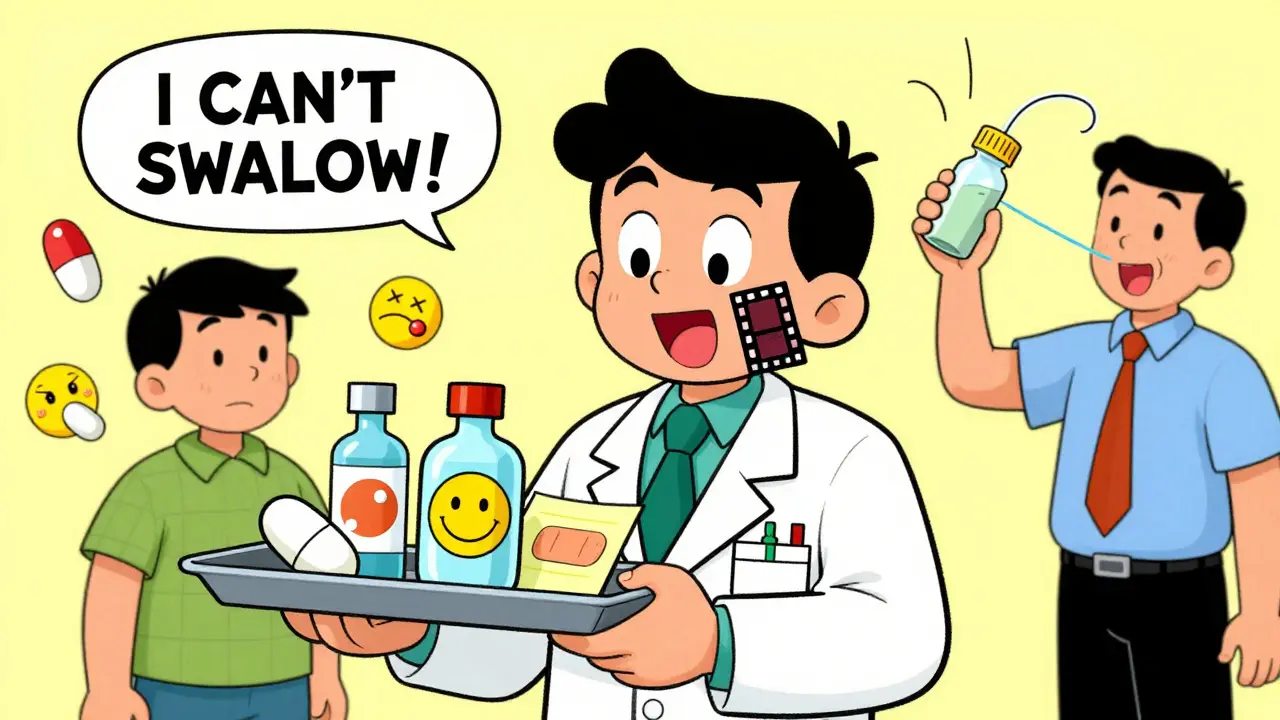
You don’t have to suffer through hard pills. There are alternatives-many of them better.- Liquids: Many drugs come in liquid form, even if it’s not the first option your doctor suggests. Ask if it’s available. Some liquid versions taste better than others-pharmacists can recommend the least bitter ones.
- Orodispersible tablets: These dissolve on your tongue. No water needed. They’re great for people with dry mouth or weak swallowing muscles.
- Effervescent tablets: Dissolve in water. Often flavored. Easier to take than pills.
- Topical patches or gels: For pain, hormones, or nicotine, patches avoid swallowing entirely.
- Rectal suppositories: Used for nausea, fever, or seizures when oral intake isn’t possible.
- Dissolvable films: Newer tech like VersaFilm sticks to the inside of your cheek and releases medicine in minutes. Studies show 85% of people with moderate dysphagia can use them successfully.
When You Need a Feeding Tube
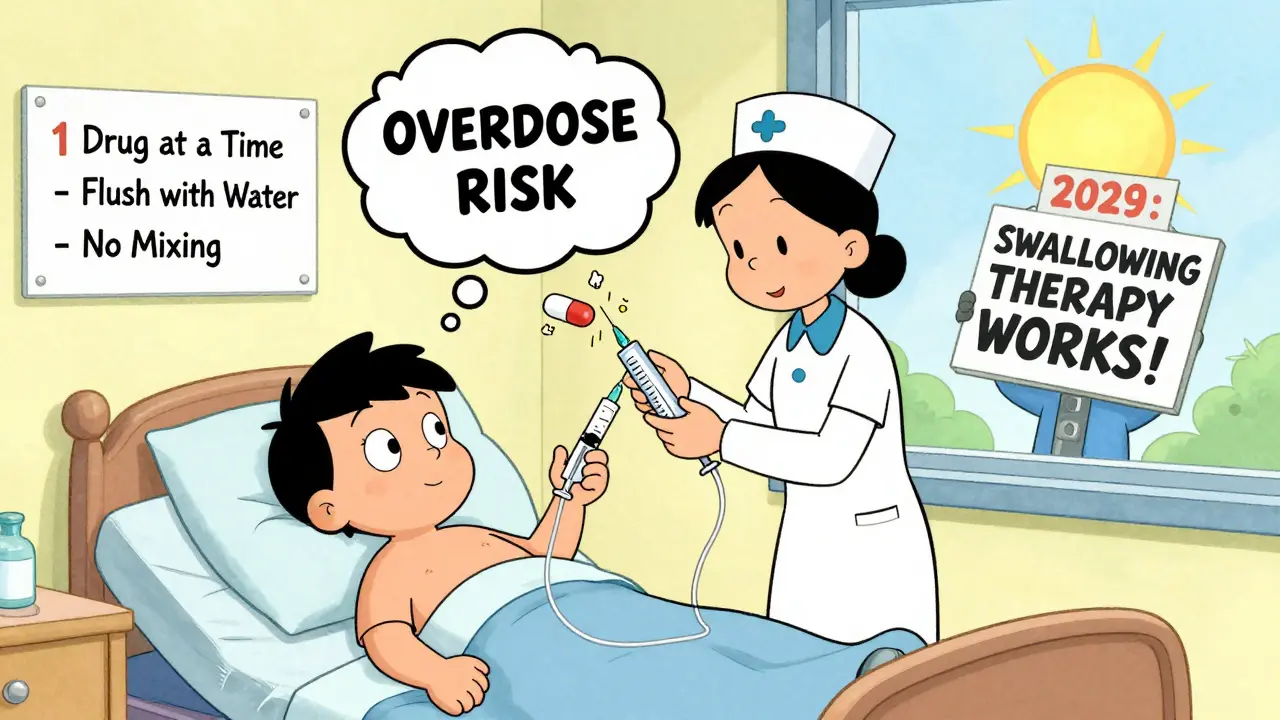
Some people with severe dysphagia rely on feeding tubes. But giving medicine through a tube isn’t simple. You can’t just dump crushed pills in.- Use one drug at a time. Flush with at least 10 ml of water between each.
- Don’t mix meds with formula. Some drugs bind to it and lose effectiveness.
- Use liquid or crushable forms only. Avoid enteric-coated or extended-release pills unless confirmed safe by a pharmacist.
- Check for interactions. Some antibiotics won’t work if given with certain feeds.
Work With Your Care Team
No one person should handle this alone. You need a team:- Pharmacist: Knows which pills can be crushed, which alternatives exist, and which ones are safest.
- Speech therapist: Can teach swallowing techniques, recommend food textures, and check if your swallowing muscles are improving.
- Doctor: Should review every medication. Is it still needed? Can it be switched?
- Nurse or caregiver: Must be trained on safe administration. Too many errors happen because staff aren’t told how to give meds properly.
What to Do If You’re Still Struggling
If you’ve tried everything and still can’t swallow your meds:- Call your pharmacist. Ask: “Is there a liquid version?” “Can this be made into a suspension?”
- Ask your doctor: “Can I stop this drug? Is there a non-pill alternative?”
- Use a pill organizer with reminders. Missing doses because you’re frustrated is common. Set phone alerts.
- Keep a log: What pill? What happened? Did you gag? Cough? Feel it stuck? Bring this to your next appointment.
- Join a support group. Talking to others who struggle with dysphagia helps you feel less alone.
Future Changes Are Coming
The market for dysphagia-friendly medicines is growing fast-projected to hit $2.9 billion by 2029. More drugmakers are listening. New labels will say clearly if a pill can be crushed. Electronic health records will soon flag patients with swallowing issues so doctors don’t prescribe hard pills by accident. But right now, you can’t wait for the system to fix itself. You have to be your own advocate. Ask questions. Try techniques. Demand better options. Your health depends on it.Can I crush my pills if I can’t swallow them?
Only if a pharmacist or doctor says it’s safe. Many pills-especially extended-release, enteric-coated, or chemotherapy drugs-can become dangerous when crushed. Crushing can cause overdose, reduce effectiveness, or irritate your stomach. Always check before you crush.
Why do some pills taste awful when crushed?
Many pills have coatings to mask bitter ingredients or control how the drug is released. When crushed, those coatings break open and expose the raw, unpleasant-tasting medicine inside. Pharmacists can sometimes recommend flavoring agents or alternative formulations to improve taste.
Are liquid medications less effective than pills?
No, not if they’re made correctly. Liquid versions contain the same active ingredient as pills-they’re just in a different form. Some are even designed to be absorbed faster. The key is getting the right dose from a reliable source. Compounded liquids should be made by licensed pharmacies following strict standards.
What if my insurance won’t cover a liquid version?
Ask your pharmacist to help you appeal. Sometimes the liquid version is the same generic drug as the pill, just in a different form. Insurance may cover it if you prove it’s medically necessary for swallowing safety. You can also ask about patient assistance programs or mail-order pharmacies that offer lower prices.
Can swallowing problems get better over time?
Yes, especially with speech therapy. Swallowing exercises can strengthen muscles, improve coordination, and reduce the risk of choking. People recovering from stroke or surgery often see progress within weeks. Even if you don’t fully recover, learning compensatory techniques can make swallowing pills much easier.
Next Steps for Better Medication Safety
Start today:- Write down every pill you take, including dose and frequency.
- Call your pharmacist. Ask: “Which of these can I switch to liquid or dissolvable forms?”
- Practice the lean forward method with a sip of water and a sugar pill.
- Ask your doctor if you still need every medication. Some may be unnecessary.
- Request a referral to a speech-language pathologist if you haven’t had one.
srishti Jain
This post made me cry. I’ve been crushing my mom’s blood pressure pills for years because she couldn’t swallow them. Turns out I was almost killing her. Never again.
Shae Chapman
OMG YES. 🥹 I used to gag every time I took my antidepressant. Tried the pop bottle method and now I’m basically a pill-swallowing ninja. Thank you for this. My therapist cried when I told her I’ve been taking my meds for 3 months straight. 💪💊
Nadia Spira
Let’s be real-this is just pharmaceutical capitalism repackaging failure as innovation. Dysphagia isn’t a problem to be solved with ‘dissolvable films’-it’s a symptom of a medical-industrial complex that refuses to prioritize patient dignity. You think a VersaFilm is progress? It’s a Band-Aid on a severed artery. The real solution is systemic: stop prescribing 12 pills a day to elderly patients. But that would require doctors to think. And they’re too busy chasing reimbursement codes.
henry mateo
i had a stroke 2 years ago and i still cant swallow pills. the lean forward thing saved my life. i use sugar pills to practice like the post said. also, my pharmacist hooked me up with a liquid version of my statin. it tastes like grape soda. i dont even mind it anymore. thanks for sharing this.
Kunal Karakoti
There’s an interesting ontological tension here: the pill as object of resistance versus the pill as symbol of medical authority. We treat medication ingestion as a purely physiological act, but it’s deeply ritualistic. The aversion isn’t just to texture or taste-it’s to the imposition of institutional control over the body. Perhaps the real dysphagia is not in the throat, but in the social contract between patient and provider.
Kelly Gerrard
Stop making this so complicated. Just take your medicine. If you can’t swallow, you’re weak. My grandma took 14 pills a day and never complained. She didn’t need fancy films or bottles or speech therapists. She had grit. And you need to have it too.
Joseph Corry
Interesting how the article romanticizes the ‘patient advocate’ narrative while ignoring that 80% of people with dysphagia are cognitively impaired or demented. Who’s advocating for them? The caregiver? The overworked nurse? This reads like a Silicon Valley wellness blog written by someone who’s never held a shaking hand or cleaned vomit off a hospital gown. The ‘solutions’ here are for the privileged. The rest of us are just waiting for the next tube.
Colin L
Okay, I’ve been a caregiver for my dad with Parkinson’s for 7 years, and let me tell you-this post is half right. The techniques? Solid. The pill-swallowing hacks? Lifesavers. But nobody talks about the emotional toll. The guilt. The way your heart breaks when your parent looks at you like you’re asking them to run a marathon after they’ve lost both legs. And then there’s the pharmacy-oh god, the pharmacy. They act like you’re asking them to perform surgery when you say ‘Can you make this into a liquid?’ And the insurance? Don’t even get me started. I’ve spent more time on hold with BlueCross than I have with my own kids. So yes, the methods work. But the system? It’s designed to make you feel like a burden for wanting your loved one to live without choking.
Hayley Ash
Wow another feel good pill swallowing guide. Did you also include a section on how to cry quietly while hiding the crushed pills in mashed potatoes? Because that’s what most of us actually do. And no, the ‘pop bottle method’ doesn’t work when you’re 87 and your throat feels like sandpaper. But sure, let’s all just ‘ask our pharmacist’ like that’s some magical genie with unlimited compounding powers. LOL
kelly tracy
Everyone’s so proud of themselves for using the straw trick like it’s some kind of victory. Meanwhile, half these ‘alternatives’ cost $300 a month and aren’t covered. And the ‘dissolvable films’? They’re basically candy for people who can’t swallow. It’s not medicine-it’s a PR stunt. This whole article feels like corporate wellness theater. Someone’s getting rich off your gag reflex.