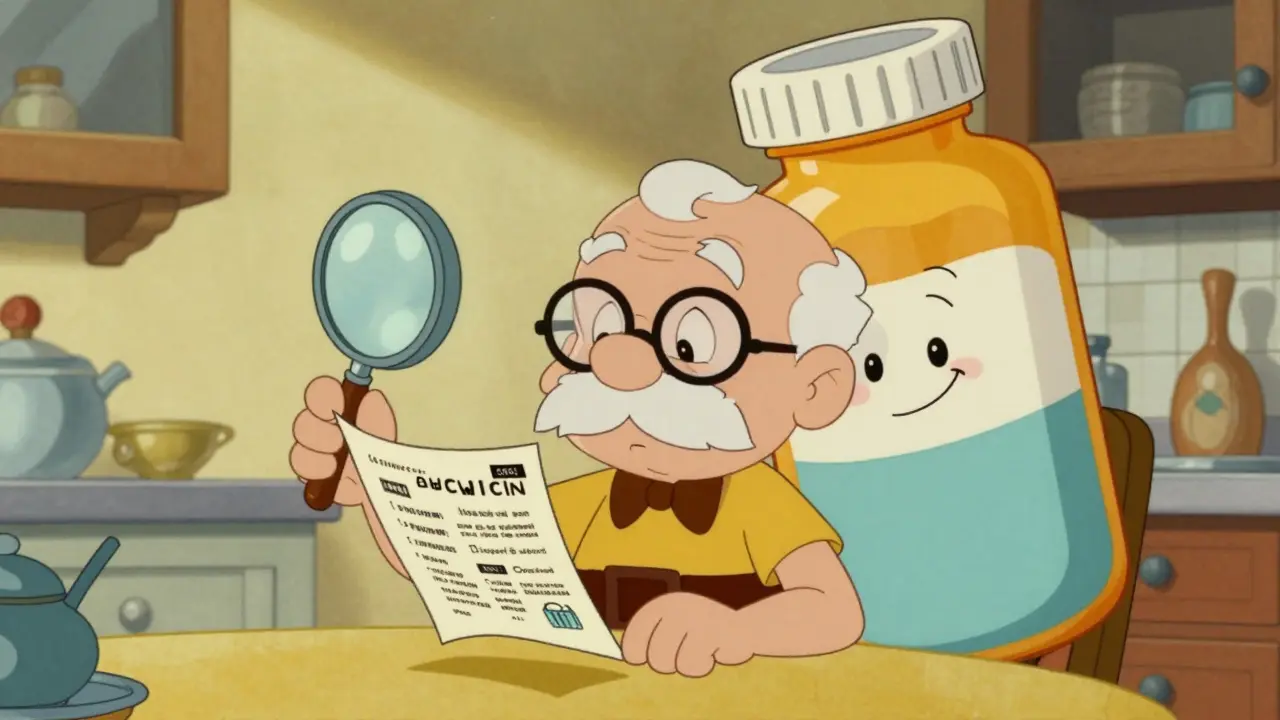
When someone turns 65, their health needs change. Medications multiply. Doctor visits become routine. Suddenly, there are new terms to remember - hypertension, anticoagulants, glycemic control. But here’s the problem: most of these materials are written for people who read at a 7th or 8th grade level. Older adults? Many read at a 3rd or 4th grade level. That’s not because they’re less smart. It’s because aging affects how we process information - and most healthcare materials ignore that.
Why Standard Medical Materials Don’t Work for Seniors
In 2003, the CDC found that 71% of adults over 60 struggled with basic health documents. That number hasn’t improved much. A 2022 survey by the National Council on Aging showed 63% of seniors had trouble understanding their own medication labels. Why? Fonts are too small. Words are too long. Instructions are too complex.Take a typical diabetes pamphlet. It might say: “Monitor fasting blood glucose levels daily and adjust insulin dosage per provider protocol.” That’s clear to a nurse. It’s confusing to someone who hasn’t read a manual since high school. And if they’re also dealing with arthritis, their hands can’t hold the paper steady. If they have macular degeneration, they can’t read the tiny print. If they’re on five different meds, they forget which one does what.
It’s not just about reading. It’s about memory, attention, and confidence. Many older adults don’t ask questions because they’re embarrassed. They nod along, go home, and guess what to do. That’s how hospital readmissions happen.
What Makes a Good Health Material for Seniors?
Effective materials for older adults follow three simple rules: big, clear, and simple.Font size matters. The National Institute on Aging says 14-point font is the minimum. Many providers use 16-point or even 18-point. Times New Roman or Arial are safe choices. Avoid fancy fonts. No italics. No all caps. Use bold only for key instructions - like “CALL YOUR DOCTOR IF…”
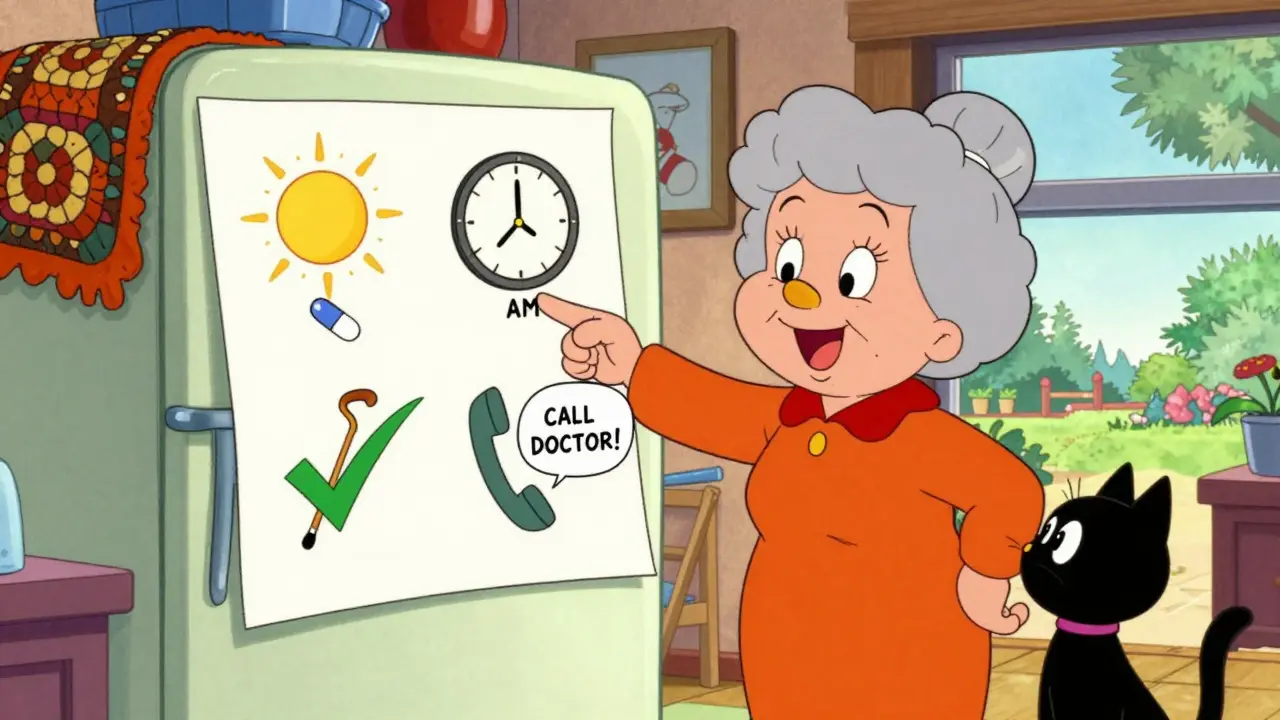
Use pictures, not paragraphs. A 2023 review in the Journal of the American Geriatrics Society found that illustrated step-by-step guides improved medication adherence by 37%. Show a hand holding a pill bottle. Show a clock with times labeled: “Take this at 8 AM. Take this at 8 PM.” No words needed. The image says it all.
Write like you talk. Replace “hypertension” with “high blood pressure.” Replace “adhere to your treatment plan” with “take your medicine like your doctor told you.” Use short sentences. One idea per sentence. Avoid medical jargon completely.
And here’s the most important part: test it with real seniors. The HealthPartners Institute spends 8 to 12 weeks developing a single handout. They test it with 15 older adults - not doctors, not nurses, but people like your mom or your neighbor. They ask: “What does this mean?” “Where would you put this on your fridge?” “Would you feel comfortable showing this to your family?” If even one person says “I don’t get it,” they rewrite it.
Where to Find Trusted Materials
You don’t have to create everything from scratch. There are free, high-quality resources already built for seniors.HealthinAging.org - run by the American Geriatrics Society - has over 1,300 easy-to-read guides. Topics include managing diabetes, preventing falls, understanding heart failure, and knowing when to call 911. All materials are reviewed by doctors and tested with seniors. Since 2020, these pages have been accessed over 2.3 million times a year.
MedlinePlus.gov - from the National Library of Medicine - has a whole section called “Easy-to-Read Health Information.” It includes 217 resources, alphabetized by topic, from “Alzheimer’s Disease” to “Healthy Aging.” Each one uses large font, simple language, and clear icons.
National Institute on Aging (NIA) offers free booklets like “Talking With Your Older Patients” for providers - and “Stay Active and Independent for Life” for seniors. Their Go4Life program, updated in January 2024, includes voice-guided exercise videos that seniors can access with a simple remote or smartphone.
These aren’t just nice-to-have. They’re backed by data. A 2021 study in the Journal of General Internal Medicine showed that when materials were rewritten to a 3rd-5th grade level, seniors understood them 42% better. That’s not a small gain. That’s life-changing.
How Providers Can Make a Real Difference
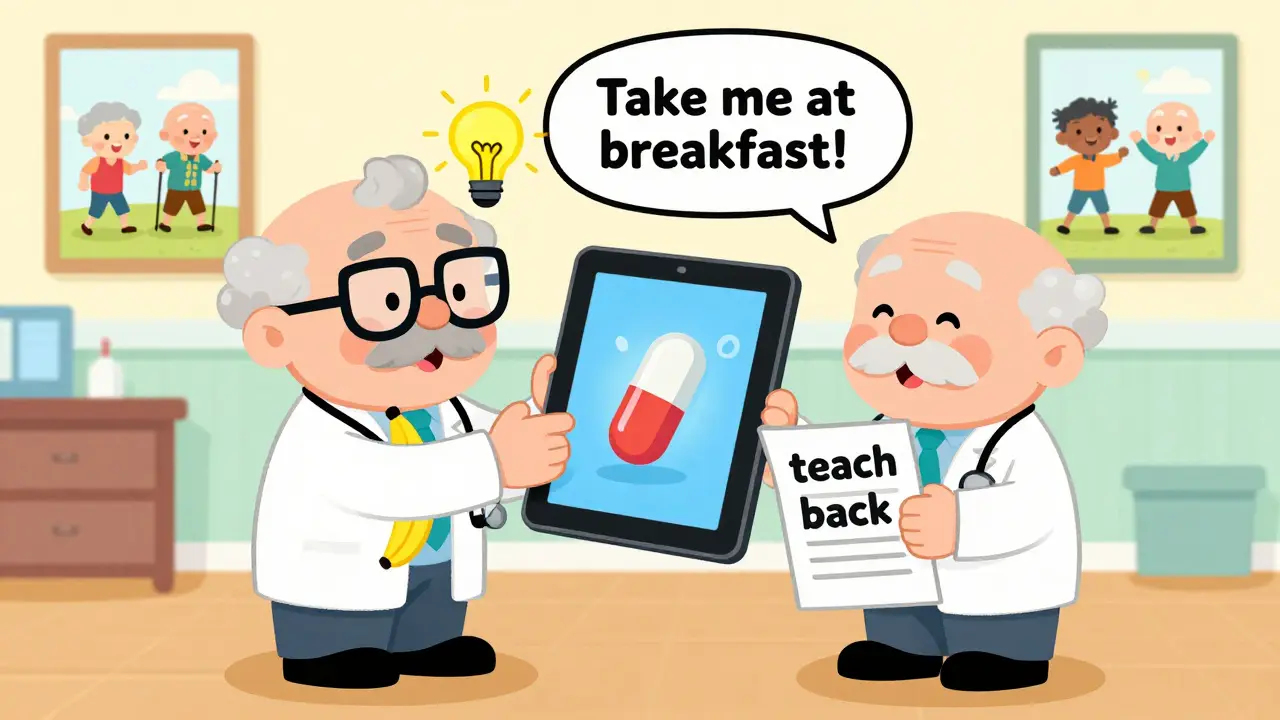
Doctors and nurses aren’t to blame. Most want to help. But they’re rushed. A 2023 American Medical Association survey found that 78% of providers said they didn’t have enough time to explain things properly.Here’s what works: the “teach-back” method. Instead of saying, “Do you understand?” say, “Can you show me how you’ll take this pill?” Or, “Tell me in your own words what you’ll do if your leg swells up.”
Research in Patient Education and Counseling found that when providers used teach-back, even with just 2.7 extra minutes per visit, patient understanding jumped 31%. That’s less than three minutes. That’s all it takes.
And don’t assume they know how to use technology. Yes, 68% of seniors used telehealth in 2023 - up from 17% in 2019. But that doesn’t mean they can navigate a portal. Many still need printed copies. Or a family member to help them log in. Always offer both.
The Real Cost of Poor Communication
This isn’t just about comfort. It’s about money and lives.The Agency for Healthcare Research and Quality estimates poor health literacy costs the U.S. system between $106 billion and $238 billion every year. Older adults pay the highest price. They’re 2.3 times more likely to report poor health. They’re 1.7 times more likely to have diabetes. And they’re far more likely to end up back in the hospital.
Hospitals that use good senior education materials see 14.3% fewer readmissions. That’s $1,842 saved per patient. Medicare is starting to notice. In 2023, they began tying reimbursement to health literacy outcomes.
And yet - only 28% of U.S. healthcare systems have fully adopted universal health literacy practices, according to Dr. Jane Johnson at the University of Michigan. That means most seniors are still getting materials written for people half their age.
What You Can Do Today
If you’re a senior, a caregiver, or a family member:- Ask for materials in large print. If they say no, ask for a different copy.
- Bring someone with you to appointments - someone who can take notes and ask questions.
- Use the “teach-back” trick: after the doctor explains something, say, “So if I feel dizzy, I should call you, right?”
- Go to HealthinAging.org or MedlinePlus.gov. Type in your condition. Download the easy-to-read version.
- If you’re a provider: print out one of these handouts. Put it on your desk. Use it with your next patient. It takes five minutes.
The goal isn’t to make seniors “easier to treat.” It’s to treat them with respect. They’ve lived long enough to know what matters. They just need the information in a way they can actually use.
Simple changes - bigger fonts, clearer words, pictures instead of paragraphs - don’t just help seniors. They help everyone. Because someday, we’ll all be older. And we’ll all want someone to speak our language.
Future of Senior Patient Education
The future is personal. The National Institutes of Health is funding a $4.2 million project to build AI tools that adapt health messages based on how well someone remembers, sees, or hears. Imagine a tablet that changes font size automatically if it notices you’re squinting. Or a voice assistant that repeats instructions slowly if you seem confused.But technology won’t replace human connection. It will support it. The most effective tools still come down to one thing: someone taking the time to make sure you understand.
By 2026, medical schools will have to teach 8 hours of health literacy training. That’s progress. But real change happens when every nurse, every pharmacist, every doctor chooses to slow down - just a little - and speak plainly.
Alex Curran
I've seen this first hand with my dad. He used to read the newspaper every morning but now he needs a magnifying glass just to see the font on his pill bottle. They make these fancy apps and portals but half the time he doesn't even know how to turn on the tablet. Big font. Simple words. Pictures. That's all it takes. Why do we make it so hard?
And don't get me started on the 'teach-back' method. My nurse actually asked me to show her how I'd take the meds. I thought she was joking. Turned out it worked. He remembered everything that week.
Dikshita Mehta
This is exactly why I started translating health materials into Hindi for my grandmother. She understood 'blood pressure' but 'hypertension' meant nothing. I printed out the MedlinePlus guides, enlarged the font, and added stick-figure drawings of pills next to times on a clock. She now takes her meds without reminders. No tech. No apps. Just paper and patience.
Healthcare needs to stop assuming everyone speaks 'doctor'. We need to speak 'human'.
pascal pantel
Let’s be real - this whole post is a feel-good fantasy. You think printing something in 18-point font magically fixes cognitive decline? 63% of seniors can’t read labels? That’s because they’re not literate, not because the font’s too small. You’re blaming the system for people who can’t manage basic tasks. The real problem is the collapse of public education over the last 40 years. Fix that before you redesign pamphlets.
Also, ‘test with real seniors’? Who’s paying for that? Medicare won’t cover it. Hospitals are drowning in red tape. You want change? Cut the bureaucracy, not the font size.
Mark Able
My mom’s 78 and she uses TikTok to track her meds. She’s got a voice assistant that tells her when to take her pills. You’re talking about paper pamphlets like we’re in 1998. Technology isn’t the enemy - laziness is. If your grandma can’t use a smartphone, maybe it’s time to get her a grandkid who actually cares.
Also, 14-point font? That’s not a standard, that’s a suggestion. Print it bigger if you want. But don’t act like this is a systemic crisis. It’s a family problem.
William Storrs
You know what’s beautiful about this? It’s not about fixing seniors. It’s about fixing how we see them. They’re not broken. We’re just not speaking their language. I work in a clinic and I started using the teach-back method last month. I used to rush. Now I pause. I ask them to show me. I watch their face. It’s not about time. It’s about respect.
And guess what? My patients are smiling more. That’s not in any study. But it’s real.
Nina Stacey
I just want to say thank you for writing this because my mom is 82 and she had to go to the ER last year because she mixed up her blood thinner with her heart pill and I didn’t even know she was confused because she never said anything she just nodded and smiled and I didn’t realize how scared she was until she ended up in the hospital and now I print out everything from HealthinAging.org and I put it on the fridge with magnets and I read it out loud to her every Sunday and I wish more people knew how easy it is to help if you just slow down a little bit and stop assuming they know what you mean
Also the part about pictures I didn’t even think of that but now I’m drawing little pills next to times on a calendar and she loves it
Kevin Motta Top
Big font. Clear words. Pictures. That’s it.
Why is this so hard to implement?
Chris porto
It’s funny how we call this ‘senior education’ like they’re students and we’re teachers. But they’ve lived decades. They’ve raised kids, paid taxes, fixed cars, buried spouses. They’re not failing to understand. We’re failing to listen.
Maybe the real lesson isn’t how to write better pamphlets. It’s how to stop talking down to people who’ve seen more of life than we ever will.
William Liu
My uncle took his insulin wrong for six months because the label said ‘take once daily’ and he thought that meant after breakfast. He didn’t ask because he didn’t want to look stupid. We found out because his blood sugar crashed at 3 a.m. and he called 911.
One sentence changed everything: ‘Take this when you wake up, not after you eat.’
Simple. Human. Life-saving.
Isabel Rábago
People like you think this is about compassion. It’s not. It’s about entitlement. Seniors want special treatment because they’re old? Newsflash - everyone gets old. You don’t get a pass on responsibility just because your eyes are bad. If you can’t read, get glasses. If you can’t use a phone, hire someone. Don’t force the system to bend to your incompetence.
And stop pretending this is about dignity. It’s about laziness.
Matt Davies
Man, this hit me right in the feels. My mum used to be the sharpest woman in the room - could quote Shakespeare, fix a carburetor, run a business. Now she stares at her pill organizer like it’s a cryptic crossword. I took her to the doctor last week and the nurse handed her a leaflet in 10-point font with tiny icons. She just smiled and said ‘I’ll figure it out’.
So I printed it in 20-point. Drew arrows. Added a sticky note: ‘If you’re confused, call me. No shame.’ She cried. Not because she was sad. Because someone finally saw her.
That’s all it is. Seeing.
Mike Rengifo
Been a nurse for 22 years. The most powerful thing I’ve ever done? Stopped saying ‘Do you understand?’ and started saying ‘Show me.’
Changed everything.
Dev Sawner
It is an undeniable fact that the deterioration of linguistic proficiency among the elderly demographic is a consequence of systemic educational deficits, compounded by the absence of lifelong learning initiatives. The notion that font size or illustrative aids constitute a substantive solution is fundamentally misguided. The root issue lies in the erosion of cognitive resilience due to socioeconomic neglect, not typographical aesthetics. One must address the epistemological foundations of health literacy, not merely its superficial manifestations.