GI Bleeding Risk Calculator
Personalized Risk Assessment
Enter your medication details to determine your risk of gastrointestinal bleeding when taking SSRIs and NSAIDs together.
Your Risk Assessment
Recommendations
Important Warning
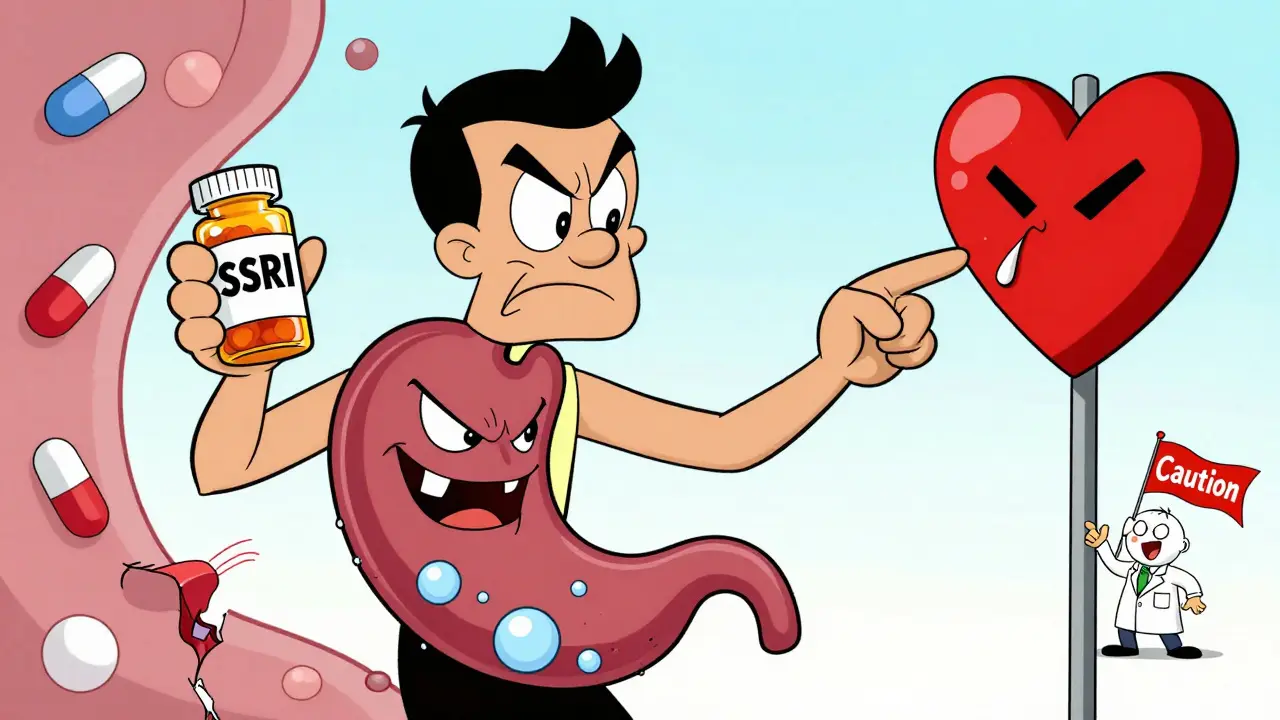
When you’re taking an SSRI for depression or anxiety and also reach for ibuprofen or naproxen for a headache or sore knee, you might not think twice about it. But combining these two common medications can silently increase your risk of a life-threatening stomach bleed - and most people have no idea.
Why This Combination Is Riskier Than You Think
Selective serotonin reuptake inhibitors (SSRIs) like sertraline, fluoxetine, and escitalopram work by boosting serotonin in the brain. But serotonin isn’t just a mood chemical - it’s also critical for blood clotting. Platelets need serotonin to stick together and stop bleeding. SSRIs block the serotonin transporter in platelets, making them less able to form clots when you get a cut or irritation in your stomach lining. NSAIDs like ibuprofen, naproxen, and diclofenac do something else: they weaken the stomach’s natural protective lining by blocking prostaglandins. These are the chemicals that keep the stomach mucus layer thick and healthy. Without them, acid can start eating away at the tissue. Put them together, and you’ve got a one-two punch: your stomach lining is damaged, and your blood can’t clot properly to stop the bleeding. A 2022 meta-analysis in Nature Scientific Reports found that people taking both SSRIs and NSAIDs have a 75% higher risk of upper GI bleeding than those taking NSAIDs alone. That’s not a small bump - it’s a major jump.Who’s Most at Risk?
Not everyone who takes both drugs will bleed. But some people are far more vulnerable.- People over 65 - aging stomachs produce less protective mucus, and platelets naturally become less responsive.
- Those with a history of ulcers or GI bleeding - even if it was years ago.
- Patients on multiple blood-thinning meds - like low-dose aspirin, warfarin, or even some herbal supplements like garlic or ginkgo.
- Those taking high-dose NSAIDs - more than 1,200 mg of ibuprofen per day raises the risk sharply.
- People on SSRIs for more than 90 days - the longer you’re on them, the more platelet function is affected.
Not All SSRIs or NSAIDs Are Created Equal
The risk isn’t the same across all drugs in these classes. Among SSRIs, drugs like paroxetine and fluoxetine bind more tightly to the serotonin transporter, so they may carry a higher bleeding risk than sertraline or citalopram. But even “lower-risk” SSRIs still pose a danger when paired with NSAIDs. For NSAIDs, the type matters a lot. Celecoxib (a COX-2 inhibitor) has a much lower GI bleeding risk than traditional NSAIDs like naproxen or diclofenac. In fact, studies show celecoxib’s bleeding risk is close to that of a placebo. Among non-selective NSAIDs, ibuprofen is generally considered safer than naproxen, but it’s still risky when combined with SSRIs.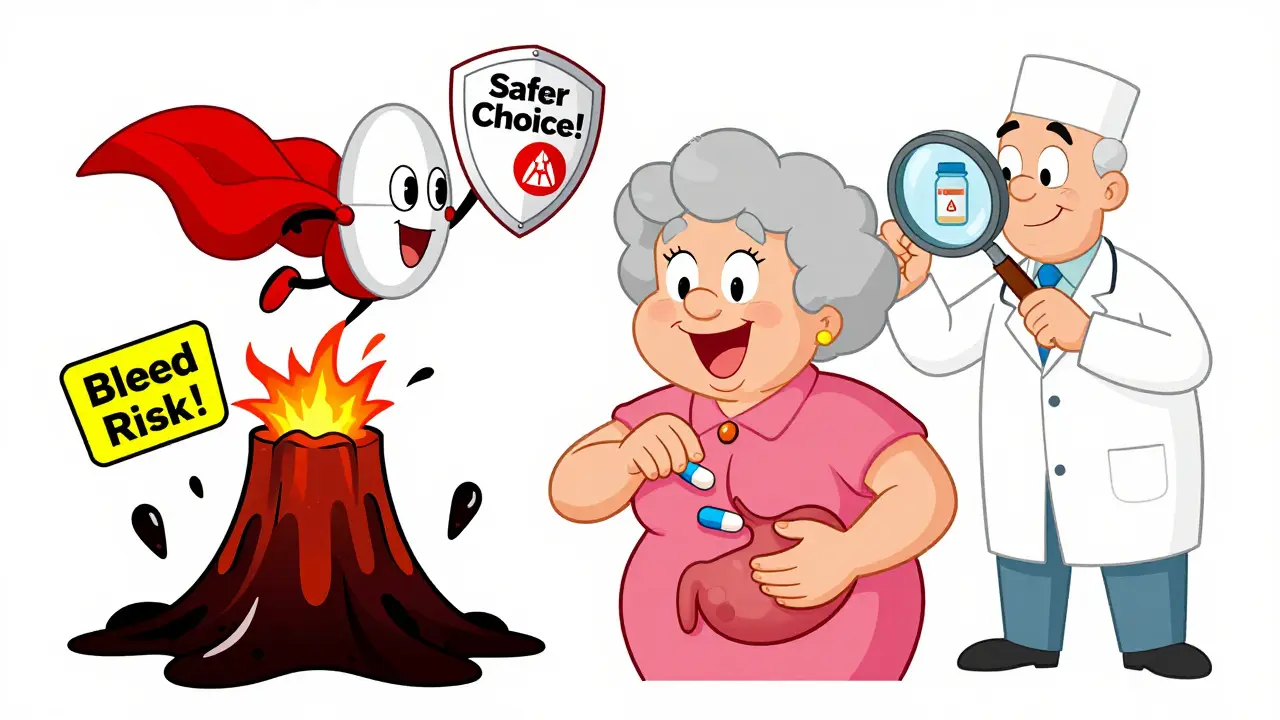
The Safer Alternative: Acetaminophen
If you need pain relief while on an SSRI, acetaminophen (paracetamol) is your best bet. Unlike NSAIDs, it doesn’t affect stomach lining or platelet function. A 2023 systematic review of over 1.2 million patients confirmed that acetaminophen shows no increased bleeding risk when taken with SSRIs. Many patients switch successfully. One user on HealthUnlocked reported: “My doctor switched me from naproxen to acetaminophen when I started fluoxetine. No GI issues in two years.” It’s not perfect - acetaminophen has liver risks at very high doses - but for most people needing occasional or daily pain relief, it’s the clear winner when SSRIs are in the mix.What Doctors Should Do - And What You Should Ask
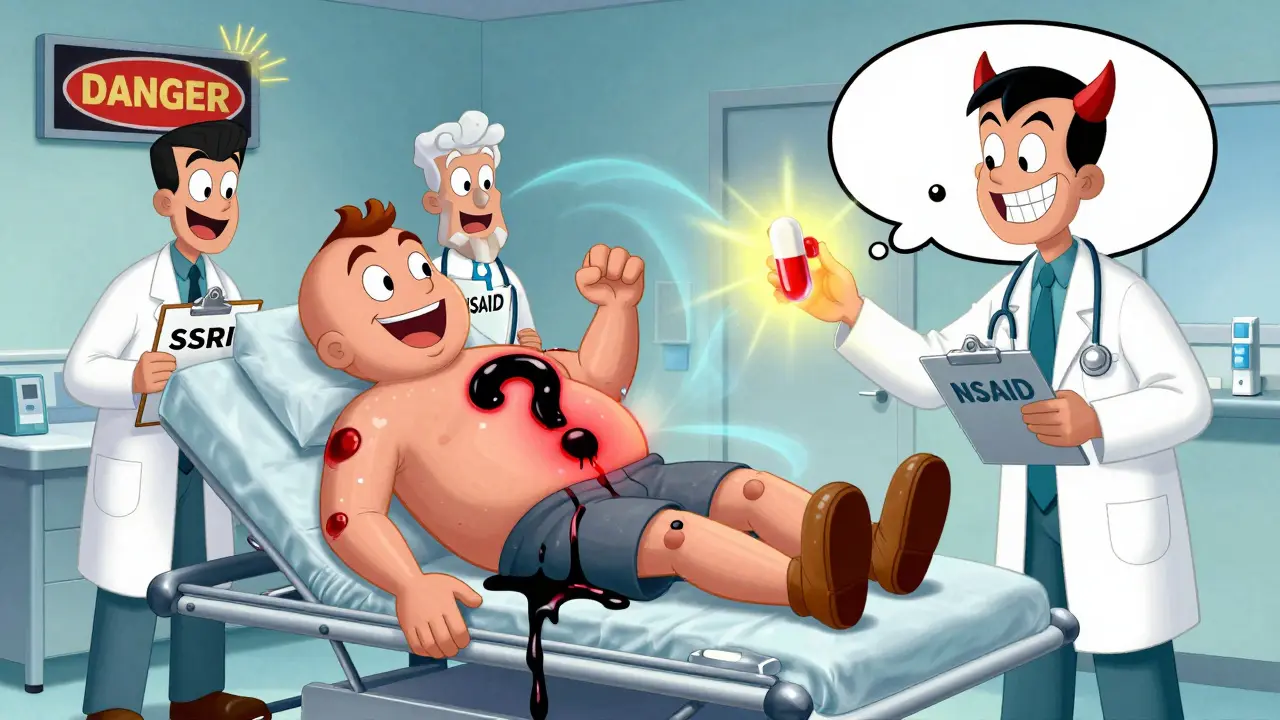
The American Gastroenterological Association (AGA) recommends that every patient taking both an SSRI and an NSAID should also take a proton pump inhibitor (PPI) like omeprazole or pantoprazole. PPIs reduce stomach acid and help heal the lining, cutting bleeding risk by about 70%. But here’s the problem: many doctors don’t think to ask about NSAID use when prescribing SSRIs. A 2021 study in JAMA Internal Medicine found that after a simple clinician education program, inappropriate co-prescribing dropped from 28% to 9% in just six months. You can protect yourself by asking:- “Is it safe for me to keep taking ibuprofen or naproxen with this antidepressant?”
- “Could I switch to acetaminophen instead?”
- “Should I be on a stomach-protecting medication too?”
What to Do If You’re Already on Both
If you’re currently taking an SSRI and an NSAID together, don’t stop either suddenly. But do take action:- Review your meds - List everything you take, including over-the-counter painkillers and supplements.
- Ask about alternatives - Can you switch to acetaminophen? Can you reduce NSAID use to only when absolutely necessary?
- Ask about PPIs - If you must keep the NSAID, ask for a low-dose PPI like omeprazole 20 mg daily.
- Watch for warning signs - Black or tarry stools, vomiting blood, sudden dizziness, or severe stomach pain could mean bleeding. Go to the ER immediately.
The Bigger Picture: Why This Isn’t Just a “Patient Error”
This isn’t about patients being careless. It’s about a system that treats SSRIs and NSAIDs as harmless, everyday meds - when they’re actually a dangerous pair. In the U.S., over 264 million SSRI prescriptions and 70 million NSAID prescriptions are filled each year. Even if only 1% of combinations lead to bleeding, that’s thousands of hospitalizations annually. The annual cost? Over $1.2 billion. The FDA added warnings to SSRI labels in 2019. The European Medicines Agency now requires doctors to assess GI risk before prescribing this combo. But awareness still lags. New tools are emerging. Some hospitals now use the GI-BLEED risk calculator, which uses 12 factors - including your specific drugs, age, and genetics - to give you a personalized risk score. It’s accurate in 89% of cases. Future research is looking at antidepressants that don’t affect platelets, like vortioxetine, which showed 40% fewer bleeding events than traditional SSRIs in a 2022 trial. But for now, the safest path is clear: avoid the combo if you can.Final Takeaway: Don’t Assume Safety
Just because a drug is available over the counter or prescribed by your doctor doesn’t mean it’s safe with everything else you take. The combination of SSRIs and NSAIDs is one of the most under-recognized, high-risk drug interactions in primary care. If you’re on an SSRI, treat NSAIDs like you would alcohol or blood thinners - something to use cautiously, sparingly, and only after talking to your provider. The goal isn’t to scare you. It’s to empower you. You have the right to know how your meds interact. And sometimes, the simplest change - swapping ibuprofen for acetaminophen - can keep you out of the hospital.Can I take ibuprofen with sertraline?
Taking ibuprofen with sertraline increases your risk of stomach bleeding. While it’s not an absolute no, it’s not safe without precautions. If you need pain relief, switch to acetaminophen instead. If you must use ibuprofen, ask your doctor about adding a proton pump inhibitor (PPI) like omeprazole to protect your stomach.
Do all SSRIs increase bleeding risk the same way?
No. SSRIs like paroxetine and fluoxetine have stronger effects on platelet serotonin uptake and may carry a higher bleeding risk than sertraline or citalopram. But even the "lower-risk" SSRIs still increase bleeding danger when combined with NSAIDs. Don’t assume one SSRI is safe just because another isn’t - the combination is the problem, not just the drug.
Is it safe to take Tylenol (acetaminophen) with SSRIs?
Yes. Acetaminophen (Tylenol) does not affect platelet function or stomach lining, and multiple studies show no increased bleeding risk when taken with SSRIs. It’s the preferred pain reliever for people on antidepressants. Just stick to the recommended dose (no more than 3,000-4,000 mg per day) to avoid liver damage.
Should I be on a stomach pill if I take both SSRIs and NSAIDs?
Yes, according to the American Gastroenterological Association. If you’re taking both an SSRI and an NSAID, you should also take a proton pump inhibitor (PPI) like omeprazole, pantoprazole, or esomeprazole. PPIs reduce stomach acid and help heal the lining, cutting bleeding risk by about 70%. This is standard care - not optional - for this combination.
What are the signs of a GI bleed from this interaction?
Watch for black, tarry stools; vomiting blood or material that looks like coffee grounds; sudden dizziness or fainting; severe abdominal pain; or unexplained fatigue and weakness. These can mean internal bleeding. If you experience any of these, go to the emergency room immediately. Don’t wait - this can be life-threatening.
Can I stop my SSRI if I want to take NSAIDs?
Never stop an SSRI suddenly. Stopping abruptly can cause withdrawal symptoms like dizziness, nausea, anxiety, or brain zaps. If you want to switch from an SSRI to avoid NSAID risks, talk to your doctor about a gradual taper and possible alternative antidepressants with lower bleeding risk, like vortioxetine. But the safer approach is usually to avoid NSAIDs, not stop your antidepressant.
Frank SSS
Y’all act like this is news. I’ve been on sertraline for 8 years and still pop ibuprofen like Skittles. Never bled. Probably just lucky. Or maybe your doctor’s scared of liability and wants to sell you omeprazole like it’s a miracle cure.
Paul Huppert
Really appreciate this breakdown. I was on naproxen for my knee and didn’t realize the combo could be dangerous. Switched to Tylenol last month-zero issues. My stomach actually feels better now.
Hanna Spittel
😂 they’re hiding the truth again. Big Pharma doesn’t want you to know acetaminophen is cheaper and safer. Also, SSRIs are basically chemical brain rewiring-why are we even on these? 🤔
Deepika D
As someone who’s been managing depression and chronic back pain for over a decade, this is one of the most important posts I’ve read in years. I used to take diclofenac daily and thought it was fine since my doctor prescribed my SSRI. Turns out, I was one bad cough away from an ER trip. I switched to acetaminophen, started physical therapy, and added a low-dose PPI as my rheumatologist suggested. No more black stools, no more panic attacks over stomach pain. It’s not about fear-it’s about awareness. If you’re on an SSRI, treat NSAIDs like a loaded gun: don’t point it at your gut unless you’ve got a damn good reason and a safety plan. Also, if you’re over 60, please, please, please get a GI baseline. Your stomach doesn’t regenerate like it used to. And yes, even if you feel fine-bleeding doesn’t always come with screaming pain. Sometimes it just sneaks in with fatigue, dizziness, or that weird ‘off’ feeling you can’t explain. Don’t wait for a crisis. Talk to your doctor. Ask for the GI-BLEED calculator if they don’t bring it up. You deserve to live without silent threats in your medicine cabinet.
Lawver Stanton
Okay but let’s be real-this whole thing is a scam. SSRIs were never meant to be long-term. The whole serotonin myth? Debunked. And NSAIDs? They’re just anti-inflammatories. The real problem is that doctors don’t know how to treat depression without pills, and they don’t know how to treat pain without pills, so they just stack them like Jenga blocks and hope you don’t fall. Meanwhile, the real solution-therapy, movement, sleep, nutrition-isn’t profitable. So instead, we get a 12-page warning pamphlet and a $100 PPI script. Classic medical industrial complex. I’ve been off SSRIs for 3 years. My stomach’s fine. My mood? Better. I don’t need a chemical crutch to feel human.
Sara Stinnett
How quaint. We’ve reduced complex neuropharmacology to a ‘switch this for that’ checklist. The real issue isn’t the drug interaction-it’s the cultural normalization of pharmaceutical band-aids for systemic failures. You don’t treat depression with a serotonin pump and pain with a COX inhibitor. You treat the life that produced the symptoms. But no, let’s just tweak the prescription and call it progress. Meanwhile, the patient is left holding the bag of side effects, wondering why their body feels like a malfunctioning appliance. The only ‘safe alternative’ is a radical rethinking of healthcare. But that’s too inconvenient for a $200 co-pay, isn’t it?
linda permata sari
Wow. This is so important. In Indonesia, everyone just takes paracetamol for everything-and I’m so glad I learned this here. My mom took fluoxetine and ibuprofen for years. She never knew. Now she’s on acetaminophen and feels better than ever. Thank you for sharing this. 🙏❤️
Brandon Boyd
You got this. Seriously. Switching from naproxen to Tylenol was one of the best health decisions I ever made. I was skeptical at first-‘But it doesn’t work as well!’-but guess what? It worked well enough. And I didn’t end up in the ER. You’re not weak for asking for safer options. You’re smart. And if your doctor pushes back? Find a new one. Your gut is worth more than their convenience.
Brady K.
Let’s deconstruct this like a pharmacokinetic equation: SSRIs inhibit SERT on platelets → reduced aggregation → impaired hemostasis. NSAIDs inhibit COX-1 → diminished PGI2 and mucus → mucosal vulnerability. Synergistic risk multiplier = 1.75x. But here’s the kicker: the real variable isn’t the drug-it’s the patient’s epigenetic expression of CYP2D6 and CYP2C9 enzymes, which most clinicians ignore because they’re too busy checking boxes on EHRs. And don’t get me started on the PPI overprescription cult. Omeprazole isn’t a shield-it’s a band-aid on a broken spine. We need better antidepressants that don’t hijack peripheral serotonin, not more acid blockers. Vortioxetine? Promising. But until we fix the upstream system, we’re just rearranging deck chairs on the Titanic. And yes, I’m aware this is the third comment I’ve written in 20 minutes about this. I’m obsessed. Deal with it.