
Walking into a doctor's office and seeing a lab report full of acronyms like eGFR, BUN, and ACR can feel like reading a foreign language. But these numbers are actually the primary way your healthcare provider checks if your kidneys are filtering your blood correctly. The tricky part about kidney health is that these organs are incredibly resilient; you can actually lose a significant amount of function before you feel any physical symptoms. That is why these tests are so critical-they find the problem while it is still manageable.
| Test Name | What it Measures | Primary Goal | Sample Type |
|---|---|---|---|
| Serum Creatinine | Muscle waste product | Detect kidney decline | Blood |
| eGFR | Filtration rate | Stage kidney disease | Calculated (Blood) |
| Urine ACR | Protein (Albumin) levels | Early leak detection | Urine |
| BUN | Urea nitrogen | Overall waste levels | Blood |
The Blood Side: Serum Creatinine and BUN
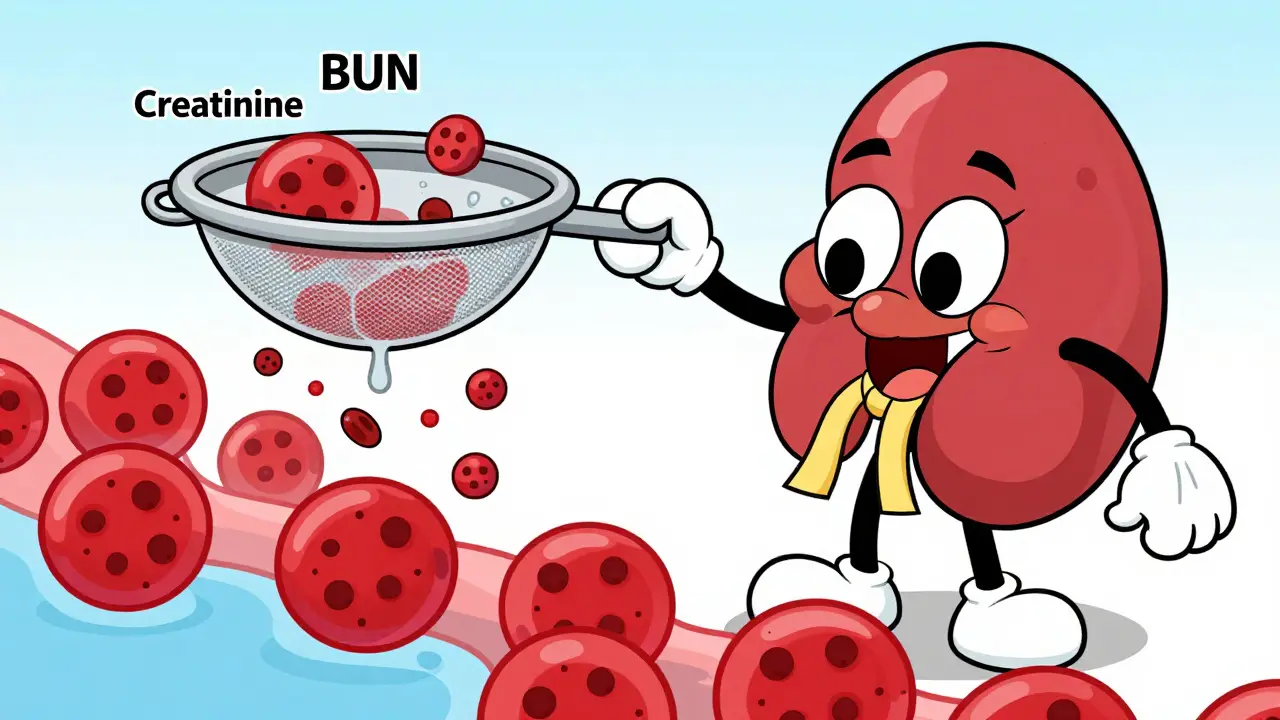
When doctors look at your blood work, they start with markers of waste. Serum Creatinine is a waste product created by the normal wear and tear of muscles in the body. Under normal conditions, your kidneys filter creatinine out of the blood and send it to your bladder. If the kidneys aren't working well, creatinine builds up in the bloodstream.
However, creatinine has a major flaw: it is a "late marker." According to data from Physiopedia, you might have to lose nearly 50% of your kidney function before a significant rise in serum creatinine even shows up on a test. This is why your doctor won't rely on this number alone.
Then there is Blood Urea Nitrogen (BUN), which is a measure of the amount of nitrogen in your blood that comes from the waste product urea. Urea is created when the liver breaks down proteins. While a high BUN can suggest kidney issues, it can also be influenced by things like a high-protein diet, dehydration, or certain medications, making it less specific than creatinine.
Decoding the eGFR: The Gold Standard for Staging
Because a raw creatinine number doesn't tell the whole story (for instance, a bodybuilder has more muscle and therefore more creatinine than a sedentary person), doctors use the Estimated Glomerular Filtration Rate (eGFR). This is a calculation that estimates how many milliliters of blood your kidneys filter per minute. It uses your serum creatinine level along with your age and sex to provide a more personalized picture of your health.
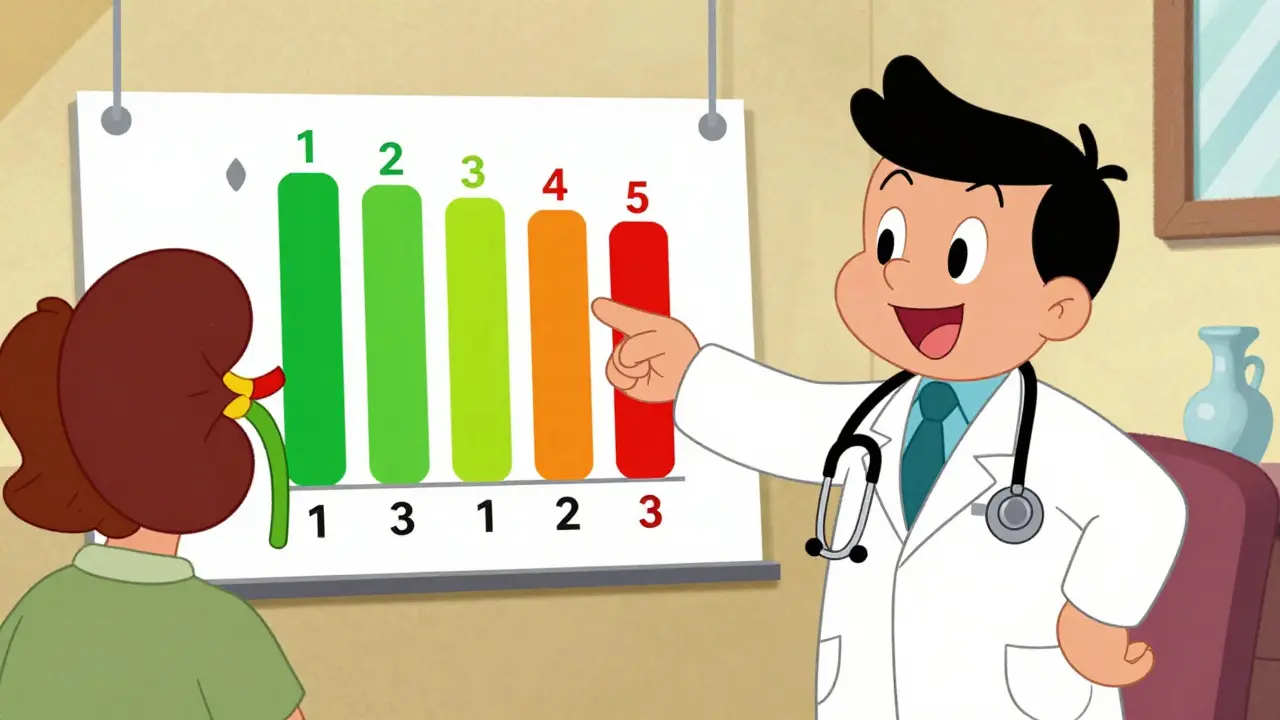
Most modern labs use the CKD-EPI equation, which is more accurate than older methods. Here is how the results are typically interpreted to determine the stage of chronic kidney disease:
- Stage 1: GFR greater than 90 (Normal or mild damage).
- Stage 2: GFR between 60 and 89 (Mildly decreased function).
- Stage 3a: GFR 45 to 59 (Moderate decrease).
- Stage 3b: GFR 30 to 44 (Moderate to severe decrease).
- Stage 4: GFR 15 to 29 (Severely compromised function).
- Stage 5: GFR less than 15 (Kidney failure/End-stage renal disease).
It is worth noting that eGFR isn't perfect. If you are pregnant, very muscular, or underweight, these equations might give a skewed result. In those cases, a cystatin C test is often used instead, as it provides a more accurate estimate regardless of muscle mass.
Urinalysis: Finding the First Warning Signs
While blood tests tell you how the kidneys are performing, urine tests tell you if the kidneys are damaged. One of the earliest warning signs of kidney disease is Proteinuria, which is the presence of abnormal amounts of protein in the urine. Healthy kidneys keep protein in the blood; if protein leaks into the urine, it means the kidney's filtration barriers are compromised.
The most reliable tool for this is the Albumin-Creatinine Ratio (ACR). Unlike a simple dipstick test (the chemically treated paper that changes color), the ACR is a quantitative measurement. It compares the amount of albumin (a specific protein) to the amount of creatinine in a single urine sample. If your ACR result falls between 3-70 mg/mmol, doctors usually want to recheck it with an early morning sample to confirm the finding.
For a more exhaustive look, some providers order a 24-hour urine collection. This involves collecting every drop of urine for a full day and night. While it is a hassle, it allows doctors to measure not just protein, but also levels of sodium, potassium, and oxalates, providing a complete map of what your kidneys are keeping and what they are tossing out.
Who Needs Regular Testing?
Not everyone needs a deep dive into renal function every month, but certain high-risk groups should have these tests as a routine part of their annual checkup. If you have Diabetes or Hypertension (high blood pressure), you are at a significantly higher risk for kidney damage. These two conditions are the leading causes of kidney failure globally because they damage the small blood vessels in the kidneys over time.
People with cardiovascular disease or a history of acute kidney injury also need a two-pronged monitoring strategy. This means getting both an eGFR blood test and a urine ACR test. Relying on just one can be dangerous; you might have a normal eGFR but still be leaking protein, meaning the disease has started but hasn't yet crashed your filtration rate.
Practical Tips for Your Next Lab Visit
To get the most accurate results from your kidney function tests, there are a few things you should keep in mind. Dehydration can artificially inflate your BUN and creatinine levels, making your kidneys look worse than they actually are. Drink plenty of water in the days leading up to your blood draw.
Similarly, be mindful of your protein intake. A massive steak dinner the night before a test can occasionally influence urea nitrogen levels. If you are doing a 24-hour urine collection, be meticulous. Missing even one void during that window can invalidate the entire 24-hour average, forcing you to start over.
Can my creatinine be high if my kidneys are healthy?
Yes. Since creatinine comes from muscle breakdown, people with very high muscle mass (like bodybuilders) often have higher baseline creatinine levels. This is why doctors use the eGFR calculation, which adjusts the creatinine value based on age and sex to get a more accurate picture.
What is the difference between a dipstick test and an ACR test?
A dipstick is a quick screening tool that uses a color-changing strip to detect protein. It is fast but lacks precision. The Albumin-Creatinine Ratio (ACR) is a laboratory-grade quantitative test that measures the exact concentration of albumin, making it far more sensitive for early detection of kidney disease.
Does a GFR of 65 mean I have kidney failure?
No. A GFR of 65 generally falls into Stage 2, which indicates mildly decreased kidney function. Kidney failure (Stage 5) typically occurs when the GFR drops below 15. However, any result below 60 for more than three months usually warrants further investigation for chronic kidney disease.
How often should I have my kidney function checked?
For most healthy adults, a basic metabolic panel during an annual physical is sufficient. However, if you have diabetes, hypertension, or heart disease, your doctor will likely recommend regular eGFR and ACR testing to catch any decline as early as possible.
What is Cystatin C and when is it used?
Cystatin C is a protein produced by all nucleated cells in the body. Unlike creatinine, it isn't affected by muscle mass or diet. Doctors use it when they suspect a creatinine-based eGFR is inaccurate, such as in very muscular athletes, people with muscle-wasting diseases, or pregnant women.
Next Steps and Troubleshooting
If you receive a lab report with a low eGFR or a high ACR, don't panic. A single "bad" test doesn't always mean you have chronic disease. Factors like temporary dehydration, high-protein supplements, or recent intense exercise can skew the numbers. Your doctor will likely order a second test to see if the trend continues.
If you are in a high-risk group, ask your provider specifically for the "Urine ACR」 rather than just a standard urinalysis dipstick. Since protein leakage is the earliest warning sign, this specific test is your best bet for early intervention. If you find the 24-hour urine collection too difficult, discuss the options for a spot-check ACR, which is often a viable and less stressful alternative.
Chad Miller
basically just tellin us to trust the docs blindly lol these tests can be so off if u dont actually look at the hole picture
Doug DeMarco
Good breakdown! For anyone struggling with the 24-hour collection, just set a timer on your phone for every time you think you'll need to go, it helps keep the log accurate! 😊💪
Franklin Anthony
funny how they only mention the standard tests but never the ones they use to actually track us through the healthcare system the numbers are probably just fake to keep us in a state of fear so we keep paying for the meds
emmanuel okafor
it is interesting how the body hides pain until it is too late we should all just be more mindful of our health and not wait for a paper to tell us we are sick
Victor Parker
The labs are all rigged anyway! 🙄 Just follow the natural path and avoid the chemicals they put in the water and your GFR will be fine!
Trey Kauffman
Ah yes, the 'gold standard' eGFR. Because nothing says precision like a mathematical approximation based on your gender and age. Truly the pinnacle of modern alchemy. 🙄
Simon Jenkins
I simply cannot believe people actually struggle with understanding a basic ACR test! It is positively primitive that we even have to explain this in a public forum! The sheer audacity of the medical system to make these reports so cryptic is an absolute travesty of the highest order!
Julie Bella
Omg I had a high BUN once because I ate a giant steak dinner and the doctor literally scolded me for it!! 😱 You guys should all be more careful about what you eat before your labs or you're basically lying to your doctor!!
Camille Sebello
My GFR was 58... totally panicked!!! My doctor said it was fine... but I don't trust him!!!
Ben hogan
This is such a shallow summary. It barely scratches the surface of renal pathophysiology and treats the reader like a child. Pathetic.
Peter Meyerssen
The ontological nature of the eGFR is essentially a heuristic for systemic failure. It's basically just a proxy for the actual physiological homeostasis. 🙄
Thabo Leshoro
I totally feel that stress... Especially when you see a number that looks scary... But just remember that the creatinine clearance is just one part of the whole picture!!! Stay positive!!!
Suchita Jain
It is highly imperative that individuals refrain from self-diagnosing based on these metrics. One must maintain a disciplined approach to their medical records and defer entirely to a qualified specialist to avoid catastrophic errors in judgment.
Sarina Montano
The 24-hour urine collection is a bit of a nightmare, but it's a treasure trove of data. If you're doing it, I've found that using a dedicated jug with a clear marker for the time of each void makes the process feel way less like a chaotic science experiment and more like a structured health audit. It really helps paint a vivid picture of the kidney's metabolic efficiency that a simple spot check just can't capture. Make sure you keep the container chilled if the lab requests it, otherwise, you're just wasting your time. It's the gold standard for a reason, even if it feels like a relic from a different era of medicine. Just stay hydrated and stay patient with the process!