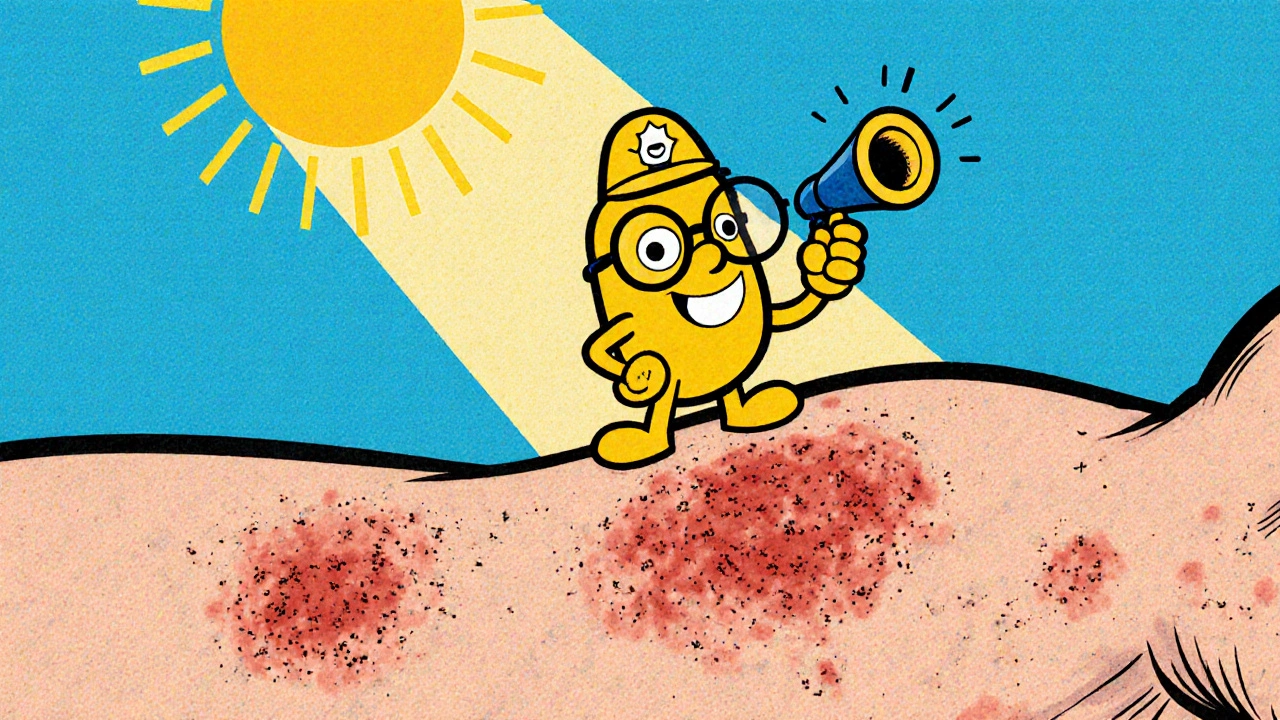
When you see a prescription for calcipotriene, it might sound like a chemical from a lab. But here’s the truth: it’s basically your body’s own vitamin D, tweaked to work better on your skin. This isn’t some synthetic drug pulled out of thin air-it’s a man-made version of the vitamin you get from sunlight, designed to calm down angry skin without the side effects of steroids.
What calcipotriene actually is
Calcipotriene is a synthetic analog of calcitriol, which is the active form of vitamin D in your body. It binds to the same receptors in your skin cells as natural vitamin D, but it’s modified so it doesn’t get absorbed into your bloodstream the same way. That’s why it’s safe to use topically for long periods, unlike oral vitamin D supplements that can raise calcium levels dangerously if overused.
It’s not a cure. It doesn’t erase psoriasis. But it does slow down the rapid growth of skin cells that cause thick, scaly patches. In clinical trials, about 60% of people using calcipotriene twice daily saw at least a 75% improvement in their psoriasis plaques within eight weeks. That’s not magic-it’s biology.
Why vitamin D matters for your skin
Your skin isn’t just a barrier. It’s an active organ that makes vitamin D when UVB rays hit it. That vitamin D doesn’t just help your bones-it tells your skin cells when to grow, when to die, and when to stop dividing. In psoriasis, that signal gets broken. Skin cells multiply too fast and don’t shed properly, building up into plaques.
Calcipotriene steps in and restores that signal. It turns down the overactive immune response in the skin and slows the production of keratinocytes-the cells that pile up in psoriasis. It also helps normalize the skin’s barrier function, reducing dryness and flaking. Think of it like a traffic cop for skin cells: telling them to slow down and behave.
How it’s used in real life
Most people use calcipotriene as a cream, ointment, or solution. It’s usually applied once or twice a day to affected areas, like elbows, knees, scalp, or lower back. The key is consistency. You don’t see results overnight. Most patients start noticing thinner plaques after two weeks, with major improvement by four to six weeks.
It’s often combined with a low-strength corticosteroid like betamethasone. That combo-sold under names like Dovobet or Taclonex-works better than either alone. The steroid reduces redness and itching fast, while calcipotriene handles the root cause: the runaway skin cell growth. This combo is one of the most prescribed treatments for moderate psoriasis in North America.
Don’t use it on your face unless your doctor says so. The skin there is thinner and more sensitive. Also, avoid applying it to large areas of skin (more than 35% of your body) for long periods. Too much can raise calcium levels, though this is rare with proper use.
What you can’t do with calcipotriene
It won’t fix eczema. It won’t help acne. It won’t treat fungal infections. It’s specifically designed for conditions driven by abnormal skin cell turnover-mainly plaque psoriasis and, sometimes, scalp psoriasis. If you’re using it for something else and it’s not working, that’s why.
It also doesn’t work for everyone. About 1 in 5 people don’t respond well, even with perfect use. If you’ve been using it for 8 weeks with no change, talk to your pharmacist or doctor. There are other vitamin D analogs like tacalcitol or maxacalcitol that might work better for you.
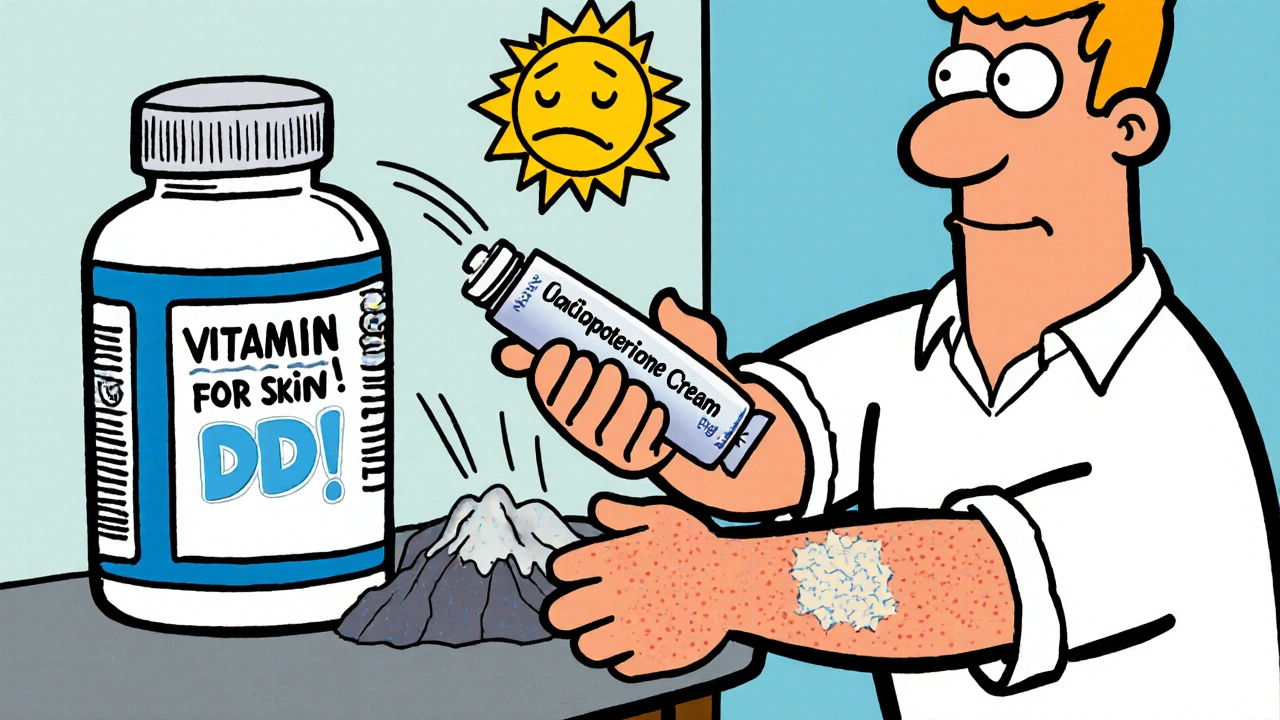
Side effects you might notice
The most common side effect? Skin irritation. About 10-15% of users feel a slight burning, stinging, or itching right after applying it. That usually fades within a few days as your skin adjusts. If it doesn’t, or if you get red, swollen patches, stop using it and get it checked.
Less common but important: high calcium levels. This is rare, but possible if you use too much over a large area. Symptoms include nausea, fatigue, frequent urination, or muscle weakness. If you feel off and are using calcipotriene daily, tell your doctor. A simple blood test can check your calcium levels.
How it compares to other treatments
Compared to topical steroids, calcipotriene doesn’t cause skin thinning. That’s a big deal if you’ve been using steroid creams for years and now have fragile, stretch-marked skin. Steroids are fast, but risky long-term. Calcipotriene is slower but safer.
Compared to coal tar or anthralin, it’s much less messy and doesn’t stain clothes. Coal tar smells bad and can irritate. Anthralin stains everything. Calcipotriene is odorless, non-staining, and comes in easy-to-use tubes or pumps.
It’s not as strong as biologics like Humira or Stelara, but those cost thousands a year and require injections. Calcipotriene is affordable, over-the-counter in some countries, and doesn’t need blood monitoring.
What to expect if you start using it
Week 1-2: Your plaques might look the same, or even get a little worse before they improve. That’s normal. Your skin is adjusting.
Week 3-4: The scales start to soften. Redness begins to fade. You might notice less itching.
Week 5-8: Flakes are gone. Skin looks smoother. Some people see near-complete clearing. Others see partial improvement. That’s still success.
After eight weeks, your doctor might suggest switching to maintenance dosing-maybe once a day, or every other day-to keep flare-ups under control without overusing the product.
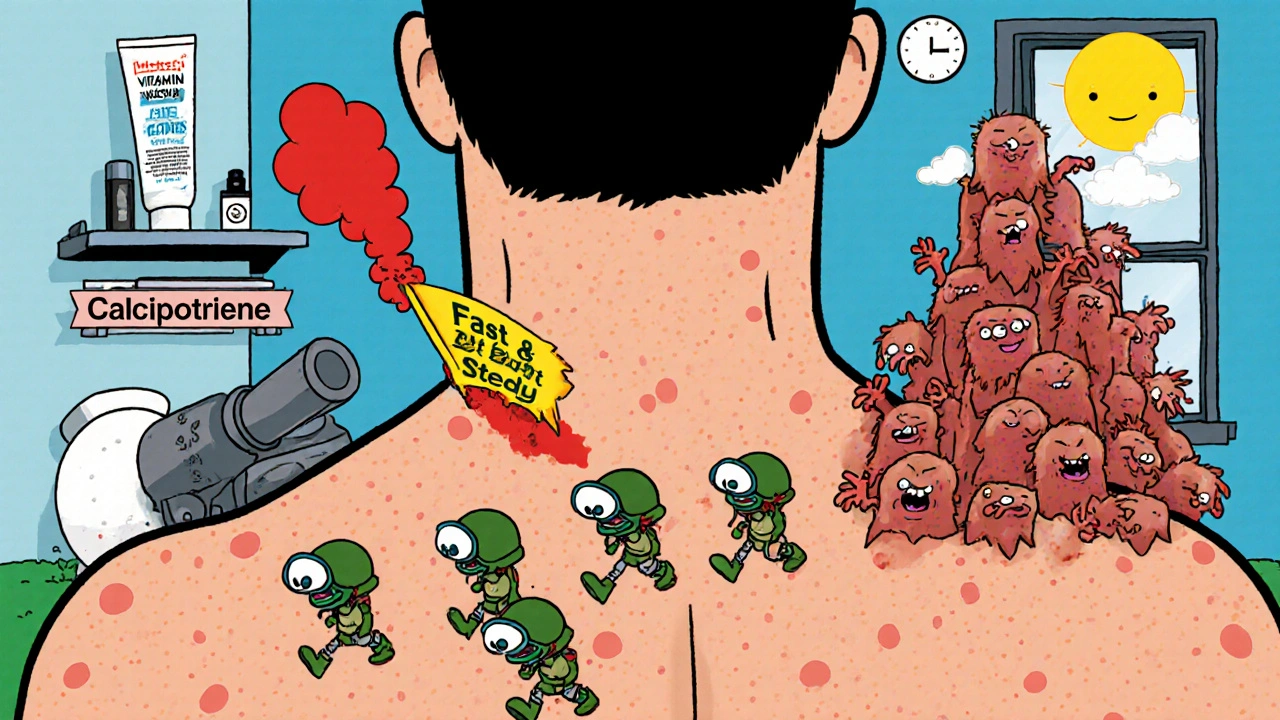
Things you should never do
- Don’t use it with UV light unless your doctor says so. Calcipotriene can make your skin more sensitive to sunlight.
- Don’t apply it to broken skin or open wounds.
- Don’t cover treated areas with tight bandages unless directed.
- Don’t use it if you’re allergic to any of its ingredients-check the label.
- Don’t use it during pregnancy without talking to your doctor. While topical use is generally low risk, no drug is 100% safe in pregnancy.
Where it fits in today’s treatment landscape
In 2025, calcipotriene is still a first-line treatment for mild to moderate plaque psoriasis. It’s in guidelines from the American Academy of Dermatology and the Canadian Dermatology Association. It’s not flashy. It doesn’t have a viral TikTok campaign. But it’s reliable, affordable, and backed by decades of real-world use.
Many patients use it as a maintenance tool after biologics or phototherapy bring their psoriasis under control. It’s the long-term keeper. The one you keep on your bathroom shelf for when things flare up again.
Final thought: It’s not magic. It’s medicine.
Calcipotriene works because it speaks the language of your skin. It’s not fighting your body-it’s helping it remember how to heal. If you’ve been told your psoriasis is "just stress" or "all in your head," this is proof it’s not. It’s a biological imbalance. And calcipotriene? It’s one of the best tools we have to fix it.
Is calcipotriene the same as vitamin D?
No, but it’s very close. Calcipotriene is a synthetic version of calcitriol, the active form of vitamin D. It’s designed to act on skin cells without raising calcium levels in your blood like oral vitamin D can. Think of it as vitamin D’s skin-specific cousin.
Can I take vitamin D pills instead of using calcipotriene?
Not for psoriasis. Oral vitamin D supplements help your bones and immune system, but they don’t deliver enough of the active form directly to your skin to affect psoriasis plaques. Calcipotriene is formulated to stay on the skin and target the problem at the source.
How long can I use calcipotriene safely?
Long-term use is generally safe if you follow the dosage. Most people use it daily for 4-8 weeks to clear plaques, then switch to maintenance (a few times a week). Using more than 100 grams per week or applying it to large areas for months may increase the risk of high calcium levels, so stick to your doctor’s instructions.
Can calcipotriene cause skin thinning like steroids?
No. Unlike corticosteroids, calcipotriene doesn’t break down collagen in the skin. That’s why it’s often used as a steroid-sparing treatment-especially for sensitive areas like the face, groin, or underarms where long-term steroid use can cause damage.
Why does my skin sting when I apply calcipotriene?
It’s common. Calcipotriene can irritate inflamed skin at first. The stinging usually fades after a few days as your skin adjusts. If it gets worse or turns into a rash, stop using it and contact your doctor. You might need a different formulation or a moisturizer applied first.
Saumyata Tiwari
Let’s be real-this is just pharmaceutical marketing dressed up as science. Vitamin D analogs? Please. The real reason psoriasis improves is because people stop eating gluten and start sleeping 8 hours. But no, let’s sell a $120 tube of cream and call it ‘biology.’ I’ve seen more legitimate science in a Bollywood soap opera.
And don’t get me started on ‘clinical trials.’ Who funded those? Big Pharma’s cousin’s intern? The 60% improvement stat? That’s with placebo creams that probably had more active ingredients than this junk.
India’s been using neem oil and turmeric paste for centuries. No prescription. No stinging. No ‘calcipotriene’ nonsense. But hey, if you wanna pay for a chemical that ‘speaks the language of your skin,’ go ahead. I’ll be over here with my grandmother’s remedies, thank you very much.
Anthony Tong
There is a fundamental error in the assertion that calcipotriene is ‘a man-made version of vitamin D.’ This is scientifically inaccurate. Calcipotriene is a synthetic analog of calcitriol (1,25-dihydroxyvitamin D3), not vitamin D3 (cholecalciferol). The distinction is not semantic-it is pharmacological, metabolic, and regulatory.
Furthermore, the claim that it ‘doesn’t get absorbed into the bloodstream’ is misleading. While topical absorption is low (approximately 0.5–2%), systemic exposure does occur, particularly with extensive application. This is precisely why the FDA mandates warnings regarding hypercalcemia with >100 g/week usage.
Additionally, the comparison to coal tar is misleading. Coal tar is a Schedule 1 carcinogen under IARC guidelines, whereas calcipotriene is not. The non-staining, odorless nature is a convenience, not a therapeutic advantage. This article reads like a press release, not a clinical review.
Roy Scorer
Look. I’ve been there. The plaques. The itching. The shame of wearing long sleeves in July. And I tried everything. Steroids made my skin paper-thin. Light therapy felt like being roasted alive. And then I tried this calcipotriene thing.
It didn’t fix me. But it didn’t try to. It didn’t scream ‘cure’ like the influencers on Instagram. It whispered. Slowly. Patiently. Like a monk teaching you to breathe again.
It’s not magic. It’s not even science, really. It’s mercy. Your skin forgot how to die. And this little molecule? It reminded it. Not with force. Not with fire. With a quiet ‘it’s okay to let go.’
I don’t care if it’s synthetic. I don’t care if it’s expensive. I care that my daughter stopped asking why my elbows looked like dragon scales. That’s not medicine. That’s grace.
And if you’re still skeptical? Then you’ve never been the person who wakes up and doesn’t have to cover up.
Marcia Facundo
I’ve been using this for six months now and honestly? I don’t know why everyone’s so dramatic. It stings at first, yeah, but so does everything when your skin is broken. I just put on a thick moisturizer 10 minutes before, and now it’s fine.
My plaques are 80% gone. I wore shorts last week for the first time in five years. I cried. Not because of the cream. Because I finally felt normal again.
Also, I’m not even going to lie-I use it on my scalp too. Doctor said it’s fine if I don’t get it in my eyes. So I don’t. And it works.
Stop overthinking it. Just use it. And if it burns? You’re probably applying it on raw skin. Wait a day. Try again.
Ajay Kumar
Everyone’s talking about calcipotriene like it’s some revolutionary breakthrough, but have you ever stopped to ask why the body even produces vitamin D in the first place? Evolution didn’t design skin cells to be regulated by sunlight because someone in a lab decided it was a good idea-it’s because our ancestors lived under open skies, and their skin evolved to respond to the sun’s rhythm, not to synthetic molecules pumped out of a German pharmaceutical factory. The real problem isn’t psoriasis-it’s the disconnection from nature. We’ve replaced sunlight with LED lights, fresh air with air conditioning, and biological regulation with chemical interventions that come with warning labels longer than the Bible. And now we’re shocked when our immune systems go haywire? Of course they do. We’ve severed the ancient contract between our bodies and the environment. Calcipotriene isn’t healing you-it’s patching a hole in a dam you built yourself. The real solution? Go outside. Barefoot. At dawn. Let your skin breathe. Let your blood make its own calcitriol. No prescription needed. No stinging. No $120 tubes. Just sun. And silence. And the quiet hum of a body remembering how to be alive.
Mike Laska
I used this for two weeks and my skin caught FIRE. Like, literally felt like someone poured hot sauce on my elbows. I thought I was allergic. Called my dermatologist. She laughed. Said ‘welcome to calcipotriene.’
Then I kept going. Week three? The scales started peeling off like old wallpaper. Week five? My skin looked like a baby’s. I didn’t believe it.
But here’s the thing-this stuff doesn’t work if you’re lazy. You have to apply it like you’re putting on holy oil. Not just smearing. Not rushing. You gotta rub it in slow. Let it sink. And don’t wash your hands after. That’s how you know you’re serious.
Also, don’t use it on your face unless you want to look like a startled raccoon for three days. I did. Regret. Always regret.
Brittney Lopez
Hey everyone-just wanted to say I’m so glad this thread exists. I’ve been using calcipotriene for a year now, and I was terrified to talk about it because I thought people would think I was ‘just taking pills’ or ‘not trying natural remedies.’ But reading this? It’s like someone finally got it.
My mom used to say ‘your skin’s just dry.’ But it wasn’t. It was a storm inside. And this cream? It didn’t silence the storm-it gave me a map to live with it.
If you’re new to this, don’t give up after two weeks. It’s not a quick fix. It’s a quiet revolution. And if it stings? That’s your skin saying ‘I remember how to heal.’ Keep going. You’ve got this.
Jens Petersen
Oh, so now we’re canonizing a synthetic vitamin D analog like it’s the Holy Grail of dermatology? Please. This is the pharmaceutical-industrial complex’s greatest hit since Prozac. They took a molecule that’s naturally produced by sunlight and turned it into a $120 monthly subscription service. And we’re supposed to be impressed?
Meanwhile, in the Global South, people are using turmeric, aloe, and neem-plants that have been healing skin for millennia-while we’re over here paying for a lab-bred compound that ‘speaks the language of your skin’ like some kind of cosmic therapist.
And don’t even get me started on the ‘steroid-sparing’ narrative. That’s just code for ‘we’re replacing one toxin with another, but this one doesn’t make your skin transparent.’
It’s not medicine. It’s marketing with a PhD. And the fact that you’re all treating this like a spiritual awakening? That’s the real tragedy.