Have you ever looked at your prescription bottle and wondered if the cheaper generic version is actually just as good as the expensive brand-name drug? It’s a question that crosses almost everyone’s mind, especially when the price difference is stark. You might be paying $15 for a generic statin while the brand name costs over $200. The logic seems sound-why pay more for the same thing? But does "same" really mean identical in how it works inside your body?
The short answer is yes, but not because the FDA simply trusts the manufacturer’s word. The U.S. Food and Drug Administration (FDA) uses a rigorous, science-based system to ensure that every generic drug approved for sale performs exactly like its brand-name counterpart. This isn’t guesswork; it’s a strict legal and scientific mandate established decades ago. Understanding this process can give you confidence in your medication choices and help you save money without sacrificing health outcomes.
The Legal Foundation: The Hatch-Waxman Act
To understand how generics are approved today, we have to look back at 1984. Before this year, brand-name drug companies held monopolies on their medications for years after patents expired, keeping prices high. Congress passed the Drug Price Competition and Patent Term Restoration Act, commonly known as the Hatch-Waxman Act. This legislation created a balanced pathway. It allowed generic manufacturers to enter the market sooner by using the clinical data already proven safe and effective by the brand-name company, while still protecting the innovator’s patent rights for a reasonable period.
This act established the Abbreviated New Drug Application (ANDA) process. Unlike a brand-name drug, which requires a full New Drug Application (NDA) with extensive animal and human trials, a generic applicant doesn’t need to repeat those costly studies. Instead, they must prove their product is therapeutically equivalent to the Reference Listed Drug (RLD)-the original brand-name medication. This shortcut saves billions in research costs, which translates directly into lower prices for consumers.
Bioequivalence: The Core Scientific Test
The heart of the FDA’s generic approval process is bioequivalence testing. This is where the rubber meets the road. A generic drug must contain the exact same active ingredient, in the same strength and dosage form, as the brand-name drug. But having the same ingredient isn’t enough; the drug must also get into your bloodstream at the same rate and to the same extent.
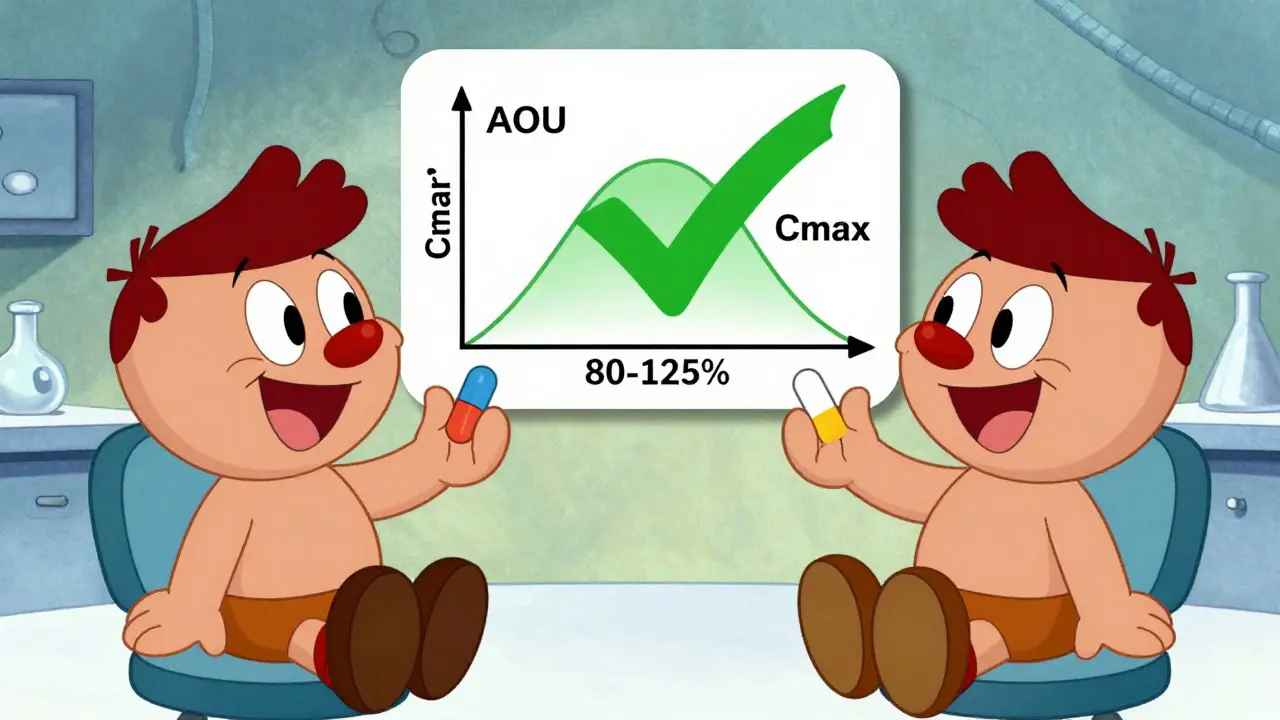
Here is how the math works. The FDA requires that the generic drug’s absorption profile falls within a specific statistical range compared to the brand name. Specifically, the 90% confidence interval for two key metrics must fall between 80% and 125%:
- AUC (Area Under the Curve): This measures the total amount of drug that enters your bloodstream over time.
- Cmax (Maximum Concentration): This measures the peak level of the drug in your blood.
If these numbers fall outside the 80-125% window, the generic fails. This ensures that whether you take the brand or the generic, your body receives the same therapeutic effect. These studies typically involve 24 to 36 healthy volunteers who switch between taking the brand and the generic under controlled conditions. The data generated is massive-often thousands of pages of raw statistics-which the FDA’s Office of Generic Drugs (OGD) reviews meticulously.
| Requirement | Brand-Name Drug | Generic Drug |
|---|---|---|
| Active Ingredient | Must be identified | Must be identical |
| Dosage Form & Route | Defined by NDA | Must match RLD exactly |
| Clinical Trials | Full Phase I-III trials required | Not required (relies on RND data) |
| Bioequivalence | Established during NDA | Must demonstrate 80-125% equivalence |
| Manufacturing Standards | cGMP compliance | cGMP compliance (same standards) |
Quality Control: Manufacturing and Ingredients
You might wonder about the other stuff in the pill-the fillers, binders, and coatings. These are called inactive ingredients. While the active ingredient must be identical, the FDA allows differences in inactive ingredients. However, these excipients must be present in safe quantities and cannot interfere with the drug’s performance. The FDA maintains an Inactive Ingredient Database with concentration limits for over 500 excipients to ensure safety.
But what about quality? Does a generic factory cut corners? Not legally. Generic manufacturers must comply with Current Good Manufacturing Practices (cGMP), codified in federal regulations. These facilities undergo annual inspections by the FDA. They must prove batch-to-batch consistency, ensuring that every single pill meets strict uniformity standards (typically 85-115% of the label claim). If a facility fails inspection, the FDA can issue warning letters or even shut down production. The stakes are high, and the oversight is constant.
The Approval Timeline and Process
Getting a generic approved isn’t instant. The process involves several distinct phases. First, there is a 60-day filing review to check if the application is complete. Surprisingly, about 35% of initial submissions receive a "Refuse-to-File" letter due to major deficiencies. If it passes, it moves to substantive review, which covers chemistry, manufacturing, biopharmaceutics, and labeling.
Thanks to the Generic Drug User Fee Amendments (GDUFA), the FDA has set strict performance goals. The target for reviewing standard applications is now 10 months. In recent years, the FDA has consistently met or exceeded these targets, approving hundreds of new generics annually. For example, in fiscal year 2022, the agency approved 777 ANDAs. This efficiency helps bring competition to market faster, driving down prices for patients.
Narrow Therapeutic Index Drugs: A Special Case
While most generics are straightforward, some drugs are trickier. These are called Narrow Therapeutic Index (NTI) drugs. Examples include levothyroxine (for thyroid conditions) and warfarin (a blood thinner). With NTI drugs, a small change in blood concentration can lead to treatment failure or toxicity. Because of this sensitivity, the FDA applies tighter bioequivalence criteria for these products. Instead of the standard 80-125% range, the acceptance criteria for NTI drugs is often narrowed to 90-111%. This extra layer of scrutiny ensures that even for sensitive medications, the generic is as reliable as the brand.
Real-World Evidence and Patient Trust
Data supports the science. Studies analyzing millions of patient records show no statistically significant difference in clinical outcomes between brand-name and generic versions of common medications like atorvastatin and metformin. In fact, adherence rates are often higher for generics because patients can afford them. The FDA’s Adverse Event Reporting System (FAERS) also shows similar safety profiles for both types of drugs.
Despite this evidence, some patients still express concerns. Surveys indicate that a minority of patients perceive differences in effectiveness, particularly with complex products like inhalers or topical creams. The FDA addresses this through specific guidance documents for complex generics, ensuring that even difficult-to-formulate drugs meet high standards. If you have concerns about switching, talk to your pharmacist or doctor-they can provide reassurance based on your specific medical history.
Why This Matters for Your Wallet and Health
The impact of this rigorous system is huge. Generic drugs account for approximately 90% of all prescriptions filled in the United States. Yet, they represent only about 23% of total pharmaceutical spending. This disparity saves the American healthcare system roughly $313 billion annually. Without the FDA’s strict enforcement of bioequivalence and quality standards, these savings wouldn’t exist, and access to essential medicines would be far more limited.
When you pick up a generic drug, you’re getting a product that has been vetted through one of the most thorough regulatory processes in the world. It’s not a "lesser" version; it’s a scientifically validated equivalent that makes healthcare more accessible for everyone.
Are generic drugs exactly the same as brand-name drugs?
Generic drugs contain the same active ingredient, strength, dosage form, and route of administration as brand-name drugs. However, they may differ in inactive ingredients (like colors or flavors) and packaging. Crucially, they must demonstrate bioequivalence, meaning they work in the body in the same way and to the same extent as the brand-name drug.
What is bioequivalence testing?
Bioequivalence testing is a clinical study that compares how quickly and how much of the drug from a generic product enters the bloodstream versus the brand-name product. The FDA requires that the generic’s absorption profile falls within 80-125% of the brand-name drug’s profile for key metrics like AUC and Cmax.
Do generic drugs undergo the same clinical trials as brand-name drugs?
No, generic drugs do not need to repeat the full Phase I-III clinical trials required for brand-name drugs. Instead, they rely on the existing safety and efficacy data of the reference listed drug (brand-name). They must, however, conduct bioequivalence studies and prove manufacturing quality through rigorous testing.
Are there any risks associated with taking generic drugs?
For the vast majority of drugs, there are no additional risks. However, for Narrow Therapeutic Index (NTI) drugs, where small changes in dose matter significantly, the FDA applies stricter bioequivalence standards. Patients with specific sensitivities to inactive ingredients should consult their pharmacist, but clinically, FDA-approved generics are considered safe and effective alternatives.
How long does it take for the FDA to approve a generic drug?
Under the Generic Drug User Fee Amendments (GDUFA), the FDA aims to review standard generic drug applications within 10 months. Priority reviews may be faster. The actual timeline can vary depending on the complexity of the drug and whether additional information is requested during the review process.