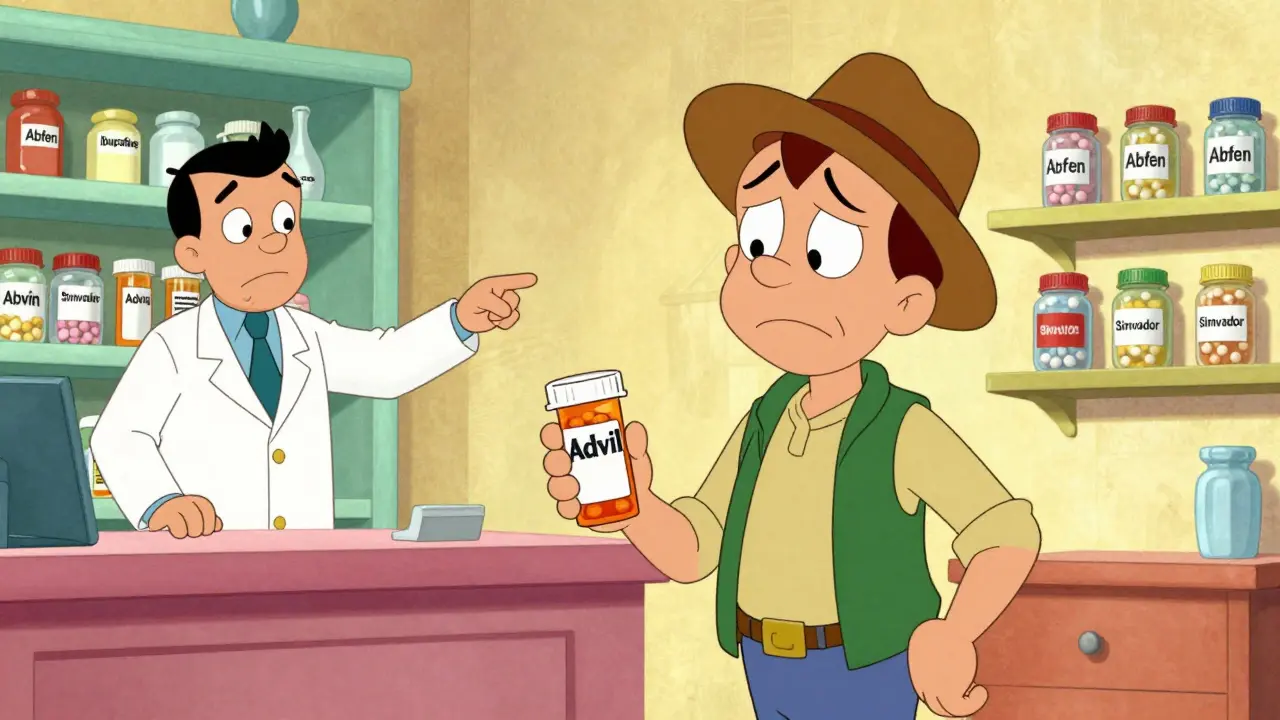
When you're traveling abroad and need to refill a prescription, it's not just about finding a pharmacy. It's about making sure the person behind the counter understands exactly what you need - down to the milligram. A simple mix-up in medication names or dosage can lead to serious harm. In France, your Advil might be labeled Ibuprofène. In Poland, it could be Abfen. In the UK, Ambyen treats heart rhythm issues - but if you confuse it with the U.S. sleep aid Ambien, you could end up in the ER. These aren't hypothetical risks. They happen every day.
Why Medication Names Vary So Much
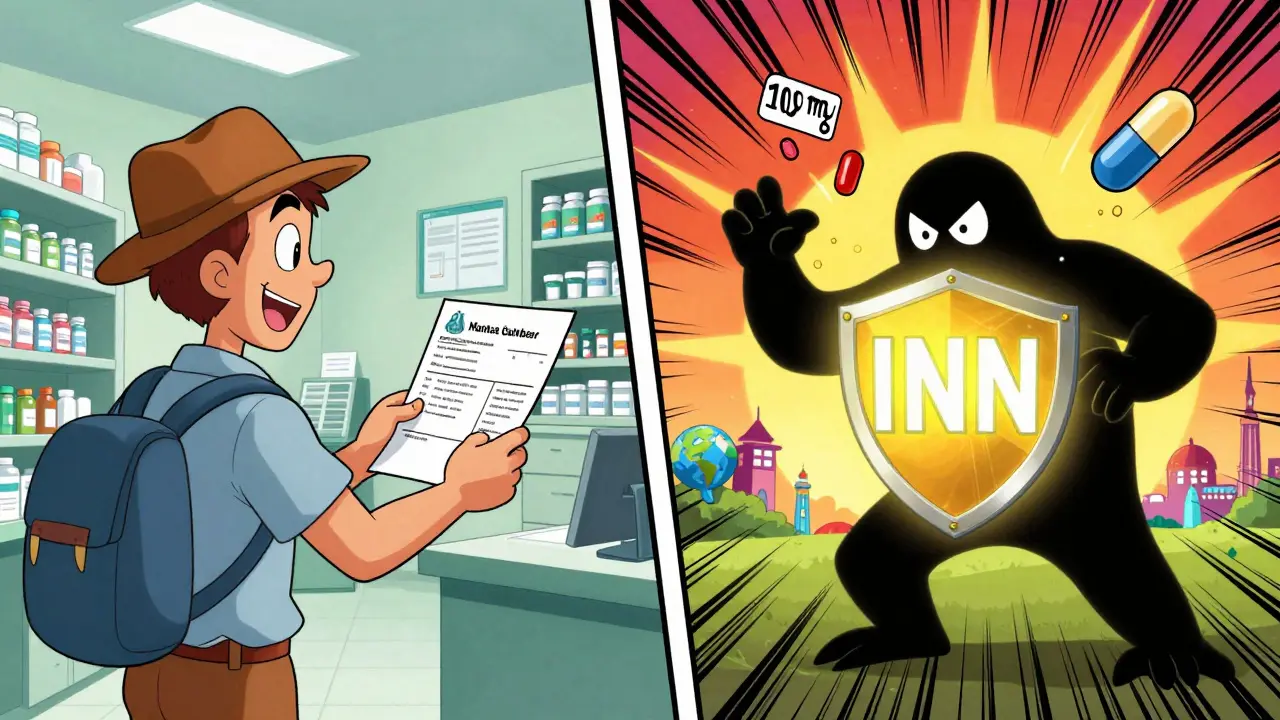
Different countries use different brand names for the same active ingredient. That’s because drug companies register trademarks locally. Your pill might be called Simvastatin in Canada, but Zocor in the U.S. and Simvador in Germany. The active ingredient is the same, but the label isn’t. Pharmacists abroad don’t know your U.S. brand name. They need the generic name - the chemical that actually does the work. The World Health Organization created the International Nonproprietary Name (INN) system to fix this. INNs are standardized global names for active ingredients. For example:- Acetaminophen (U.S.) = Paracetamol (Europe, Australia)
- Loratadine (U.S.) = Claritin (brand), but also sold as Clarityn in some countries
- Metformin (U.S.) = Glucophage (brand), but the INN is always Metformin
Dosage Formats Can Trick You
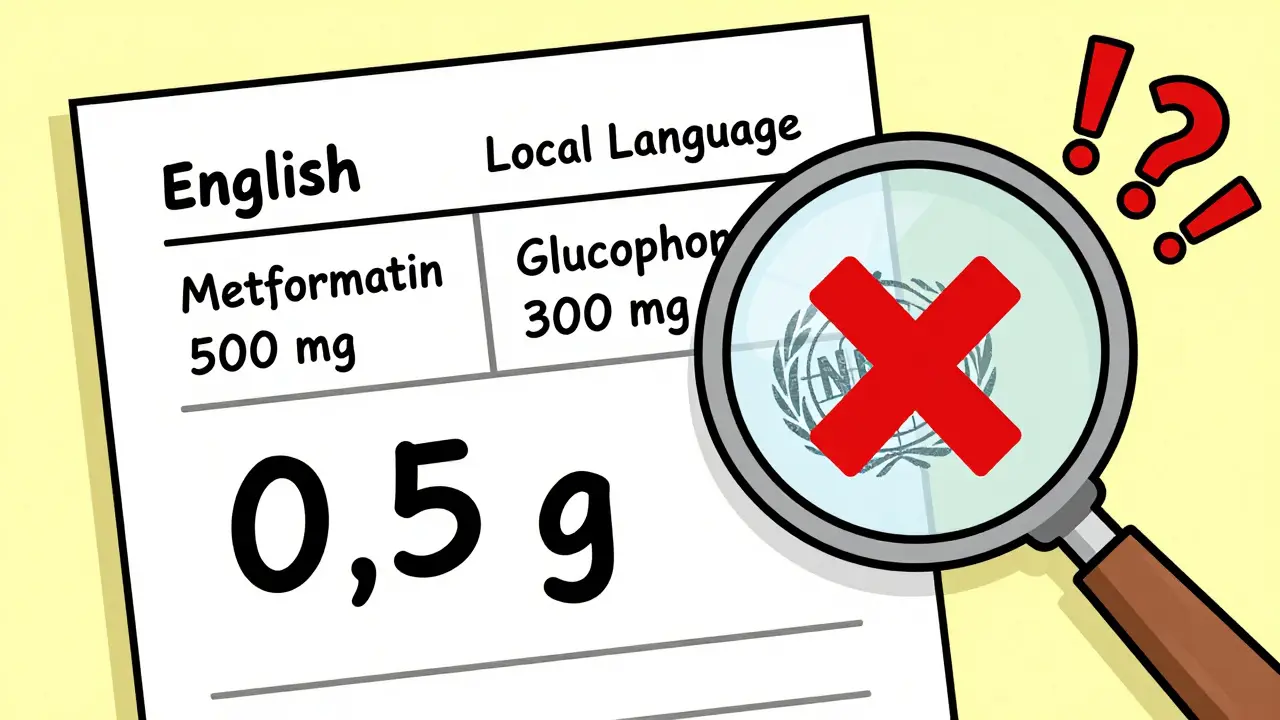
Dosage isn’t just about numbers. It’s about how they’re written. In the U.S., you’ll see “500 mg” or “1 g.” In many European countries, they use commas instead of periods for decimals. So “0,5 g” means 500 mg - not half a gram as a non-native speaker might misread it as 5 grams. That’s a tenfold overdose risk. Some countries write doses as “1 tablet 3x daily.” Others use “TID” or “3x/d.” In Mexico, you might see “cada 8 horas.” In Japan, it’s “8時間ごと.” If you don’t know what these mean, you could take too much or too little. Even pill size can be misleading. A “1g tablet” in Spain means 1000 milligrams. But if someone misreads it as “1 gram” without understanding metric units, they might think it’s a different strength. One Reddit user shared how a Spanish prescription for “1g” was almost misinterpreted as 1 gram instead of 1000mg - a mistake that could have caused an overdose.What You Need to Bring
Don’t rely on memory. Don’t trust your phone’s translation app alone. Here’s what to carry:- Your original prescription bottle - with the pharmacy label still on
- A written list of your medications: generic name, dose, frequency, purpose (e.g., “Metformin 500 mg, once daily, for type 2 diabetes”)
- A translated version of that list in the local language - not just Google Translate
- Your passport or ID - pharmacies often require proof of identity to fill foreign prescriptions
- A letter from your doctor explaining why you need the medication - especially for controlled substances
Translation Tools: Use Them Wisely
Google Translate and DeepL are handy - but dangerous for meds. They don’t understand medical context. They can’t distinguish between “10 mg” and “100 mg.” They might translate “take with food” as “take during dinner,” which changes how the drug works. Professional services like RxTran and Stepes use medical databases built over years. They know that “hydrochlorothiazide” in English is “hidroclorotiazida” in Spanish and “hydrochlorothiazid” in German. They know how to format dosing instructions for local regulations. These tools integrate directly with pharmacy systems and are used by hospitals and chain pharmacies worldwide. For travelers, apps like Drugs.com have international equivalents. Type in your U.S. drug name, and it shows you what it’s called in 50+ countries. That’s a lifesaver when you’re in Paris and your Advil is gone.What Pharmacies Are Required to Do
In the U.S., New York State’s SafeRx law requires pharmacies to provide translated labels in Chinese, Italian, Russian, and Spanish if those are the top languages spoken in the area. Other states are following. In Canada, Ontario requires translation services for patients with limited English proficiency under the Human Rights Code. In Dubai, hospitals serve patients from 47 countries. In Australia, pharmacies routinely translate scripts for Vietnamese, Arabic, and Mandarin speakers. These aren’t optional services anymore. They’re part of standard care. But here’s the catch: not every small pharmacy abroad has the resources. If you’re in a rural town in Italy or a small clinic in Vietnam, they might not have a translator on staff. That’s why you need to come prepared.When Translation Isn’t Enough
Some medications aren’t available overseas. Others have different dosing forms. Your 10 mg extended-release tablet might only come as a 5 mg immediate-release capsule abroad. Or your insulin pen might not be sold there at all. In these cases, you need to talk to a pharmacist - not just get a label translated. Ask:- Is there an equivalent medication?
- What’s the active ingredient?
- How does the dosage compare?
- Are there any local restrictions or warnings?
Real-Life Mistakes That Could Have Been Deadly
In 2022, a traveler in Spain was given a medication labeled “Lorazepam 1 mg” - but the pharmacist thought the prescription said “Lorazepam 10 mg.” The patient ended up sedated and confused. Why? The handwritten “1” looked like a “10” in the original script. The pharmacist didn’t cross-check with the generic name. Another case: a Canadian tourist in Thailand was prescribed “Omeprazole 20 mg.” The Thai pharmacy gave her “Omeprazole 40 mg,” thinking the U.S. prescription was for double the dose. She had severe stomach cramps for days. The bottle had no INN listed. These aren’t rare. They’re predictable. And they’re preventable.How to Avoid Being the Next Story
Here’s your simple checklist before you leave:- Get your doctor to write down your medications: generic name, dose, frequency, reason.
- Look up each drug on Drugs.com/international to find its name in your destination country.
- Print a two-column list: English on the left, local name on the right.
- Use a professional translation service - even a one-time paid translation from RxTran or Stepes costs less than an ER visit.
- Carry at least a 30-day supply of your meds - just in case.
- Never rely on a pharmacy’s verbal translation alone. Always ask for written confirmation.
Final Word: Safety Over Convenience
Medication translation isn’t about being fancy. It’s about survival. The $528 billion spent yearly on medication non-adherence? A big chunk of that comes from people not understanding what they’re taking. That’s not just a statistic. It’s your neighbor. Your parent. You. When you’re far from home, your meds are your lifeline. Don’t leave them to chance. Know your drug’s real name. Know your dose. Know how to ask for it. And if you’re unsure - wait. Ask again. Get it in writing.Can I use Google Translate to understand my foreign prescription?
No. Google Translate doesn’t understand medical context. It can misread “0,5 g” as 5 grams instead of 500 mg, or confuse “Ibuprofène” with a completely different drug. Automated tools lack the specialized databases needed to interpret dosage formats, brand-to-generic equivalents, and country-specific regulations. Always verify with a certified medical translator or pharmacist.
What’s the difference between a brand name and a generic name for a drug?
The brand name is what the drug company calls it for marketing - like Advil or Ambien. The generic name is the active ingredient - like ibuprofen or zolpidem. Generic names are standardized globally through the WHO’s INN system. Pharmacies abroad only recognize the generic name. Always bring both, but rely on the generic name to get the right medication.
Do all countries accept foreign prescriptions?
No. Many countries don’t allow foreign prescriptions to be filled unless they’re verified by a local doctor. Some require a new local prescription. Others only allow a 30-day supply. Always check the rules of your destination country before you travel. Carry a letter from your doctor explaining your condition and medication needs.
How do I find out what my medication is called in another country?
Use Drugs.com/international. Type in your U.S. drug name - brand or generic - and it shows you the equivalent names in over 50 countries. You can also search the WHO’s International Nonproprietary Names database. Write down the generic name and the local name before you travel. Don’t wait until you’re at the pharmacy.
Why do some countries use commas instead of periods for decimal points in dosages?
In many European and Latin American countries, commas are used as decimal separators. So “0,5 g” means 0.5 grams, or 500 mg. In the U.S., we use periods: “0.5 g.” If you misread a comma as a period, you could think “1,5 g” is 1500 mg when it’s actually 1.5 g - a massive overdose. Always double-check dosage formats with a pharmacist.
Adam Rivera
Just got back from a trip to Portugal and this hit home. I had to get my blood pressure med refilled and the pharmacist stared at my bottle like it was hieroglyphics. Turned out my 'Lisinopril' was called 'Lisinopril' there too-lucky break! But I saw someone else trying to get 'Zoloft' and they were handed 'Sertralina' with zero context. Bring the generic name. Always.
lucy cooke
Oh darling, this is just the most *exquisite* example of modern medical colonialism. We Americans assume our brand names are universal, like Shakespearean sonnets or the sanctity of the dollar. But no-pharmacies in Bangkok, Bucharest, or Buenos Aires are linguistic minefields where your life hinges on whether someone can parse a comma as a decimal. It’s not just about translation-it’s about epistemic humility. I weep for the poor soul who thought '0,5g' meant five grams. That’s not a mistake. That’s a tragedy dressed in pharmacy scrubs.
Trevor Whipple
bro i once took a 10mg tablet thinking it was 1mg because the label said '10 mg' but i misread it as '1 0mg' like a total idiot. never again. always write it down. and stop trusting google translate for meds. that app once told me 'aspirin' was 'a spire' in french. i almost cried.
John Tran
Okay so i was in Berlin last year and tried to get my antidepressant and the pharmacist said 'oh you mean Sertralin?' and i was like 'yes!' and then he handed me a bottle with no dosage info. i had to show him my original bottle and he looked at me like i was from mars. point is: dont just know the name, know the number. and print it out. in big letters. with a highlighter. i swear to god if i hadnt done that i would be dead right now.
Rosalee Vanness
As someone who’s had to navigate this while caring for my mom with diabetes during our trip to Japan, let me tell you-this isn’t just helpful, it’s sacred. We printed out a two-column cheat sheet: English on the left, Japanese on the right, with the INN in bold. We had a pharmacist in Kyoto tear up because no one had ever come prepared like that before. It’s not about being ‘extra.’ It’s about being alive. I wish every traveler carried this list like a passport. Your meds aren’t a suggestion-they’re your heartbeat abroad.
Alan Lin
There is a systemic failure here. The burden of cross-border pharmaceutical literacy is placed entirely on the patient, while healthcare systems in high-income nations refuse to invest in standardized, multilingual prescription infrastructure. This is not an individual responsibility-it is a public health crisis. We have the technology, the databases, the trained personnel. Yet we expect travelers to carry laminated cards like medieval pilgrims with relics. This is unacceptable. The American Pharmacists Association’s data is not an anomaly-it is a indictment.
Adam Vella
It is imperative to recognize that the International Nonproprietary Name (INN) framework, while laudable, remains underutilized by both patients and clinicians. The WHO’s database is publicly accessible and meticulously maintained. Yet, the average traveler is unaware of its existence. Educational campaigns, integrated into pre-travel medical consultations, are not merely advisable-they are ethically obligatory. To neglect this is to perpetuate preventable iatrogenic harm on a global scale.
James Castner
Let me be blunt: this post should be mandatory reading for every medical student, every pharmacist, every airline attendant, every embassy worker, and every damn person who thinks they can wing it with a phone app overseas. I’ve seen people die because they trusted a Google Translate result that turned '0,25 mg' into '25 mg'-twenty-five times the dose. That’s not a typo. That’s a murder weapon disguised as a convenience. We have the tools: Drugs.com, RxTran, WHO INN, printed lists, doctor letters. We have the knowledge. What we lack is the collective will to act before the next person ends up in an ICU because someone thought 'Ibuprofène' was a type of cheese. This isn’t about travel tips. It’s about survival. And if you’re not preparing like your life depends on it-you’re already one mistake away from becoming a statistic.
Anny Kaettano
I work in a clinic that serves refugees and immigrants, and I see this every day. A woman from Syria brought her insulin prescription written in Arabic. The pharmacy gave her the wrong type because they assumed 'insulin' was just 'insulin.' No dosage. No timing. No context. We had to call her doctor in Damascus via WhatsApp to verify. This isn’t a 'traveler problem.' It’s a human problem. We need medical interpreters trained in pharmacology-not just language. And we need pharmacies to treat translation like a vital sign. Not an afterthought.
mike swinchoski
you people are making this way too complicated. just bring your pills. dont take chances. if you run out, dont go to the pharmacy. go to the embassy. they’ll help. if you dont have your pills, you deserve what happens. its your fault. stop being lazy.
John Pope
There’s a deeper metaphysical layer here, isn’t there? The pill-this tiny, inert disc of chemistry-is the last vestige of our personal sovereignty in a globalized world. We carry it like a talisman across borders, hoping the language of the body-the INN, the milligram, the frequency-will be understood by strangers who speak different tongues. But what if the body’s language is already corrupted? What if the very systems designed to heal us-pharmacies, regulations, translations-are themselves fractured by nationalism, profit, and bureaucratic inertia? We don’t just need translations. We need a new covenant between patient and planet. And until then? I’ll keep my laminated card. And my prayers.
Robin Williams
just learned that 'paracetamol' is 'acetaminophen' and now i feel like i've been lied to my whole life. also, why does the world hate periods? why is everything a comma? i'm never traveling again. also, if you're gonna write '1g' don't make it look like '10g'-i saw a guy almost die from that. just say '500mg' and be done with it. save lives. not confusion.