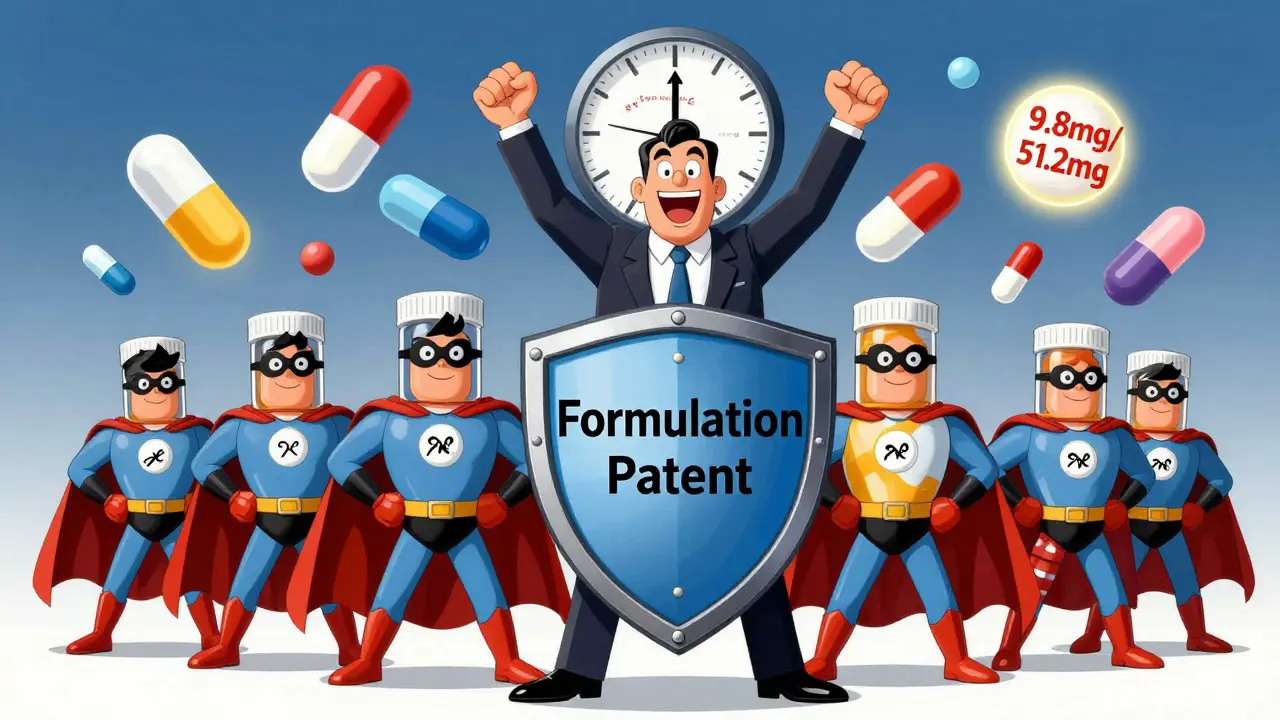
When a blockbuster drug’s core patent expires, generics can legally enter the market. But in many cases, they don’t - not because the drug is still protected by its original patent, but because the brand company has built a formulation patent fence around it. These aren’t just minor tweaks. They’re carefully engineered legal tools that delay competition, keep prices high, and extend profits for years after the original patent runs out.
What Exactly Is a Formulation Patent on a Drug Combination?
A formulation patent doesn’t protect the individual drugs themselves. Instead, it protects how those drugs are combined - the exact amounts, the way they’re delivered, or even when they’re taken. For example, if two drugs are usually taken as separate pills, a company might patent a single pill that contains Drug A at 10mg and Drug B at 50mg, with a special coating that releases them at different times. That’s a formulation patent. These patents are different from composition-of-matter patents, which cover the actual chemical structure of a drug. Once that original patent expires, generics can copy the active ingredients. But formulation patents block them from copying the specific combo - even if the ingredients are the same. The FDA tracks these in its Orange Book, where you’ll find three types: combination patents (multiple active ingredients), formulation patents (delivery systems), and method-of-use patents (how the drug is prescribed). The last two make up 63% of all secondary patents filed between 2018 and 2022.Why Do Companies Use Them?
Developing a new drug costs, on average, $2.6 billion and takes 10 to 15 years. When the original patent expires, revenue can drop by 80% within a year as generics flood the market. Formulation patents are a way to slow that drop. By securing a new patent on a slightly different version - say, a once-daily tablet instead of two pills a day - companies can keep their product as the only option for a few more years. Take Roche’s Phesgo®. It combines trastuzumab and pertuzumab into a single subcutaneous injection, replacing the older IV infusions. Even though the core patents on both drugs had expired, Phesgo’s delivery method was patented. Patients and doctors switched to the new version because it was faster and less invasive. Generics couldn’t copy it without infringing the formulation patent. The result? Market exclusivity extended by over 5 years. The FDA says 78% of new drug applications between 2015 and 2020 included at least one formulation or combination patent designed to extend exclusivity. For top-selling drugs, this can mean 3 to 16 extra years of protection - far beyond the original 12 to 14 years.How Do You Get One? It’s Not Easy
The patent office doesn’t just rubber-stamp these. Under U.S. law (35 U.S.C. § 103), combining two known drugs for a known purpose is considered “obvious” - and obvious things can’t be patented. To get approval, companies must prove their combination produces something unexpected. That means showing statistically significant improvements - not just “it works.” You need data proving the combo is safer, more effective, or more convenient in a way that wasn’t predictable. For example, a patent might claim a 9.8mg/51.2mg ratio that reduces side effects by 40% compared to the standard 10mg/50mg. That tiny difference matters. Patent attorneys have seen claims rejected for 10mg/50mg, then approved for 9.8mg/51.2mg - because the precision suggests intentional design, not guesswork. The FDA also requires “new clinical investigation” data to qualify for 3-year exclusivity under the Hatch-Waxman Act. That means running new trials - not just reusing old ones. Companies spend $15 to $25 million on these studies. And even then, rejection rates are high: 62% for first-time filers, compared to 31% for experienced players like Pfizer or Novartis.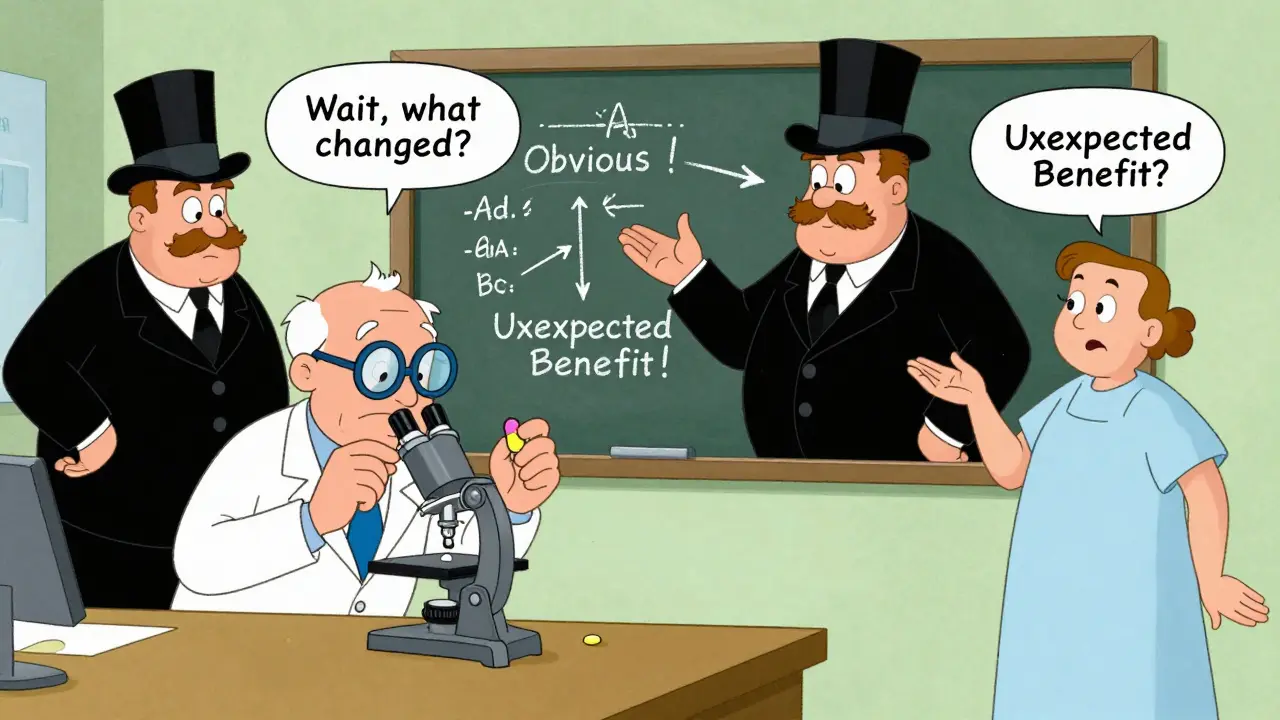
The Dark Side: Evergreening and Product Hopping
Critics call this strategy “evergreening” - extending monopoly power through minor changes that don’t benefit patients. The FTC says it drives up U.S. drug prices by 17% to 23% beyond what innovation justifies. In some cases, companies discontinue the original version to force patients onto the patented one. This is called “product hopping.” One example is oxaliplatin. When the original IV formulation’s patent neared expiry, the maker released a new version with a different packaging system and stopped supplying the old one. Pharmacies had no choice but to switch. The FTC investigated this tactic, and courts are now more likely to see it as anti-competitive. Even worse are patents on trivial changes - like switching from one salt form to another or swapping a harmless excipient. The FDA’s Orange Book shows 31% of combination patents between 2015 and 2022 covered these kinds of tweaks with no real clinical benefit. Harvard’s Dr. Aaron Kesselheim called this “patent privateering” - exploiting the system without improving care.Generics Fight Back - And Win Sometimes
Generic manufacturers aren’t sitting idle. They file Paragraph IV certifications, challenging formulation patents in court. In 2023, there were 842 such challenges - up from 517 in 2020. Success rates have climbed to 45%, especially after the 2007 KSR v. Teleflex Supreme Court decision, which made it harder to patent obvious combinations. In 2021, Mylan won a case against Celgene over Revlimid®. The formulation patent covered a specific dosing schedule for multiple myeloma. Mylan got approval to sell a generic version - but only for a different indication: mantle cell lymphoma. The patent didn’t cover that use. So generics didn’t need to copy the exact combo - they just needed to avoid the protected use. Another failure? Amgen’s attempt to patent a subcutaneous injector for Enbrel®. The court ruled it was just “obvious automation” of a manual process. Amgen lost $147 million in legal fees.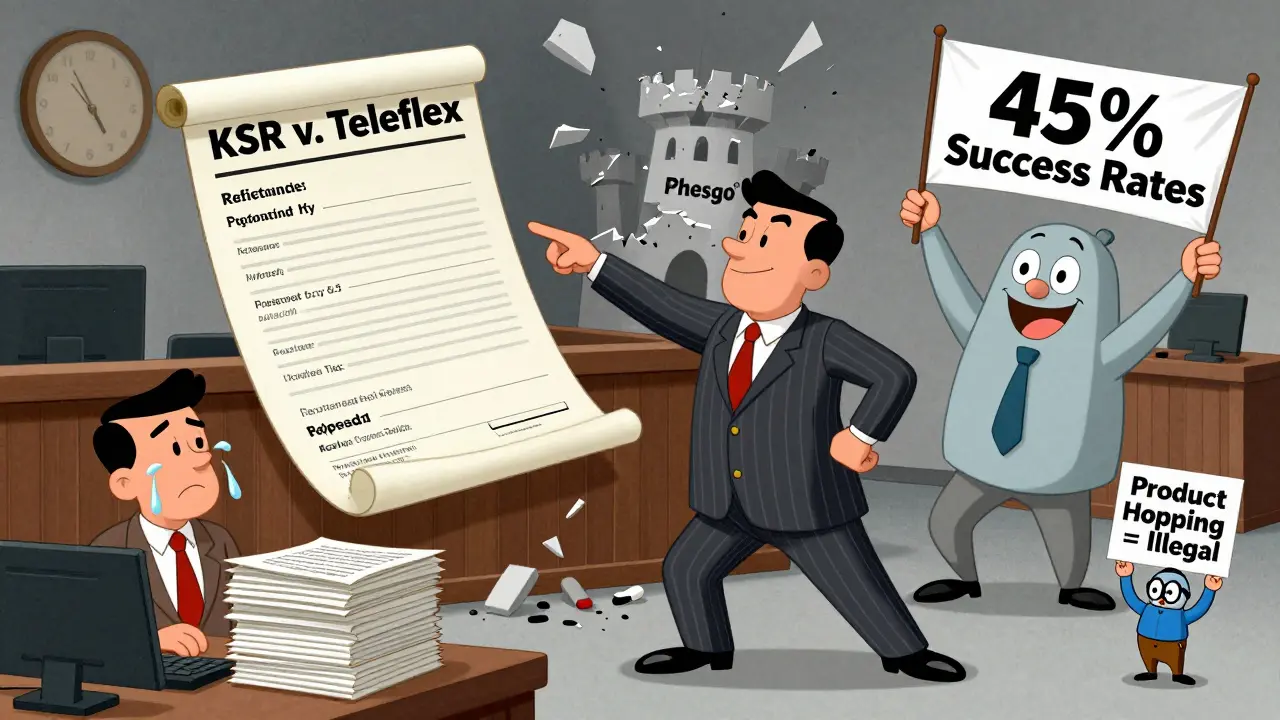
Where It Works Best - And Where It Fails
Formulation patents thrive in areas where delivery is complex: oncology, rare diseases, and biologics. For example, 58% of formulation patents are in biologics, where delivery systems (like auto-injectors or pH-sensitive coatings) create real innovation space. The approval rate for oncology combination patents is 78% - the highest of any therapeutic area. But in CNS drugs (like those for depression or Alzheimer’s), approval rates drop to 43%. Why? Because combining two brain-targeting drugs is often seen as “obvious” - doctors have been trying these combos for decades. The patent office sees little novelty. The same goes for drugs with simple dosing. If a combination doesn’t improve adherence, safety, or effectiveness, it’s unlikely to survive scrutiny. One practitioner on Reddit noted: “I’ve seen 10mg/50mg get rejected while 9.8mg/51.2mg gets granted. Precision matters.”What’s Changing? Regulatory Pressure Is Rising
The tide is turning. In May 2024, the FDA proposed requiring “clinical superiority” evidence for any new formulation seeking 3-year exclusivity. That means no more patents on “me-too” versions without proof they’re better. Congress is also considering the Preserve Access to Affordable Generics Act, which would limit secondary patents to those demonstrating “meaningful clinical benefit.” If passed, it could invalidate 28% of existing formulation patents. The USPTO is tightening too. Their 2024 report recommended narrowing obviousness exceptions for combination therapies. And the FTC has 17 active investigations into product hopping as of September 2024.The Bottom Line: A Strategy Under Siege
Formulation patents on drug combinations are powerful. They’ve protected $312 billion in annual drug sales in 2023. Top pharma companies average 14.7 of these patents per blockbuster drug. For companies like AstraZeneca, the Nexium® formulation patents generated $189 billion in revenue over a decade. But the cost is rising - in money, time, and legal risk. The average exclusivity extension from these patents has dropped from 5.3 years (2020-2023) to an expected 3.8 years (2025-2030). Generics are winning more often. Regulators are watching closer. The future belongs to companies that use formulation patents to solve real problems - not just delay competition. A pH-sensitive release system that reduces nausea in chemo patients? That’s innovation. A 0.2mg difference in tablet weight with no clinical benefit? That’s a lawsuit waiting to happen. The line between protection and exploitation is thin. And it’s getting thinner every year.Can a generic drug maker copy a combination drug if the original patent expired?
No - not if a formulation patent is still active. Even if the individual drugs are off-patent, generics can’t sell the exact same combination with the same ratios, delivery method, or dosing schedule without infringing. They must create a non-infringing version - like changing the ratio, removing a coating, or targeting a different condition. That often requires new clinical trials, which takes time and money.
How long does a formulation patent last?
A formulation patent lasts 20 years from its filing date, just like any other utility patent. But because these patents are often filed years after the original drug, the actual market exclusivity window is much shorter. Many last only 3 to 8 years after approval. The Hatch-Waxman Act allows for patent term extension (PTE) of up to 5 years, but the total exclusivity can’t exceed 14 years after FDA approval.
Do formulation patents improve patient outcomes?
Sometimes - but not always. In cases like Phesgo®, which replaced IV infusions with a quick subcutaneous shot, patients benefit from less time in clinics and fewer side effects. But many formulation patents cover changes with no clinical advantage - like switching from a tablet to a capsule, or changing a harmless filler. The FDA found 31% of these patents between 2015 and 2022 had no proven benefit. The key is whether the change improves safety, adherence, or effectiveness - not just convenience.
What’s the difference between a formulation patent and a method-of-use patent?
A formulation patent protects the physical makeup of the drug - how the ingredients are combined, coated, or delivered. A method-of-use patent protects how the drug is prescribed - for example, “using Drug A and Drug B together to treat Stage 3 breast cancer.” Generics can often get approval by targeting a different use, even if the formulation is identical. That’s why companies file both types to create overlapping protection.
Why do some formulation patents get rejected by the patent office?
Most rejections happen for two reasons: obviousness and insufficient data. If the combination of drugs or delivery method was already suggested in prior research, the patent office considers it obvious - especially after the KSR v. Teleflex ruling. Also, 37% of rejections are due to weak written description - meaning the patent didn’t clearly explain how the invention works or how to make it. Without hard data showing unexpected results (like a 40% drop in side effects), the patent won’t pass.
How do generic companies challenge these patents?
They file Paragraph IV certifications with the FDA, declaring the formulation patent invalid or not infringed. This triggers a lawsuit from the brand company. If the generic wins, they can enter the market early - sometimes with 180 days of exclusivity as the first generic. In 2023, 45% of these challenges succeeded, especially when the patent covered minor changes or lacked clinical evidence.
Babe Addict
So let me get this straight - you're telling me Big Pharma is just playing chess with patent law? 🤯 They don't even need to invent anything new. Just tweak the damn pill coating and call it 'innovation'. 9.8mg/51.2mg? That's not science, that's a spreadsheet trick. And the FDA lets this slide? I'm starting to think the Orange Book is just a bingo card for greed.
Satyakki Bhattacharjee
This is not medicine. This is theft. God gave us health. Corporations give us bills. When a man dies because he cannot afford his medicine, who is the real criminal? The sick man? Or the one who locks the door to the cure?
Kishor Raibole
The phenomenon under examination herein constitutes a systemic aberration within the regulatory architecture of pharmaceutical intellectual property. The strategic deployment of secondary patent protections, while technically lawful, evidences a profound moral dissonance vis-à-vis the fiduciary duty owed to public health. One must question the epistemological legitimacy of a system wherein trivial alterations in molar ratios are granted monopolistic privileges under the guise of innovation.
John Barron
I've read the FDA’s 2024 proposal. And I'm not just saying this - I've got the PDFs. 📄 The 'clinical superiority' requirement? It's a start. But it's still toothless. Why? Because the patent office still accepts 'statistical significance' from n=32 trials. That's not science - that's statistical magic. 🧪 And don't get me started on the 3-year exclusivity loophole. It's a backdoor to monopoly. 💸 #PharmaLobby #PatentAbuse
Liz MENDOZA
I work with patients who can't choose between their insulin and their rent. I see the real cost of these patents every day. Not in dollars - in tears. If a pill tastes better or comes in a cooler package, that doesn't save lives. But if we made access easier? That does. Let's stop pretending convenience is innovation.
Anna Weitz
Everyone acts like this is new but it's been happening since the 80s. The system was built to fail patients. The patent office doesn't care about you. The FDA doesn't care about you. The only thing that matters is the stock price. You think they're going to change because someone wrote a report? Please. They'll just hire better lawyers
Jane Lucas
i just had to pay $400 for a generic that was supposed to be cheaper but turns out its the new version with the patent so i got stuck with the old one that cost $150 but they stopped making it so now im paying more for the same thing lmao
Caitlin Foster
OH MY GOD. I JUST REALIZED - they're doing the SAME THING with ADHD meds!!! 🤯 My kid’s Ritalin got switched to a 'new improved' version that costs 3x more and does the exact same thing. And now the old one is GONE. They didn't even tell us. This isn't innovation - it's a trap. 😤💸 #ProductHoppingIsAManipulation
Robyn Hays
What if we flipped this? Instead of asking 'Can we patent this?' what if we asked 'Does this actually help someone?' I mean, if a drug combo reduces nausea by 40% - that’s revolutionary. But if it just changes the color of the pill? That’s not science. That’s marketing. And we’re paying for it. What if the system rewarded real impact instead of legal loopholes?
Liz Tanner
I know people who’ve been on the same meds for 15 years. They didn't switch because they wanted to - they switched because the old version disappeared. That’s not a choice. That’s coercion. And it’s not just about money - it’s about stability. People get used to a routine. Then they’re forced to relearn everything because a corporation decided to ‘upgrade’ the packaging.
Elizabeth Alvarez
This isn’t just about drugs. This is part of the Great Pharmaceutical Control Agenda. The FDA, USPTO, and Big Pharma are all connected through the same shadow network. The ‘clinical trials’? Fabricated. The ‘data’? Cooked. The patents? Tools to keep you dependent. They want you sick and buying forever. The ‘new’ versions? Placebos with a patent. They’re not selling medicine - they’re selling addiction. And the government? They’re in on it. Wake up.
Miriam Piro
You think this is about patents? Nah. This is about control. The same people who own the patents own the media, the hospitals, the insurance companies. They don’t want you healthy - they want you on a subscription. Every time you take a pill, you’re feeding the machine. And the 'formulation' changes? They’re designed to keep you confused. If you can’t tell the difference between the old and the new, you’ll keep paying. That’s the plan. They’re not trying to cure you - they’re trying to monetize your biology.
dean du plessis
honestly i dont get why everyone is so shocked. this is capitalism. if you can make a buck by making a pill look different, you do it. the system rewards that. its not evil - its just how the game works. but yeah, it sucks for the people who need the medicine
Kylie Robson
The 37% rejection rate due to inadequate written description? That’s the real story. Most of these patents are written by paralegals using boilerplate templates. They don't understand pharmacokinetics. They just copy-paste from prior art. The patent office is overwhelmed - they’re approving junk because they can’t audit 10,000 filings a year. This isn't innovation - it's paperwork fraud.
Todd Scott
In South Africa, we see this every day. A patient gets a generic version of a drug - great. Then the brand company releases a 'new formulation' with a different excipient - suddenly the generic is no longer bioequivalent. The patient’s insurance won't cover it. They have to pay out of pocket. Or they stop taking it. And then they end up in the hospital. The cost isn't just financial - it's human. This isn't just an American problem. It's a global one. We need transparency - not more patents.