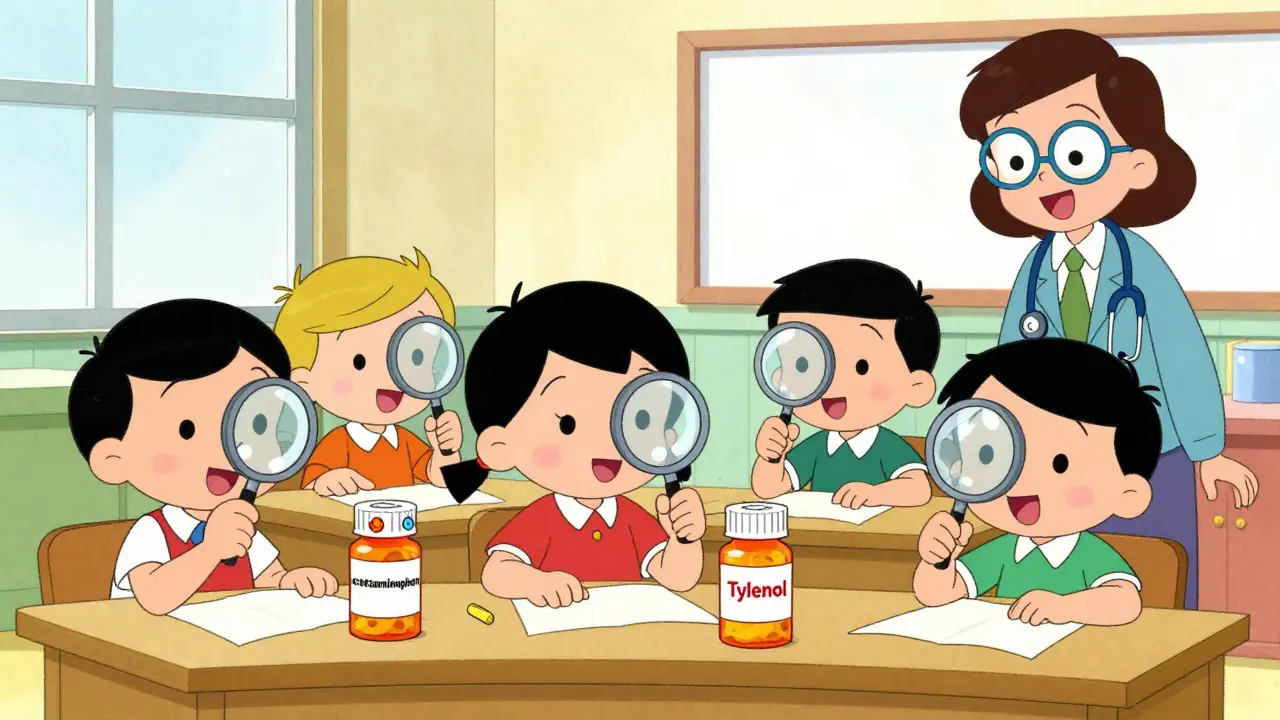
Most parents assume kids understand medicine simply because they’ve seen them take pills. But here’s the truth: children don’t naturally know the difference between a candy pill and a real drug. In Halifax, a 2023 school survey found that 1 in 5 elementary students had picked up a bottle of pills from a counter, thinking it was candy. That’s not fearmongering-it’s a real risk. And it’s why teaching kids about medicines, including generic drugs, isn’t optional. It’s essential.
What Are Generic Drugs, Really?
Generic drugs aren’t ‘fake’ or ‘cheap knockoffs.’ They’re the same medicine as the brand-name version, just without the fancy packaging or marketing. The active ingredient? Identical. The effect? The same. The only differences are the color, shape, or name on the label. For example, the generic version of ibuprofen is just as good as Advil. It works the same way, costs less, and is approved by Health Canada and the FDA.
But kids don’t see it that way. To them, if it doesn’t have a cartoon mascot or a bright logo, it’s not ‘real.’ That’s why we need to start early. A 2022 study from the Canadian Pediatric Society found that children as young as six can understand simple comparisons: ‘This is the same medicine as the one with the red cap, just in a different box.’ That’s the foundation.
Why Start With Medication Safety Before Generic Labels?
Before you explain what ‘generic’ means, kids need to know three basic rules:
- Never take medicine without an adult
- Medicines aren’t candy
- Every pill has a job
These aren’t just rules-they’re survival skills. In 2023, Canada recorded over 2,100 emergency room visits from children under 12 who accidentally swallowed pills. Many of those cases involved unsecured bottles of acetaminophen or antihistamines. Teaching kids to treat all medicine with respect-even if it’s just a vitamin-reduces those numbers.
Programs like Generation Rx, used in over 1,500 Canadian schools, start with this: a game called ‘Medicine Detective.’ Kids look at real medicine bottles (with fake pills inside) and learn to spot warning labels: ‘Keep out of reach of children,’ ‘Do not crush,’ ‘Take with food.’ They learn to ask: ‘Who is this for? Why am I taking it?’ That’s how you build awareness before you talk about cost or branding.
Introducing Generic Drugs Without Confusing Them
Once kids understand that medicine has rules, you can introduce generics. Don’t start with the word ‘generic.’ Start with a comparison.
Bring two identical-looking bottles-one with a brand name like Tylenol, one with a plain label saying ‘acetaminophen.’ Ask: ‘What’s the same? What’s different?’ Kids notice the price difference right away. Then say: ‘They both have the same medicine inside. One just costs less because the company didn’t spend money on ads or fancy colors.’
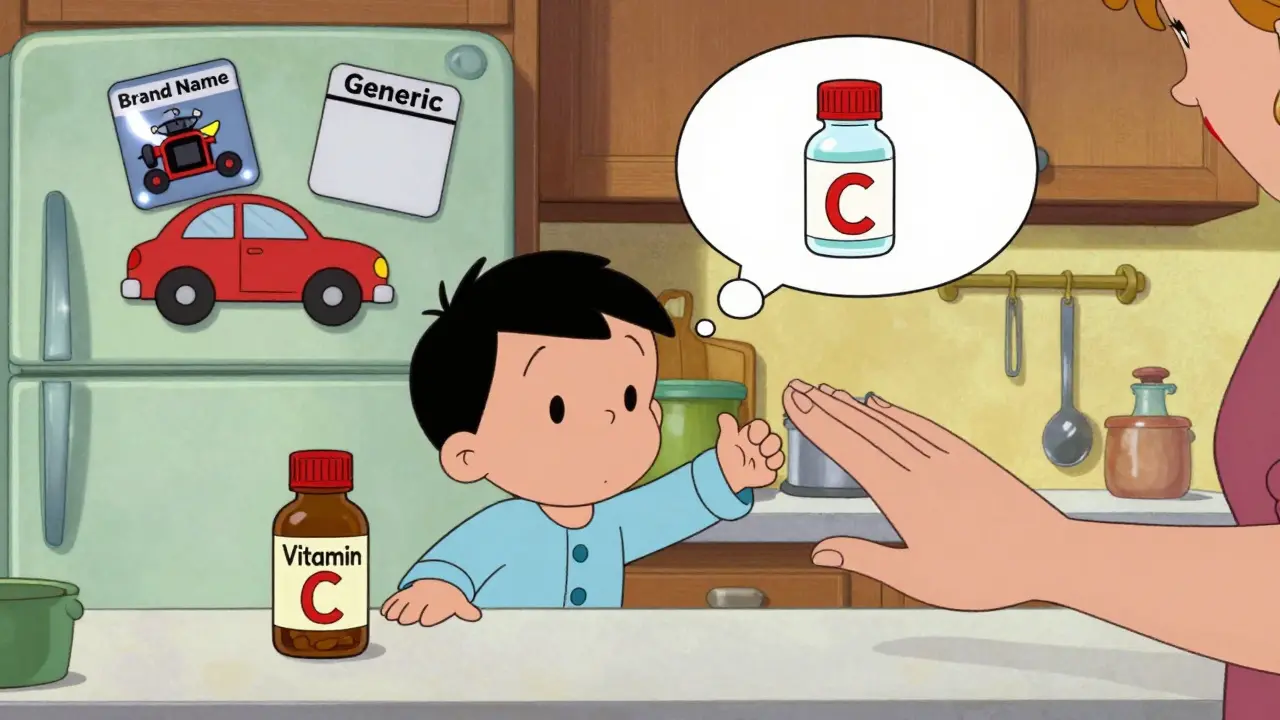
Use visuals. Draw two identical cars-one with a shiny logo, one with no logo. Same engine. Same speed. Same safety features. That’s generics. The 2021 ‘Medicine Science and Safety’ project book from Ohio State University, now used in Nova Scotia classrooms, uses this exact analogy. Teachers report 89% of students understood the concept after one 30-minute lesson.
What Not to Do
Don’t scare kids. Don’t say, ‘If you take the wrong pill, you’ll die.’ That doesn’t work. Research from the Canadian Centre on Substance Use and Addiction shows fear-based messages make kids more curious, not more cautious. In fact, one 2020 study found kids exposed to ‘drug danger’ videos were 18% more likely to try unknown pills.
Don’t say, ‘Brand names are better.’ That teaches them to equate price with quality. And it’s wrong. A 2023 Health Canada review confirmed generic drugs are just as safe and effective as brand-name ones.
Don’t skip the ‘why.’ Kids need to know why we use generics. Explain: ‘We use them so our family can save money for food, clothes, or the dentist. It’s smart, not cheap.’ That turns it into a life skill, not a chemistry lesson.
Real-Life Scenarios That Work
Here’s what actually sticks:
- Role-play a pharmacy trip. Let the child be the pharmacist. They check the label, ask, ‘Is this the right medicine?’ and explain why they’re choosing the generic.
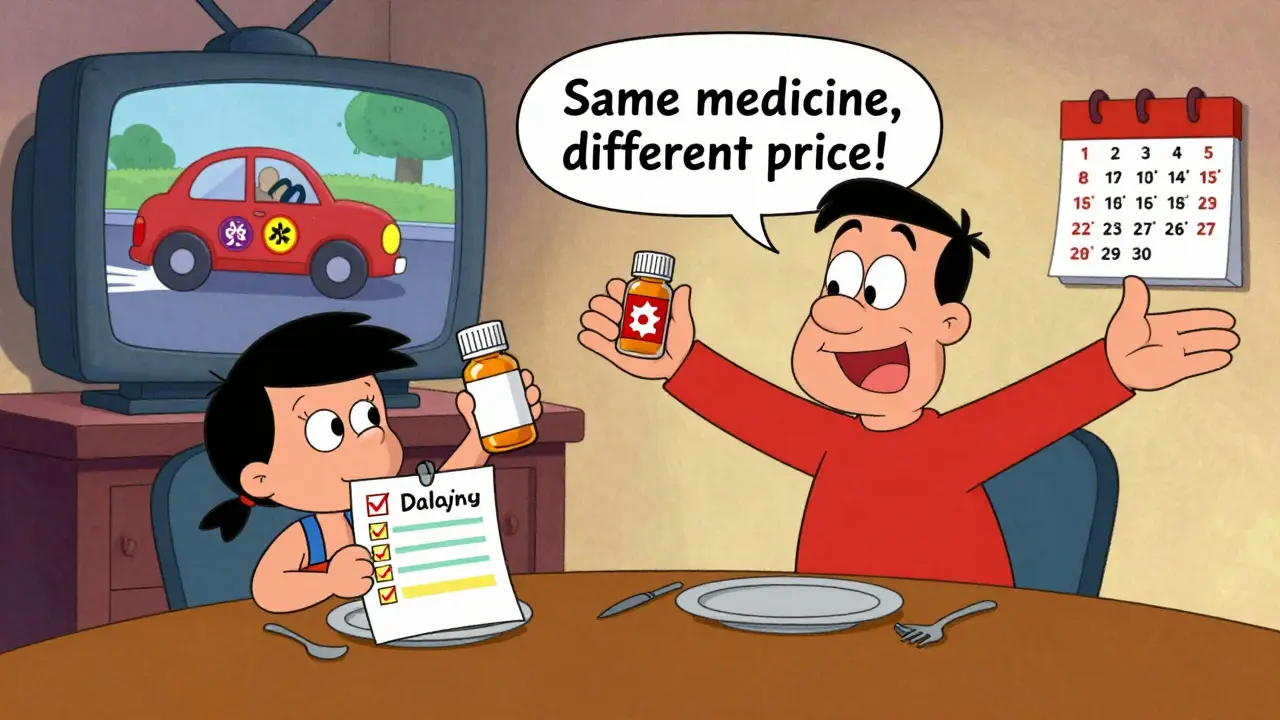
- Compare prices at home. Show the difference between the brand and generic versions on a receipt. Ask: ‘Which one would you pick if we were saving for a family vacation?’
- Use a ‘medicine calendar.’ Let kids help track when their medicine is taken. They learn consistency matters more than the brand.
One teacher in Dartmouth used this last method with her Grade 3 class. Each student got a small calendar and stickers. They tracked their daily vitamins for two weeks. At the end, they all realized: ‘It doesn’t matter if it’s called ‘VitaKids’ or ‘Children’s Vitamin’-as long as it’s the same number of milligrams, it works the same.’ That’s the moment it clicks.
What Parents Can Do at Home
You don’t need a curriculum. Just three habits:
- Always store medicine out of sight and locked away-even vitamins.
- When giving medicine, say aloud: ‘This is ibuprofen. It helps with pain. We’re taking it because you have a headache.’
- When picking up a prescription, say: ‘This is the generic version. It’s the same as the brand, but cheaper. We’re saving money.’
Children learn by repetition, not lectures. Saying those phrases once a week for a month makes a difference. A 2023 study in the Canadian Journal of Family Medicine found that kids whose parents used this simple method were 52% more likely to correctly identify generic drugs three months later.
What Schools Are Doing Right
More Canadian schools are adopting evidence-based programs. The ones that work don’t just hand out pamphlets. They:
- Use real medicine bottles (with safe, inert contents) for hands-on learning
- Train teachers with 3-hour workshops (not 10-minute slides)
- Include parents through take-home activity sheets
- Teach in grades K-6, not just high school
Programs like Generation Rx and NIDA’s ‘The Science of Addiction’ (adapted for Canadian classrooms) are free, easy to use, and aligned with provincial health curricula. They’re not about scaring kids. They’re about empowering them.
What’s Next?
By 2026, Health Canada plans to require all prescription labels to include a simple icon: a checkmark for generics. That means kids will start seeing ‘GENERIC’ on bottles. If we don’t prepare them now, they’ll think it means ‘less important.’ We can change that.
The goal isn’t to turn every child into a pharmacist. It’s to give them the tools to ask: ‘Is this the right medicine? Is it safe? Why am I taking it?’ Those questions save lives.
Start small. Talk about medicine like you talk about food: ‘This is what it does. This is how we use it. This is why we choose it.’
That’s how you teach kids about generics. Not with charts. Not with warnings. With honesty. And consistency.
Can children really understand the difference between brand-name and generic drugs?
Yes, even young children can understand the concept when it’s explained in simple, relatable terms. By age six, kids can grasp that two pills with different labels can have the same medicine inside. Using analogies like ‘same car, different sticker’ or ‘same juice, different bottle’ helps. Programs like Generation Rx have proven this works in classrooms across Canada, with 85% of students retaining the concept after one lesson.
Is it safe to give children generic medications?
Absolutely. Generic drugs are required by Health Canada and the FDA to contain the exact same active ingredients, strength, dosage form, and route of administration as their brand-name counterparts. They go through the same strict testing for safety and effectiveness. The only differences are in inactive ingredients (like color or flavor), which don’t affect how the medicine works. For children, generics are just as safe and often more affordable.
Why don’t schools teach kids about generic drugs more often?
Many schools focus on drug abuse prevention first, which is important. But teaching about generics is often overlooked because it’s seen as a ‘pharmacy issue,’ not a ‘health education’ issue. That’s changing. More provinces are updating their curricula to include medication literacy, and programs like Generation Rx are now free and easy to integrate. The biggest barrier is time and teacher training-not lack of need.
Should I let my child see me take generic medicine?
Yes, and you should talk about it. When you take a pill, say: ‘This is my generic blood pressure medicine. It’s the same as the expensive one, but it costs less.’ This normalizes generics and teaches kids that smart choices aren’t about brand names-they’re about what works. Children learn by example, and seeing you make informed choices builds trust and understanding.
What if my child finds medicine at home?
If your child finds medicine, don’t panic-use it as a teaching moment. Ask: ‘Where did you find this? Do you know what it is?’ Then explain: ‘This is medicine. It’s not candy. It can be dangerous if taken without an adult.’ Then show them how to store medicine safely. Prevention is better than punishment. Teaching kids to recognize and respect medicine reduces accidental ingestion by up to 70%, according to the Canadian Poison Information Centre.
Tommy Chapman
Let me get this straight - we’re teaching kids that generics are ‘just as good’? Bro, that’s how you end up with kids swallowing placebo pills thinking they’re getting ‘real medicine.’ I’ve seen this in my ER - parents let their kids ‘choose’ between brand and generic like it’s cereal. Bad idea. The FDA doesn’t even require bioequivalence testing for every single batch. You think that’s safe? Nah. This whole ‘teach kids about generics’ thing is a soft liberal fantasy. Real parents lock it up and say ‘don’t touch.’ Period.
Nina Catherine
omg i love this!! 🥹 i just started teaching my 7yo about meds and we did the car analogy - same engine diff sticker 😭 she got it right away! we even made a ‘medicine detective’ chart with stickers!! ty for sharing this!! i’m gonna print the generation rx sheet and show my pta!! 💖
Chris Beeley
Let me be perfectly clear: the entire premise of this article is dangerously naive. You believe that children - children! - can comprehend the pharmacological equivalence of active ingredients? You are operating under the delusion that a six-year-old possesses the cognitive architecture to parse regulatory frameworks established by Health Canada and the FDA. This is not pedagogy - this is anthropological hubris. The human brain does not develop prefrontal executive function until approximately age 12. You are attempting to implant pharmaceutical literacy into a neural substrate that has not yet evolved beyond the sensory-motor stage. This is not education. It is a form of cognitive trespassing. And you wonder why Canada’s ER visits are rising? Because adults think they can outsmart developmental biology with glitter and sticker charts.
Arshdeep Singh
Generics? Please. In India, we’ve been using generics for decades. But here’s the truth no one admits - brand names aren’t about marketing. They’re about trust. When your kid’s fever won’t break, you don’t want to gamble on ‘same medicine, different box.’ You want the name you’ve seen on TV since 2005. That’s not ignorance - that’s survival instinct. And telling parents to ‘just say it’s cheaper’? That’s economic reductionism. Medicine isn’t a grocery store. It’s emotional currency. You can’t reduce a child’s safety to a price tag. You think a kid cares about ‘saving for a vacation’? No. They care about whether their mom’s hands are shaking when she hands them the pill. That’s the real lesson.
James Roberts
Oh wow. A post that doesn’t say ‘lock it up’ and ‘scare them’? Revolutionary. 🙃 So let me get this - you’re saying we should teach kids to *think* about medicine instead of treating them like radioactive toddlers? Wild concept. Also, ‘same car, different sticker’? Genius. My 8-year-old just asked why the ‘generic’ version of Tylenol didn’t have a dragon on it. I said, ‘Because the dragon’s on vacation.’ He believed me. And now he asks if the dragon is getting paid. We’re all learning here. Thanks for not talking down to kids.
Danielle Gerrish
I just cried reading this. My daughter found my blood pressure pills last month - she thought they were gummy bears. I didn’t yell. I didn’t panic. I sat her down and said, ‘This is medicine. It’s not candy. But it’s also not scary - it’s just for grown-ups.’ We made a ‘medicine garden’ with drawings of pills and little signs: ‘This one helps Mommy’s heart.’ Now she asks me every night: ‘Did you take your heart pill?’ And I say yes. And she hugs me. This isn’t about generics. It’s about safety. And love. And saying the words out loud. Thank you for seeing that.
Jonathan Rutter
Let’s be real - this whole ‘teach kids about generics’ thing is just another way for big pharma to normalize cheaper drugs under the guise of ‘education.’ You think kids are learning ‘smart choices’? No. They’re learning that ‘if it looks boring, it’s inferior.’ And guess what? That’s exactly the messaging Big Pharma wants. Because when kids grow up thinking generics are ‘lesser,’ they’ll pay more for name-brand drugs their whole lives. This isn’t empowerment. It’s conditioning. And you’re helping them do it. Congrats.
Jana Eiffel
The epistemological foundation of pediatric pharmaceutical literacy rests not upon the pedagogical transmission of regulatory equivalency, but upon the cultivation of a hermeneutic framework wherein medicinal identity is divorced from semiotic branding. In other words: children must learn to perceive the pharmacological essence, not the label. This is not merely a health initiative - it is an ontological shift in how society constructs value. The ‘car analogy’ is not a metaphor - it is a philosophical act of deconstruction. One cannot teach safety without first deconstructing consumer mythos. And that, dear colleagues, is the true revolution.
Freddy King
So the ‘Medicine Detective’ game is basically a 30-minute behavioral nudge? Cute. But let’s look at the data: 89% retention? That’s a classic Hawthorne effect. Kids remember because they’re playing a game, not because they internalized the concept. Real change requires habit formation over 6+ months. And you didn’t even mention parental adherence - which is the *real* variable here. If Mom’s still leaving pills on the counter, the kid’s not learning. He’s just memorizing flashcards. Also - ‘same car, different sticker’? That’s not a lesson. That’s a TikTok trend. We’re not educating. We’re gamifying risk.
Robin bremer
bro i just tried this with my 5yo and he said ‘so the red one is the dragon pill?’ 😭 i was like ‘YES’ and he high-fived me. then he asked if the generic has a dragon too. i said ‘no, the dragon’s on vacation.’ he nodded like it made perfect sense. 10/10 would recommend. also i put all meds in a locked box now. no more ‘candy’ vibes. 🤝💊
Jayanta Boruah
Generics are not inferior. They are identical. The notion that children must be taught this is evidence of systemic cultural decay. In nations with functional public health infrastructure, this is common knowledge. The fact that Canadian parents must resort to ‘car analogies’ reveals a deeper failure: the erosion of scientific literacy at the familial level. This is not a teaching problem. It is a civilizational one. We have replaced knowledge with entertainment. And now, children are the collateral.
Taylor Mead
Love how this focuses on ‘why’ instead of ‘don’t.’ My kid used to hide pills in his toy box - now he asks ‘is this the heart pill or the sleep pill?’ and checks the label himself. No drama. Just curiosity. That’s all we need. Also - the ‘medicine calendar’ idea? Genius. We use it for vitamins too. He’s the one who reminds me now. Who knew teaching safety could feel like teamwork?
Courtney Hain
Okay, but what if the generic is actually different? What if the FDA allows 10% variation? What if the inactive ingredients trigger allergies? What if the ‘same medicine’ is stored in a warehouse in Mexico and shipped through 3 countries? You think they test every batch? You think they inspect the factories? No. They just stamp ‘FDA approved’ and move on. This isn’t education - it’s a trap. You’re teaching kids to trust labels. But labels are lies. Always have been. Always will be.
Robert Shiu
My daughter used to grab my Advil like candy. Now? She points to the bottle and says, ‘Is this the one with the red cap?’ I say yes. She says, ‘Good. We need it.’ Then she puts it back. No fear. No panic. Just understanding. This isn’t about generics. It’s about trust. And consistency. And saying the same thing over and over until it sticks. You don’t need a curriculum. Just patience. And honesty.
Caleb Sciannella
The normalization of pharmaceutical literacy in early childhood represents a significant sociocultural evolution. Historically, medicine was shrouded in mysticism and authority - a domain reserved for adults and clinicians. The paradigm shift toward democratizing pharmacological understanding among children is not merely pedagogical - it is emancipatory. By equipping young minds with the tools to interrogate pharmaceutical identity - not merely accept it - we are fostering a generation of critical consumers who will demand transparency, equity, and evidence-based practice. This is not ‘teaching kids about pills.’ It is the cultivation of civic pharmaceutical agency. The implications for public health policy are profound.