
What Is Meibomian Gland Dysfunction?
Meibomian gland dysfunction is a common eye condition where the oil-producing glands in your eyelids become blocked or don’t work right. These glands, called meibomian glands, sit along the edge of your eyelids and release a clear oil that forms the outer layer of your tears. This oil stops your tears from drying out too fast. When the glands are clogged, your tears evaporate quickly, leading to dry, gritty, burning eyes - the hallmark of evaporative dry eye disease.
It’s not just discomfort. Left untreated, MGD can lead to long-term damage. Studies show that over 86% of people with dry eye have MGD as the root cause. The condition worsens with age - nearly half of all adults over 50 show signs of it. And it’s not rare. In eye clinics, up to 50% of patients have MGD, making it the most common cause of chronic dry eye.
Two Types of MGD - And Why It Matters
Not all MGD is the same. There are two main types, and knowing which one you have helps guide treatment.
- Obstructive MGD (OMGD): This is the most common form. The gland ducts get clogged with thickened oil, like toothpaste hardening in a tube. The glands can’t squeeze out enough oil, so your tear film breaks down fast.
- Hypersecretory MGD (HMGD): Less common. The glands produce too much oil, but it’s poor quality - oily, cloudy, and not smooth enough to protect the eye surface.
Most people have obstructive MGD. That’s why most treatments focus on unclogging and clearing the glands. If you have HMGD, you might need different approaches - like anti-inflammatory meds - because the problem isn’t blockage, it’s the oil itself.
Why Home Care Is Non-Negotiable
Going to the doctor for an in-office procedure isn’t enough. If you skip daily care, symptoms come back - fast.
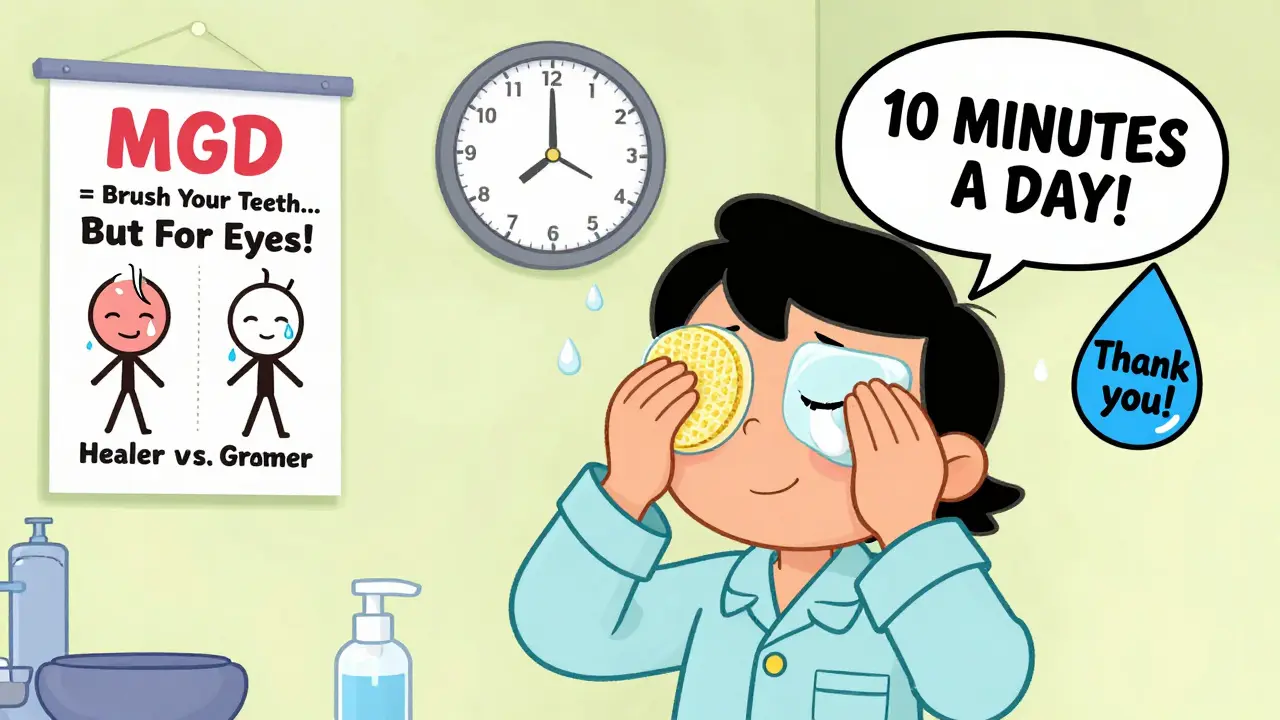
The gold standard home routine takes just 10 to 15 minutes a day:
- Warm compress: Use a heated mask like the Bruder Mask at 40-42°C for 5 minutes. Heat melts the hardened oil blocking the glands.
- Lid massage: Gently rub your eyelids from the outer corner toward the nose with clean fingers. This pushes the melted oil out.
- Lid cleaning: Wipe the lid edge with a hypochlorous acid solution (like OCuSOFT Lid Scrub). This kills bacteria and reduces inflammation.
Studies show you need to stick with this routine 85% of the time to keep symptoms under control. Skip a few days, and your eyes feel gritty again within a week. This isn’t optional - it’s maintenance, like brushing your teeth.
In-Office Treatments: What Works and What Doesn’t
If home care isn’t enough, doctors offer procedures that target the root of the problem.
LipiFlow Thermal Pulsation
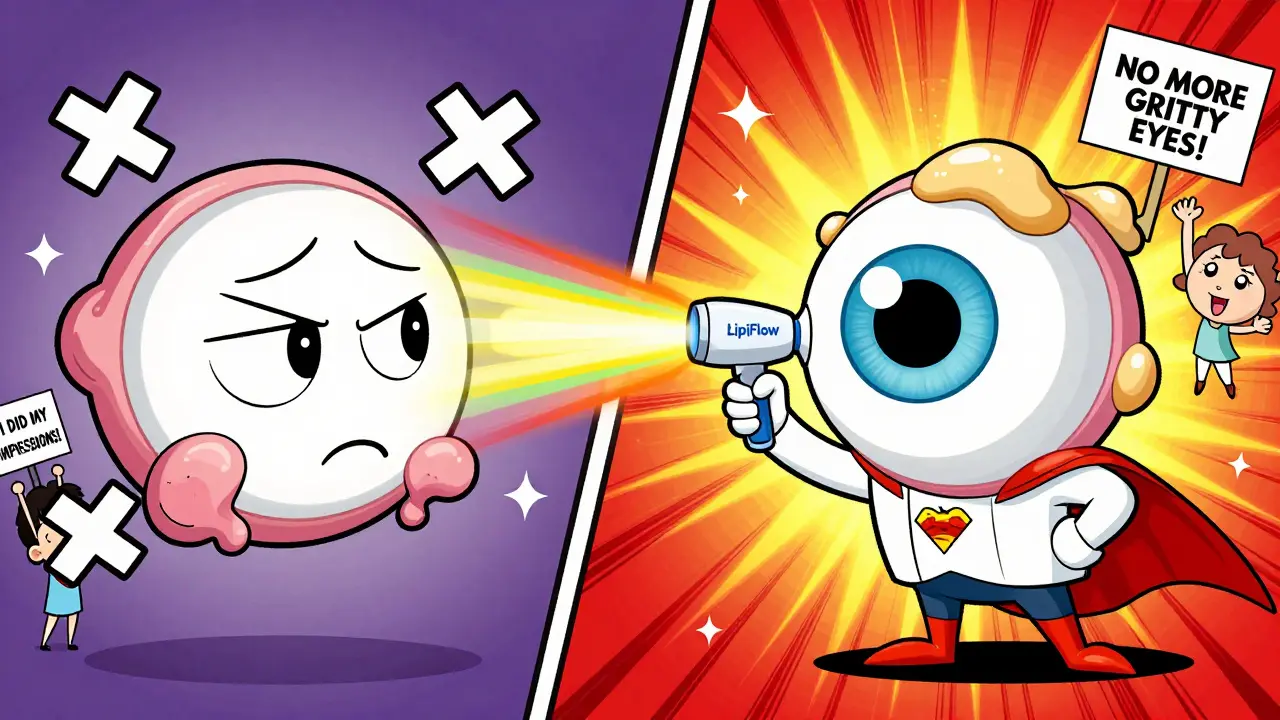
LipiFlow is a device that heats the inside of your eyelids to 42.5°C while gently massaging them. It’s FDA-cleared and designed specifically for MGD. The whole session takes about 12 minutes per eye.
Clinical data shows it improves gland function significantly. One study found meibomian gland expressibility scores jumped from 1.8 to 2.7 on a 4-point scale after treatment. But it’s not magic. Patients who did LipiFlow and kept up daily hygiene saw 79% improvement at 12 months. Those who skipped home care? Over 60% were back to square one in six months.
The downside? Cost. A single LipiFlow session runs $1,500 to $2,500. Insurance rarely covers it - only 15-20% of plans pay anything. That’s why many patients delay treatment until symptoms are severe.
Intense Pulsed Light (IPL)
IPL uses flashes of light to target blood vessels near the eyelids that cause inflammation. It’s often paired with manual gland expression. Each session lasts 15 minutes, and you typically need four treatments spaced three weeks apart.
Results are strong: one study showed OSDI (dry eye symptom) scores dropped from 32.6 to 18.3 after IPL plus expression. But IPL alone? Not enough. Experts like Dr. Anat Galor say it’s only effective when combined with gland expression. Without it, you’re treating inflammation but not the blockage.
Meibomian Gland Probing (MGP)
This is a more aggressive option. A thin probe is inserted into each gland duct to physically break up scar tissue and blockages. It’s done under local anesthetic and takes about 40 minutes.
It’s especially helpful for advanced cases where glands are scarred or fibrotic. Dr. Scheffer Tseng says most heat devices fail here because they don’t address the fibrosis. MGP does. Studies show combining MGP with heat gives better long-term results than heat alone.
Medications That Actually Help
Not all eye drops or pills fix MGD. But some do - and they’re backed by hard data.
Oral Azithromycin
Instead of the old standby, doxycycline, many doctors now prescribe a short 5-day course of azithromycin. One study compared the two: azithromycin improved redness in 78.6% of patients versus 62.3% with doxycycline. And side effects? Only 3.2% of azithromycin users had issues - compared to 28.6% on doxycycline.
Why it works: Azithromycin reduces inflammation and improves oil quality. It’s not an antibiotic in the usual sense - it’s more like a silent anti-inflammatory.
Topical Lifitegrast
This prescription eye drop (5%) targets inflammation directly on the eye surface. In patients with stage 4 MGD (severe damage), corneal staining scores dropped from 12.4 to 5.7 in just 12 weeks. It’s not a cure, but it helps the surface heal while you work on the glands.
Who Gets the Best Results?
Not everyone responds the same. Success depends on timing and consistency.
- Early treatment wins: Patients treated within a year of symptoms improve 37% more than those who wait five years. Glands can recover - if caught early.
- Advanced MGD is harder: If more than half your glands are gone (seen on meibography imaging), no treatment will fully restore them. The goal shifts to slowing damage and managing symptoms.
- Compliance is everything: Only 43% of patients stick with daily care after six months. And those who don’t? Their symptoms return. The science is clear: home care isn’t optional.
What’s Next? Emerging Treatments
The field is moving fast. New options are on the horizon:
- Exosome therapy: Early trials show 92% symptom improvement when exosomes (cell signaling molecules) are used with MGP and heat.
- Nanomicellar cyclosporine (Cequa): A new formulation that penetrates the eye surface 35% better than older versions.
- Genetic research: Scientists are identifying genes tied to IL-17 inflammation pathways - which could lead to targeted biologic drugs.
Also, the 2023 Dry Eye Workshop II now recommends treating MGD even before cataract surgery - because unmanaged MGD increases post-surgery inflammation by 40%.
Real Talk: Cost, Insurance, and Choices
Let’s be honest - the biggest barrier isn’t science, it’s money.
LipiFlow: $1,500-$2,500 per eye
IPL with expression: $800-$1,200 per session (usually 4 needed)
Meibomian gland probing: $750-$1,200 per session
Insurance coverage? Spotty. Only 22% of LipiFlow claims were approved in 2022. Many patients pay out-of-pocket. That’s why some wait until they’re in pain - and by then, the damage is harder to reverse.
Here’s the truth: You can’t skip home care. Even if you get the most expensive treatment, without daily warm compresses and lid hygiene, you’re wasting your time and money.
Final Takeaway: MGD Is Manageable - But Not Curable
Meibomian gland dysfunction isn’t a one-time fix. It’s a chronic condition, like high blood pressure. You don’t cure it - you manage it.
Start with daily hygiene. See a dry eye specialist if symptoms persist. Combine in-office treatments with medications when needed. And don’t wait until your eyes burn all day. The earlier you act, the more of your glands you’ll save.
And remember - you’re not alone. Millions of people live with MGD and still see clearly, comfortably, and without pain. It just takes the right plan - and the discipline to stick with it.
Can meibomian gland dysfunction cause permanent vision loss?
Not directly. MGD doesn’t destroy your retina or optic nerve. But if left untreated for years, it can cause chronic corneal damage, scarring, and surface irregularities that blur vision. In severe cases, this can reduce your best-corrected vision. The key is early treatment to prevent long-term surface damage.
Is LipiFlow worth the cost?
For people with moderate to severe obstructive MGD who’ve tried home care without success, yes - if you can afford it. Studies show 78% of patients report lasting relief for 9+ months. But if you don’t do daily warm compresses and lid hygiene afterward, the benefits fade fast. It’s not a cure - it’s a reset button. You still need to maintain it.
Can I treat MGD with over-the-counter eye drops?
Regular lubricating drops (like artificial tears) only mask symptoms. They don’t fix the root problem - blocked glands. For real improvement, you need to clear the glands and reduce inflammation. Some OTC products like hypochlorous acid sprays (e.g., Avenova) can help with lid hygiene, but they’re not enough alone. You need heat, massage, and cleaning - not just drops.
Why does my dry eye get worse in winter?
Cold, dry air increases tear evaporation. If your meibomian glands aren’t producing enough oil, your tears vanish faster. Indoor heating makes it worse. That’s why symptoms spike in winter - it’s not a new problem, it’s your existing MGD reacting to environmental stress.
Should I stop wearing contacts if I have MGD?
Not necessarily, but you might need to switch. Soft contacts can trap debris and worsen inflammation. Daily disposables are better than monthly ones. Some patients find that switching to scleral lenses - which vault over the cornea - helps by protecting the surface and holding moisture. Talk to your eye doctor about lens options that suit your MGD stage.
Can diet help with MGD?
Yes. Omega-3 fatty acids (found in fish oil, flaxseed, walnuts) improve oil quality from the meibomian glands. Studies show taking 2,000-3,000 mg of EPA/DHA daily can reduce inflammation and make tears more stable. It’s not a replacement for other treatments, but it supports them. Avoid trans fats and processed oils - they make the oil thicker and harder to express.
How do I know if I have MGD or just dry eye?
Most dry eye is caused by MGD. If you have gritty, burning eyes that feel worse after screen use or in air-conditioned rooms, MGD is likely. A doctor can confirm it with meibography (an imaging test that shows gland structure) or by checking how easily oil expresses from your eyelids. Don’t assume it’s just ‘dry eyes’ - if it’s persistent, get it checked.
Amber Lane
This is the most practical guide to MGD I've ever read. Just started the warm compress routine last week - already feel less grit in the morning.
Rod Wheatley
I’ve been doing the Bruder mask + lid scrub for 8 months now. My eyes used to burn all day. Now? Barely noticeable. The key is consistency - skip a day, and you feel it by night. It’s like brushing your teeth but for your eyes. And yes, it’s boring. But so is dialysis. You do it because you have to.
michelle Brownsea
I can't believe people still think artificial tears are a solution?!?!? You're treating the symptom, not the disease!!! The glands are CLOGGED - not dry!!! This is why so many people end up with corneal ulcers - because they're too lazy to do the 10-minute routine!!!
Roisin Kelly
LipiFlow is a scam. My insurance denied it, so I paid $2k out of pocket. Two weeks later, my eyes were worse. I think the clinics are just milking desperate people. They don't tell you that 60% of people are back to square one in 6 months if they don't do the home care. And who has time for that?
Malvina Tomja
Let’s be real - this whole ‘MGD is chronic’ narrative is just the eye industry’s way of selling lifelong maintenance. They don’t want you cured. They want you coming back every 6 months for IPL, then LipiFlow, then probing, then exosome therapy. It’s a money machine disguised as medicine.
Jerry Rodrigues
I’ve got MGD and wear contacts. Switched to daily disposables and started the warm compress thing. No more red eyes by 3pm. Just saying - it works if you actually do it.
Andrew Rinaldi
I appreciate how the article doesn’t just say ‘do this’ - it explains why. Like how azithromycin isn’t really an antibiotic here. It’s more like a quiet anti-inflammatory. That’s the kind of nuance most doctors skip. I wish more medical content was this thoughtful.
Philip Williams
The data on omega-3s is compelling. I’ve been taking 2,500 mg daily for 10 weeks. My meibum is noticeably clearer when I do the lid massage. Not a cure, but a meaningful adjunct. I’d recommend it to anyone with MGD - especially if they’re eating processed foods.
Jarrod Flesch
Just got back from Australia - switched to scleral lenses after 4 years of MGD. Game changer. No more burning on the plane. No more blinking 20 times a minute to see clearly. If you're struggling with advanced MGD, talk to your optometrist about them. They're pricey, but they're like a shield for your cornea.
Stephen Rock
Exosome therapy? Sounds like sci-fi. Next they’ll be selling stem cell eye drops for $10k. Meanwhile, my optometrist still thinks I have ‘dry eye’ and gives me more drops. The system is broken.
Gerard Jordan
I used to think this was just ‘old person stuff’… until I was 32 and couldn’t read my phone without blinking 10 times. Started the routine. 3 weeks later, I cried because my eyes didn’t feel like sandpaper anymore. 🥹 You’re not alone. This stuff works if you give it a real shot.
Alex Carletti Gouvea
I’m sick of this ‘Western medicine’ nonsense. My grandma in Romania just used warm tea bags and rubbed her eyes with her fingers. She’s 87 and still sees fine. Maybe we’ve overcomplicated this.
lokesh prasanth
I have MGD. Tried everything. Lipiflow $2k, IPL $3k, azithromycin. Nothing worked. Turns out I had a vitamin D deficiency. Took 5000 IU daily for 2 months. My glands started expressing again. Maybe the real issue is not the glands - it’s your diet.
Dee Monroe
I’ve been living with this for 12 years, and I can tell you this: the moment you stop treating it like a temporary annoyance and start treating it like a chronic condition - like hypertension or diabetes - that’s when things start to change. It’s not about finding the one magic treatment. It’s about building a lifestyle around it. The warm compress isn’t a chore - it’s your daily ritual. The lid scrub isn’t a task - it’s your act of self-respect. The supplements aren’t optional - they’re part of the foundation. You don’t cure MGD. You learn to live with it so well that it stops controlling you. And that’s the real victory.
Kevin Narvaes
i tried all this but honestly the only thing that helped was just avoiding screens. like, i stopped using my phone for 2 weeks and my eyes stopped burning. maybe its not the glands maybe its just we stare too much. just saying.