
Most people think burning calories means hitting the gym, lifting weights, or running on a treadmill. But what if you could burn hundreds of calories a day just by walking to the mailbox, taking the stairs, or pacing while on a phone call? That’s NEAT-Non-Exercise Activity Thermogenesis-and it’s one of the most powerful, overlooked tools for weight management.
What Is NEAT, Really?
NEAT stands for everything you do that isn’t sleeping, eating, or formal exercise. It’s the little movements that add up: standing at your desk, washing dishes, gardening, walking to the bus stop, even fidgeting in your chair. Dr. James Levine at the Mayo Clinic brought this concept into the spotlight in the early 2000s. His research showed that two people eating the same diet and working the same hours could have wildly different weights-just because one moved more throughout the day.
Think of it this way: if you sit all day at work, then go home and sit on the couch, your body is basically on standby. But if you walk around your house while talking on the phone, take a lap around the block after lunch, or park farther away from the store, you’re turning your body into a calorie-burning machine-without ever stepping into a gym.
How Many Steps Actually Burn Calories?
Step counters turned NEAT into something measurable. The 10,000-step goal? It didn’t come from science. It came from a Japanese pedometer company in 1965 selling a device called the Manpo-kei-‘10,000 step meter.’ The number stuck because it sounded impressive. But here’s the truth: 10,000 steps isn’t magic. It’s a starting point.
For an average person weighing 160-180 pounds, each step burns about 0.04 to 0.05 calories. That means:
- 2,000 steps ≈ 100 calories burned
- 5,000 steps ≈ 250 calories burned
- 10,000 steps ≈ 400-500 calories burned
But here’s where it gets tricky. A heavier person burns more calories per step. Someone who weighs 220 pounds might burn 600 calories in 10,000 steps. Someone who weighs 130 pounds might only burn 350. Height matters too-taller people have longer strides, so they cover more ground with fewer steps. And speed? It changes everything.
Walking Slow vs. Walking Fast: The Surprising Math
You’d think faster walking burns more calories per step. But it doesn’t. In fact, walking slower can burn more calories overall for the same number of steps.
Why? Because it takes longer. If you walk 10,000 steps at 2 mph, you’re moving for about 3 hours. At 4 mph, you’re done in 1.5 hours. The slower pace means your body is working longer-so you burn more total calories, even though each step is less intense.
Example: A 187-pound person walking 10,000 steps:
- At 2 mph (slow): ~559 calories
- At 3 mph (average): ~469 calories
- At 4 mph (fast): ~501 calories
Wait-why does fast walking burn fewer calories than slow? Because the body becomes more efficient. At higher speeds, your muscles adapt, your stride lengthens, and your energy use per step drops. But the total time spent moving is shorter. So if your goal is to burn calories, don’t just chase steps. Chase time.
It’s Not Just About Steps-It’s About Movement Type
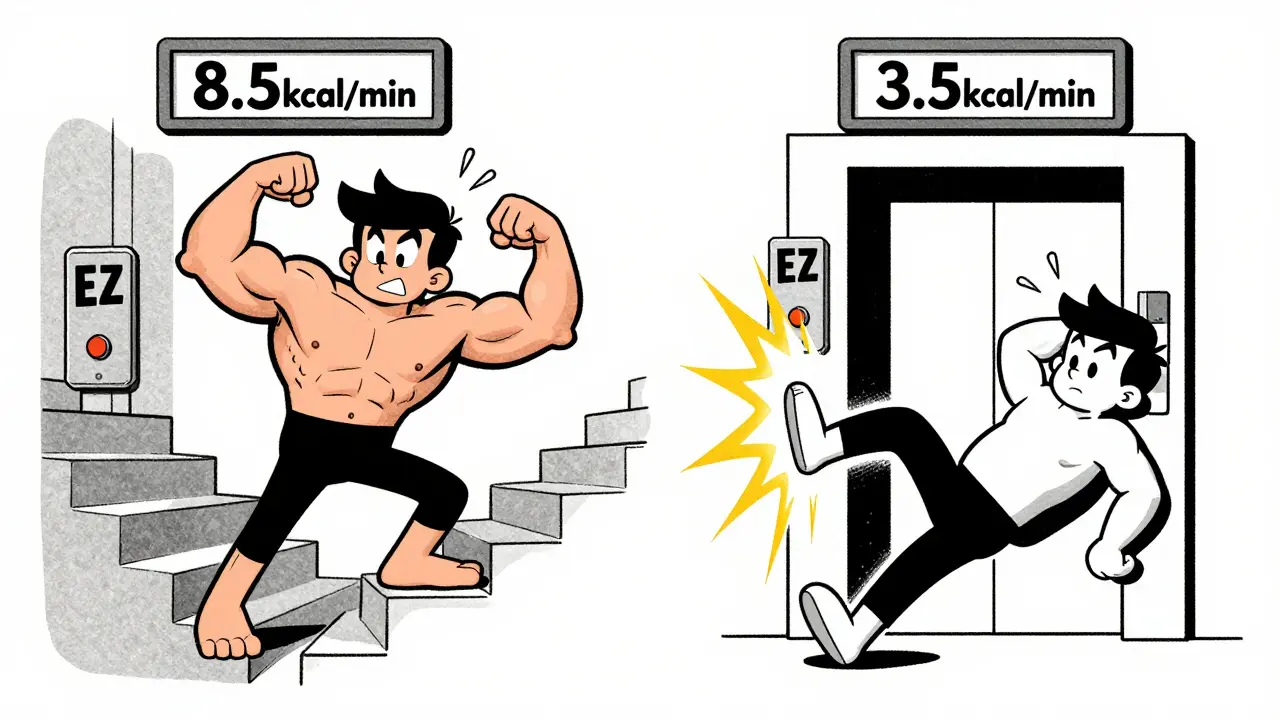
Not all movement is created equal. Stair climbing burns way more than walking on flat ground. One study found that climbing stairs one step at a time burns more calories per minute than taking two steps at a time-even though it feels easier. Why? Because lifting your knee higher engages more muscle, and that takes more energy.
Here’s what burns more per minute:
- Single-step stair climbing: 8.5 kcal/min
- Double-step stair climbing: 9.2 kcal/min
- Walking at 3 mph: 3.5 kcal/min
But here’s the catch: a flight of stairs might only be 20 steps. So while stair climbing is intense, it doesn’t add up to thousands of steps. That’s why mixing it in helps. Take the stairs instead of the elevator. Park on the top floor. Walk up and down your front steps a few times after dinner. These are the real NEAT hacks that add up.
Why Your Fitness Tracker Might Be Lying to You
Ever had a day where you only took 7,000 steps but burned 2,200 calories? Or another day where you hit 14,000 steps but only burned 1,800? That’s not a glitch. That’s your tracker doing its best with incomplete data.
Devices like Fitbit, Apple Watch, and Garmin don’t just count steps. They use your height, weight, heart rate, and movement speed to estimate calories. If you’re walking briskly, it assumes you’re doing more work. If you’re driving over bumpy roads, it might count bumps as steps. If you’re gesturing a lot while talking, it might think you’re walking.
One user on Fitbit’s forum noticed that on busy days-when they were running errands, carrying groceries, and pacing-they burned more calories with fewer steps. Why? Because their movements were more intense, not more frequent. That’s NEAT in action: it’s not about the number of steps. It’s about how much energy you’re using.
Forget 10,000. What’s Your Real Goal?
A 2019 study in JAMA Internal Medicine looked at over 16,000 older women. They found that the sweet spot for lowering death risk wasn’t 10,000 steps-it was 7,500. Beyond that, the benefits plateaued. For younger people? Maybe higher. For someone recovering from injury? Maybe lower.
Here’s a better approach: track your baseline. For one week, don’t try to change anything. Just record your average daily steps. If you’re at 4,000, aim for 5,500 next week. Then 6,500. Then 7,500. Small, steady increases beat giant leaps that burn you out.
And here’s the biggest mistake people make: thinking that burning 500 calories from steps means they can eat a big burger and fries. Nope. A single fast-food meal can wipe out all those steps. One banana, a handful of almonds, and a yogurt? That’s 250-300 calories. You just erased half your effort.

How to Build NEAT Into Your Day (Without Trying)
You don’t need to change your life. You just need to change your habits.
- Stand up every 30 minutes-even for 1 minute. Stretch. Walk to the window.
- Take the long way to the bathroom, the printer, or the kitchen.
- Walk while you talk. Use speakerphone and pace around your house or yard.
- Do chores like folding laundry, vacuuming, or washing dishes standing up. No sitting.
- Watch TV standing or doing light stretches. No couch lounging.
- Get off the bus or subway one stop early and walk the rest.
- Use a standing desk-or turn your kitchen counter into one.
- Play with your kids or pets. Chase them. Toss a ball. It counts.
These aren’t workouts. They’re lifestyle tweaks. And they add up to 200-400 extra calories burned a day. That’s 1,400-2,800 calories a week. That’s half a pound to a full pound of fat loss every two weeks-without dieting or sweating.
Why This Matters More Than Ever in 2026
Most jobs are still sedentary. Remote work means even less movement. People are sitting more than ever. But our bodies weren’t built for that. We evolved to move constantly-hunt, gather, walk, climb. Sitting for 8 hours straight? That’s unnatural.
Now, wearables are smarter. Apple Watch tracks your walking steadiness. Fitbit gives you a Daily Readiness Score based on your movement, sleep, and heart rate. AI is learning to tell the difference between walking, climbing stairs, and even fidgeting. The future isn’t just about counting steps. It’s about understanding movement quality.
By 2025, experts predict we’ll stop chasing 10,000 steps and start chasing “movement snacks”-five-minute bursts of walking, stretching, or stair climbing scattered through your day. That’s NEAT optimized. That’s sustainable.
Final Thought: Movement Is Medicine
You don’t need to run a marathon. You don’t need to lift heavy weights. You just need to move more than you did yesterday. NEAT isn’t about discipline. It’s about design. Make your environment push you to move. Make your routine reward movement. And don’t let the number on your tracker fool you-it’s not about steps. It’s about energy.
Start small. Stand up. Walk around. Take the stairs. Your body will thank you-not with a six-pack, but with more energy, better sleep, and steady weight control.
Courtney Carra
NEAT changed my life. I used to think I had to run marathons to lose weight. Now I just walk while on Zoom calls, pace during ads, and stand while brushing my teeth. No gym. No guilt. Just movement. 🚶♀️
thomas wall
It is profoundly irresponsible to suggest that calorie expenditure through incidental movement can substitute for disciplined physical training. The notion that fidgeting equates to fitness is not merely misleading-it is a cultural abdication of responsibility toward bodily integrity. One does not become healthy by shuffling to the fridge.
Shane McGriff
Thomas, I hear you-but let’s not throw the baby out with the bathwater. NEAT isn’t about replacing the gym, it’s about filling the gaps. Most people sit 14 hours a day. Even adding 20 minutes of walking here and there? That’s 100+ extra calories. Over a week, that’s a whole meal. And for someone who hates the gym? This is their gateway. I’ve seen people start with ‘walking while on calls’ and end up hiking on weekends. It’s not magic. It’s momentum.
Jacob Cathro
ok but like… 10k steps is a lie?? lol. my fitbit says i burned 800 cal yesterday just from ‘walking’ but i literally just sat on the couch scrolling and my dog kept jumping on me. also why is the math so weird? slow walking burns more? that’s like saying napping burns more calories than working out. this article feels like someone trying to justify why they won’t leave the house.
Paul Barnes
There is a fundamental error in the calculation presented: the assumption that calories burned per step are linearly proportional to body weight without accounting for metabolic efficiency scaling, which follows a 2/3 power law, not a direct proportion. Additionally, the claim that slower walking increases total caloric expenditure over the same step count ignores the non-linear relationship between velocity and energy expenditure in human locomotion. The data presented is statistically misleading.
Manoj Kumar Billigunta
My aunt in Kerala, 72 years old, never steps into a gym. She walks to the market, carries vegetables, cleans the house, and tends to her small garden. Every day. She doesn’t count steps. She just moves. And she’s stronger than half the people in my gym. NEAT isn’t new. It’s just how people lived before screens took over. We’re not broken-we just forgot how to move naturally.
kumar kc
Stop glorifying laziness. If you want results, train. Not pace.
Thomas Varner
Okay, but… what if you live in a 300 sq ft apartment? You can’t exactly ‘take the long way’ to the bathroom when it’s two steps away. And what if you have a bad knee? Or a job that requires you to sit for 10 hours? I get the vibe, I do. But this article feels like it was written by someone who has a backyard, a standing desk, and no chronic pain. Just… a little more nuance? Please?
Art Gar
One must question the epistemological foundations of this discourse. The conflation of activity thermogenesis with metabolic health presumes a reductionist model of human physiology that neglects hormonal regulation, circadian rhythm, and neural adaptation. The quantification of NEAT through step-counting devices-themselves calibrated to industrial-era biomechanical norms-is an act of technological colonialism over bodily autonomy. One cannot optimize movement by measuring it. One must, instead, cultivate presence.