
When you suddenly see a storm of new floaters, or bright flashes in the corner of your eye, it’s easy to brush it off as eye strain or aging. But if you ignore those signs, you could lose vision permanently-fast. Retinal detachment isn’t a slow, creeping problem. It’s an eye emergency that demands immediate action. Every hour counts. If the retina peels away from the back of your eye, the light-sensitive cells starve without blood flow, and they start dying. Once they’re gone, they don’t come back.
What Exactly Is a Retinal Detachment?
The retina is a thin, delicate layer of tissue lining the back of your eye. It’s like the film in a camera-catching light and turning it into signals your brain turns into images. When it detaches, it pulls away from the layer that feeds it oxygen and nutrients. Without that connection, vision goes dark, starting at the edges and creeping inward like a curtain falling. This isn’t just blurry vision. It’s a physical separation that can happen in minutes or hours.
It’s not rare. About 1 in 10,000 people will experience it each year. But the risk jumps sharply after age 40, especially if you’re nearsighted (over -5.00 diopters), had cataract surgery, or have lattice degeneration-a thinning of the retina that affects 1 in 10 people. Even if you’ve never had eye problems, a hard hit to the head or a sudden jerk can trigger it.
6 Warning Signs You Can’t Ignore
There’s no mild version of retinal detachment. If you’re experiencing any of these, get to an eye specialist today:
- Sudden increase in floaters-not just one or two, but dozens of dark spots, strings, or cobwebs that appear out of nowhere. These aren’t the harmless floaters you’ve had for years. These are new, overwhelming, and persistent.
- Flashes of light-like camera strobes or lightning strikes in your peripheral vision, especially in the dark. These aren’t migraines. They’re your retina being tugged.
- A dark curtain or shadow-this is the most urgent sign. It starts in your side vision and slowly moves toward the center. It doesn’t go away. It grows.
- Sudden blurry or distorted vision-everything looks warped, as if you’re looking through a cracked lens. This often means the macula, the part of the retina for sharp central vision, is involved.
- Loss of peripheral vision-you can’t see things to your left or right without turning your head. It’s not just tunnel vision; it’s a missing section of your visual field.
- Changes in color perception-colors look duller or washed out, especially if the center of your vision is affected. This is a late but critical signal.
One Reddit user, "VisionWarrior22," waited three days after noticing floaters and flashes. By the time he saw a specialist, the curtain had spread halfway across his vision. His final vision was 20/100. He could’ve kept 20/25 if he’d gone in the same day.
How Doctors Diagnose It
There’s no home test. You need an eye doctor with the right tools. A regular eye exam won’t cut it. You need a dilated fundus exam-drops to widen your pupil, then a bright light and special lenses to see the back of your eye. If the view is blocked by blood or cataracts, they’ll use B-scan ultrasound to create an image of the retina. Optical coherence tomography (OCT) gives a high-res cross-section, showing exactly how far the retina has lifted.
General ophthalmologists miss about 22% of early detachments. Retina specialists get it right 95% of the time. That’s why if your primary care doctor says it’s just eye strain, go straight to a specialist. Don’t wait for an appointment next week. Call every clinic in your area until someone sees you the same day.

Three Main Surgical Treatments
There’s no one-size-fits-all fix. The right surgery depends on where the tear is, how big it is, and whether the macula is still attached.
1. Pneumatic Retinopexy
This is the least invasive. A gas bubble is injected into your eye. You then position your head so the bubble floats up and presses against the detached area, sealing the tear. A laser or freezing treatment (cryopexy) is used to weld the retina back in place. Success rate: 70-80% for tears on the top half of the retina.
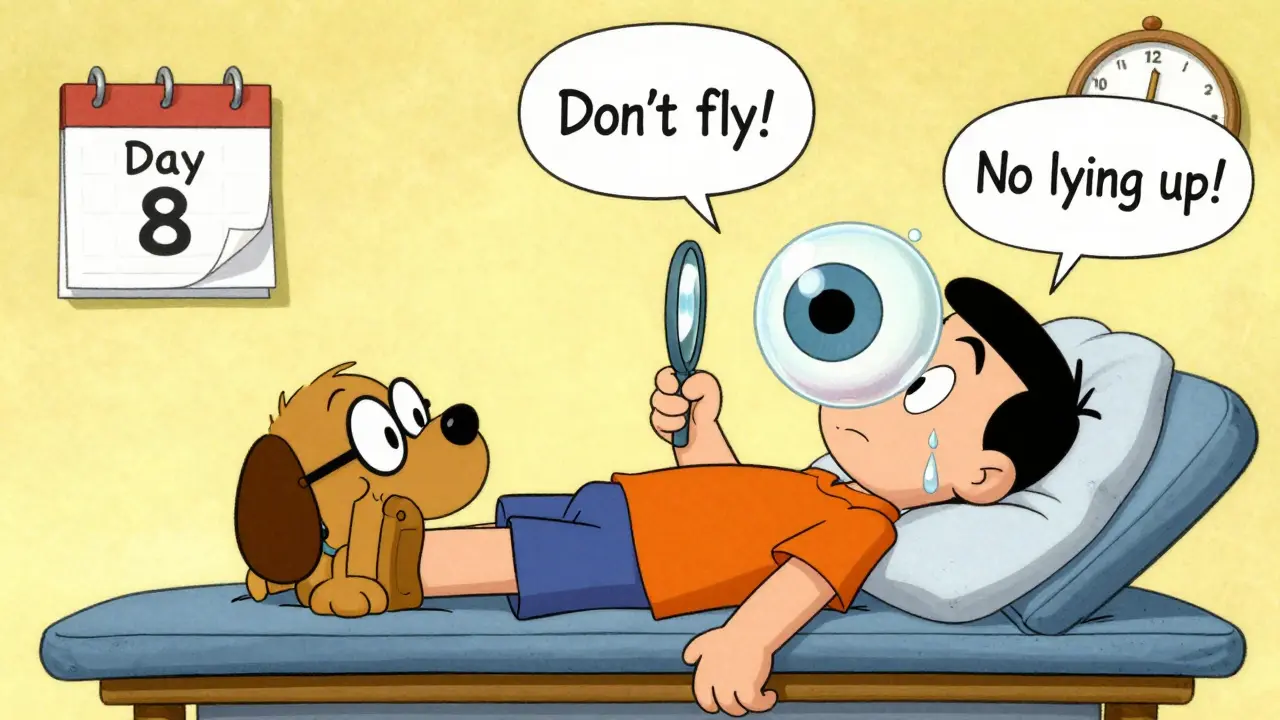
But here’s the catch: you must stay in a specific position-often face-down-for 7 to 10 days. That’s 50% of every 24 hours. No lying on your back. No sitting upright. You sleep in a recliner, eat with your head down, and use special mirrors to read. One patient described it as "being trapped in a dark room with a balloon in your eye." It’s grueling. And if the tear is on the bottom half of the retina? This won’t work.
2. Scleral Buckling
A silicone band is stitched around the outside of your eye, gently pushing the wall inward to meet the detached retina. It’s like putting a belt around your eye to hold everything in place. This is often used in younger patients with lattice degeneration or giant tears. Success rate: 85-90%.
Downsides? It can permanently change your eye shape, leading to nearsightedness (1.5-2.0 diopters). About 5-8% of patients get double vision afterward. Recovery takes weeks. But it leaves your natural lens untouched-so you won’t need cataract surgery right away.
3. Vitrectomy
This is the most common surgery today. The surgeon removes the gel-like vitreous inside your eye, then peels off any scar tissue pulling on the retina. A gas or silicone oil bubble is injected to hold the retina flat while it heals. Success rate: 90-95%, especially for complex cases or when the macula is involved.
The trade-off? Almost 70% of people who have this surgery and still have their natural lens will develop a cataract within two years. You’ll likely need cataract surgery later. But if your retina is badly torn or scarred, this is the only option that gives you a real shot at saving vision.
Timing Is Everything
Dr. Carl Regillo at Wills Eye Hospital says, "Every hour counts." If the macula (the center of your vision) is still attached when you get treated, you have a 90% chance of keeping 20/40 vision or better. If you wait more than 72 hours and the macula detaches, that drops to 35%. That’s not a small difference. That’s reading a book vs. reading with a magnifying glass.
Studies show that patients treated within 24 hours have a 90% anatomical success rate. After 48 hours, satisfaction drops from 92% to 67%. And if you wait a week? You might lose central vision for good.
Emergency protocols at top hospitals require evaluation within 4 hours of arrival for macula-off cases. Surgery should happen within 12 hours. That’s not a suggestion-it’s the standard.
What Happens After Surgery?
Recovery isn’t just about healing. It’s about positioning, avoiding pressure, and watching for complications.
- Gas bubble patients must keep their head down for days. No flying. The gas expands at high altitude and can cause blindness.
- Don’t rub your eye. Don’t lift anything over 10 pounds.
- Watch for increased pain, redness, or sudden vision loss-signs of infection or re-detachment.
- Expect blurry vision for weeks. Colors may look off. Your eye might water. That’s normal.
- Follow-up visits are non-negotiable. You need checks at 1 day, 1 week, 1 month, and 3 months.
Thirty-eight percent of patients need help at home-someone to cook, drive, or remind them to stay in position. Don’t try to do this alone.
Who’s at Risk?
You’re at higher risk if you:
- Are nearsighted (over -5.00D)
- Had cataract surgery
- Have a family history of retinal detachment
- Have diabetes or sickle cell disease
- Have had a previous retinal detachment in the other eye
- Have lattice degeneration (thin patches in the retina)
People with lattice degeneration are often told to get preventive laser treatment. But experts disagree. Some say yes-others warn the procedure can cause its own complications. If you’re unsure, get a second opinion from a retina specialist.
What’s New in Treatment?
Minimally invasive vitrectomy systems, like the 27-gauge EVA Platform approved in early 2023, mean smaller incisions, less pain, and faster healing. Intraoperative OCT lets surgeons see the retina in real time during surgery, improving precision. In the next five years, AI tools may scan your eye images and flag early signs of detachment before you even notice symptoms.
Long-term, researchers are testing bioengineered retinal patches and gene therapies. But for now, surgery is still the only proven fix.
What If You Can’t Get to a Specialist?
Only 35% of U.S. counties have a retinal specialist. If you’re in a rural area and can’t get there in time, go to the nearest ER. They can’t do the surgery, but they can stabilize you, order an ultrasound, and coordinate transfer. Don’t wait for a referral. Call ahead. Say: "I think I have a retinal detachment. I need urgent evaluation."
Retinal detachment isn’t something you can treat with drops or rest. It’s not a migraine. It’s not dry eye. It’s a medical emergency that demands speed, expertise, and action. If you see those signs-floaters, flashes, a curtain-don’t wait. Don’t hope it goes away. Go now. Your vision depends on it.
Can retinal detachment fix itself?
No. A detached retina will not reattach on its own. Without surgery, the light-sensitive cells in the retina die from lack of oxygen. Once they’re gone, vision loss is permanent. Even if symptoms seem to improve, the damage is still happening. Delaying treatment almost always leads to worse outcomes.
How long does retinal detachment surgery take?
Most procedures last between 1 and 2 hours. Pneumatic retinopexy is the quickest-often under an hour. Scleral buckling and vitrectomy take longer because they involve more steps. Recovery time, however, is much longer. You’ll need days to weeks of positioning and follow-up visits.
Is retinal detachment surgery painful?
During surgery, you’re either numbed with local anesthesia or put to sleep, so you won’t feel anything. Afterward, most people report mild discomfort, pressure, or a scratchy feeling-not sharp pain. Over-the-counter pain relievers are usually enough. The real challenge isn’t pain-it’s the strict head positioning needed for weeks after gas bubble surgery.
Will I need glasses after surgery?
You may need new glasses, especially after vitrectomy or scleral buckling. These surgeries can change your eye’s focusing power, often making you more nearsighted. Most patients need a new prescription 4-8 weeks after surgery. If you had cataract surgery at the same time, you might need glasses less often.
Can I drive after retinal detachment surgery?
No-not until your doctor says it’s safe. If you have a gas bubble, flying is dangerous and driving is impossible because your vision will be blurry and distorted. Even after the bubble clears, your depth perception and peripheral vision may still be affected. Most patients wait at least 2-4 weeks before driving again, and only after a clear eye exam.
Can retinal detachment happen again?
Yes. About 5-15% of cases re-detach, depending on the surgery type and how complex the original tear was. People with lattice degeneration or severe myopia are at higher risk. That’s why regular retinal exams are critical-even years after surgery. Catching a new tear early means a simple laser treatment can prevent another full detachment.
Sandeep Jain
My uncle had this happen last year-no warning, just a curtain coming down one morning. He waited two days because he thought it was just a migraine. By the time he got to the specialist, his macula was already off. Vitrectomy saved him, but he lost 30% of his central vision. Don’t be like him. If you see flashes or new floaters, GO. NOW. No excuses.
Sophia Daniels
Oh wow, another ‘eye emergency’ PSA. Next they’ll tell us blinking too hard causes brain explosions. Honestly, if you’re not a 60-year-old nearsighted grandma who’s never heard of an optometrist, you’re probably fine. My cousin’s dog had more eye problems than I’ve ever had. Just chill, people.
roger dalomba
So let me get this straight-you’re telling me I need to spend 10 days face-down like a confused turtle because my eye has a balloon in it? And if I move wrong, I go blind? Cool. I’ll just wait until I can’t see my phone screen anymore. Priorities, people.
Rajni Jain
I’m from India and we don’t have retina specialists in most towns. My sister had this last year-she drove 6 hours to the nearest city, slept in the ER hallway, and got treated in 5 hours. She’s seeing fine now. If you’re scared, just go. No one’s gonna hold your hand, but someone will help you if you show up.
Brittany Fuhs
It’s sad how Americans treat their bodies like disposable gadgets. You wait until you’re half-blind, then expect magic surgery to fix it. In my country, people get annual eye checks-no drama, no panic. Just responsibility. Maybe if you didn’t stare at your phone 12 hours a day, this wouldn’t happen.
Erwin Asilom
For anyone considering pneumatic retinopexy: the head positioning is brutal, but it’s the only option that preserves your natural lens. I did it last year. Used a recliner, a neck pillow, and a mirror to read. Lost 12 pounds. But my vision is 20/20. Worth it. Just don’t underestimate the mental toll.
Steven Destiny
THIS IS WHY YOU DON’T IGNORE YOUR BODY. I almost lost my left eye because I thought ‘it’ll go away.’ I didn’t. I got surgery within 8 hours. Now I see better than ever. If you’re reading this and have symptoms-STOP. SCROLL. CALL A DOCTOR. TODAY. Your future self will thank you.
Amy Lesleighter (Wales)
It’s not about fear. It’s about listening. Your eyes aren’t just windows-they’re alive. When they scream, don’t turn up the music. Just stop. And go. No one’s asking you to be brave. Just be smart.
Fabio Raphael
Has anyone here had the new 27-gauge vitrectomy? I read it’s less invasive but still has the same cataract risk. Also-anyone know if AI screening is available in the U.S. yet? My optometrist said it’s still experimental, but I’m curious if anyone’s tried it.