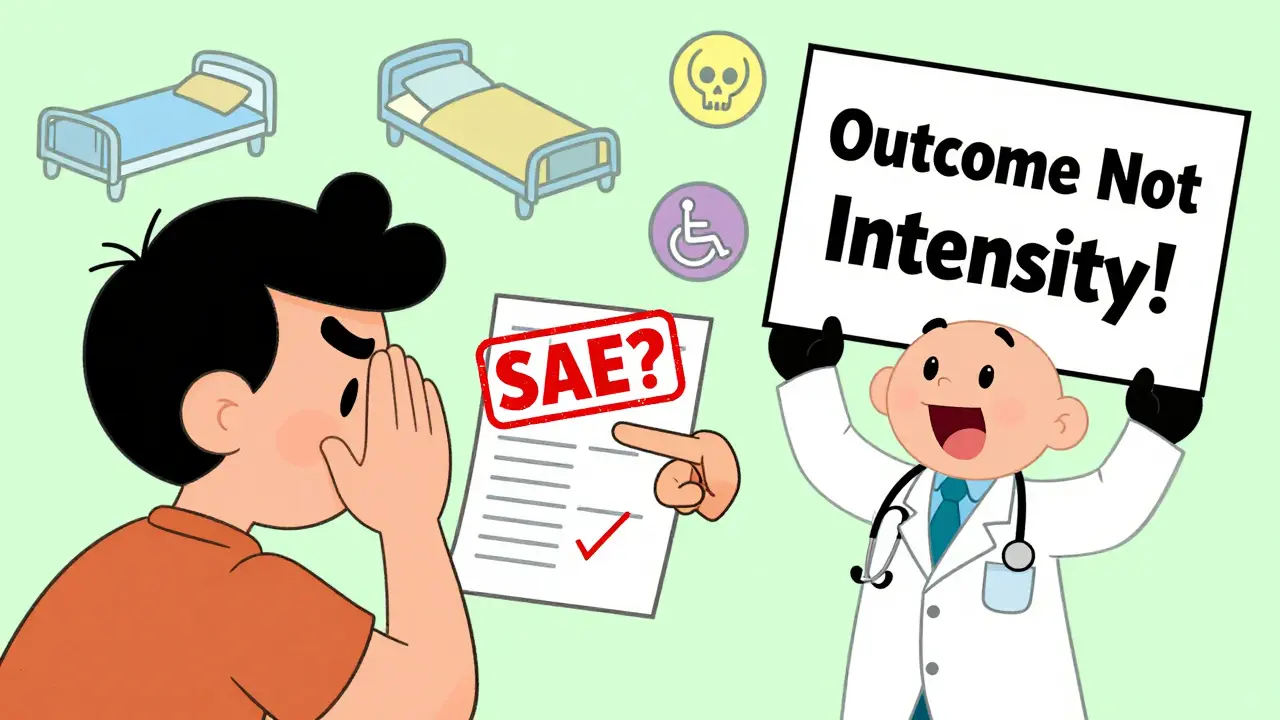
When you’re running a clinical trial, every patient reaction matters. But not every reaction needs to be reported the same way. Confusing a serious adverse event with a mild headache can waste weeks of review time, delay life-saving data, and even put patients at risk. The difference isn’t about how bad the symptom feels-it’s about what it does to the person’s life.
What Makes an Adverse Event ‘Serious’?
An adverse event (AE) is any unwanted medical occurrence during a clinical trial, whether it’s linked to the drug or not. But only some AEs are classified as serious. The FDA and ICH E2A guidelines define seriousness by outcome-not intensity. A severe migraine might be painful, but if it doesn’t lead to hospitalization, disability, or death, it’s not serious.
Here’s the exact list of what counts as serious:
- Death
- Life-threatening condition (the patient was at immediate risk of dying)
- Requires hospitalization or extends an existing hospital stay
- Results in permanent disability or significant loss of function
- Causes a congenital anomaly or birth defect
- Requires medical or surgical intervention to prevent any of the above
That’s it. No gray area. If it doesn’t hit one of these six outcomes, it’s non-serious-even if the patient is in agony.
Why Severity Isn’t the Same as Seriousness
This is where most people mess up. A lot of researchers think ‘severe’ means ‘serious.’ It doesn’t. A Grade 3 (severe) rash that clears up in three days with antihistamines? Non-serious. A Grade 1 (mild) drop in blood pressure that triggers a cardiac arrest? That’s serious.
The National Institute on Aging’s 2018 guidelines make this crystal clear: severity describes intensity (mild, moderate, severe). Seriousness describes consequence. You can have a mild event that’s serious-or a severe event that’s not.
At UCSF’s IRB, over 42% of adverse event reports submitted in 2022 needed clarification because someone labeled a ‘severe’ symptom as ‘serious’ without checking the outcome. That’s not just a mistake-it’s a system-wide problem.
When and How to Report Serious Adverse Events
If an event meets the seriousness criteria, you report it fast. No delays. No waiting for next week’s meeting.
Investigators must notify the trial sponsor within 24 hours of learning about the event-even if they’re not sure it’s related to the drug. The clock starts the moment you know. Not when you confirm causality. Not when you finish your paperwork. When you know.
The sponsor then has to report to the FDA:
- Within 7 days for life-threatening events
- Within 15 days for all other serious events
And don’t forget the Institutional Review Board (IRB). Most IRBs require SAEs to be reported within 7 days, even if the sponsor already reported it. Each entity has its own timeline. Missing one means non-compliance.
What About Non-Serious Events?
Non-serious adverse events are still important-but they’re tracked differently. These go into the Case Report Form (CRF) and are summarized in routine reports. Monthly or quarterly, depending on the trial’s Data and Safety Monitoring Plan (DSMP).
You don’t rush them. You don’t call the sponsor at 2 a.m. because a patient got a rash. You document it. You watch for patterns. If 15 people out of 200 develop the same mild nausea after taking the drug on day 5? That’s a signal. But it’s not an emergency.
Some IRBs don’t require non-serious events to be reported at all unless they’re part of a trend. Others ask for them at continuing review. Always check the protocol. Don’t assume.
The Cost of Getting It Wrong
Getting this wrong isn’t just a paperwork issue-it’s expensive.
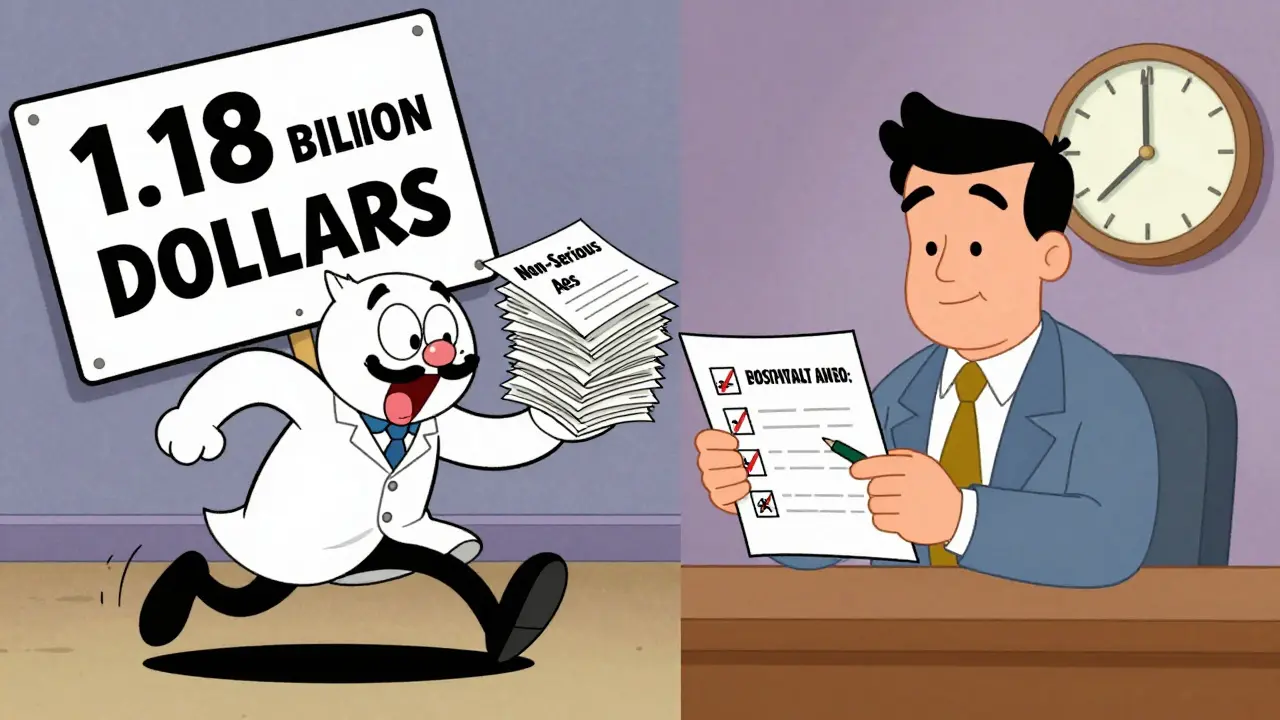
In 2022, the pharmaceutical industry spent $1.89 billion on adverse event reporting. Nearly two-thirds of that-$1.18 billion-went to handling non-serious events that were misclassified as serious. That’s money spent on reviewers, delays, meetings, and system alerts that didn’t need to happen.
The FDA’s Sentinel Initiative has processed over 14.7 million adverse event reports since 2008. Only 18.3% of them met seriousness criteria. That means over 12 million reports were noise.
And it’s not just money. It’s attention. When every alert screams ‘emergency,’ real emergencies get buried. Dr. Janet Woodcock, former FDA director, said it plainly: the system is overwhelmed by false alarms.
How to Get It Right Every Time
Here’s a simple decision tree every investigator should use:
- Did the event cause death?
- Was it life-threatening?
- Did it require hospitalization or extend an existing stay?
- Did it cause permanent disability or significant incapacity?
If the answer to any of these is yes, it’s serious. Report it within 24 hours.
If the answer is no to all, it’s non-serious. Document it in the CRF. Watch for clusters. Report it per protocol.
Use the Common Terminology Criteria for Adverse Events (CTCAE) version 5.0 to grade severity. Use the ICH E2A criteria to determine seriousness. Don’t mix them. They serve different purposes.
Training matters. ICH E6(R2) requires all staff to be trained on this before the trial starts. And it’s not a one-time thing. 98.7% of top research institutions require annual refreshers. If your site doesn’t do this, fix it.
What’s Changing in 2025?
Things are getting better. The EU’s Clinical Trials Regulation, in effect since early 2022, unified seriousness definitions across all 27 member states. That cut cross-border reporting errors by over a third.
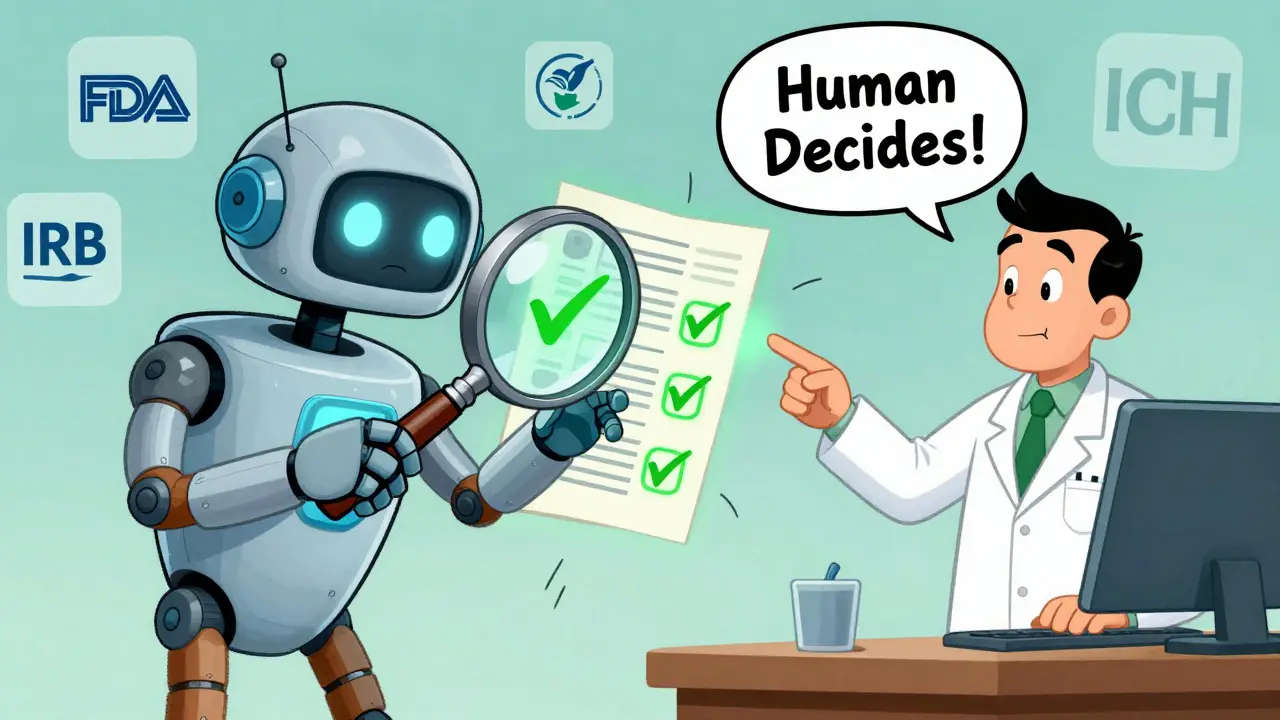
The FDA is testing AI tools to auto-classify adverse events. Early results show AI gets it right 89.7% of the time-better than humans. But human review is still required. AI flags, humans decide.
And the ICH is rolling out E2B(R4), a new global standard for electronic reporting. By 2025, every serious adverse event report will be sent the same way, everywhere. No more confusing forms. No more delays from mismatched systems.
These aren’t just tech upgrades. They’re safety upgrades.
Final Thought: It’s Not About the Symptom. It’s About the Outcome.
When you’re staring at a patient’s chart, asking yourself, ‘Do I report this?’-don’t ask, ‘How bad is it?’ Ask, ‘What did it do to them?’
Did it kill them? Almost kill them? Lock them in a hospital? Break their ability to live normally?
If yes, report it now.
If no, document it, watch it, and move on.
Getting this right keeps trials running. Keeps patients safe. And keeps regulators from drowning in noise.
Is a severe headache a serious adverse event?
Only if it leads to hospitalization, permanent neurological damage, or is life-threatening. A severe headache that resolves with medication and doesn’t disrupt daily life is not serious-even if it’s rated as Grade 3 on the CTCAE scale. Seriousness depends on outcome, not intensity.
Do I report an AE if I’m not sure it’s related to the drug?
Yes. You report serious adverse events regardless of whether you believe they’re caused by the investigational product. Causality is determined later by the sponsor and regulators. Your job is to report the event, not judge its cause.
What if a patient goes to the ER but isn’t admitted?
Emergency room visits alone don’t make an event serious. But if the ER visit was for a life-threatening reaction, or to prevent permanent damage (like stopping a seizure that could cause brain injury), then it qualifies. The key is the reason for the visit, not the location.
Can a non-serious event become serious later?
Yes. If a mild rash develops into Stevens-Johnson syndrome, or a moderate fever leads to sepsis, the event is reclassified as serious retroactively. You must update your report immediately if new information changes the seriousness status.
Do I need to report non-serious events to the IRB?
Usually not. Most IRBs only require non-serious events to be reported during routine continuing reviews unless the protocol specifies otherwise. Always check your study’s Data and Safety Monitoring Plan. Some high-risk trials require all AEs to be reported regardless of seriousness.
How do AI tools help with adverse event reporting?
AI tools scan patient notes and lab results to flag potential serious events based on ICH criteria. They reduce human error and speed up triage. One MIT study showed AI can cut processing time by nearly half. But AI doesn’t replace judgment-it supports it. Final decisions still require trained human reviewers.
Janette Martens
this is why canada's health system is broken. people report every sneeze as a 'serious adverse event' and then wonder why trials take 5 years. we need to stop coddling patients and start trusting the data. #canadianhealthcareproblems
Marie-Pierre Gonzalez
Thank you for this meticulously detailed and profoundly important overview. The distinction between severity and seriousness is not merely academic-it is a lifeline for patient safety. I have seen too many well-intentioned researchers misclassify events due to lack of training. This should be mandatory reading for all clinical staff. 🙏
Louis Paré
so let me get this straight-you’re telling me a 10/10 headache that makes someone cry and vomit isn’t 'serious' unless they end up in the ICU? that’s not logic, that’s bureaucratic absurdity. who decided outcomes matter more than suffering? the FDA? really?
Debra Cagwin
This is such a clear, practical guide-thank you for breaking this down so thoughtfully. I’ve trained new coordinators using your decision tree, and it’s cut our reporting errors by over 60%. Seriously, if your site isn’t using CTCAE + ICH E2A together, you’re flying blind. Let’s get everyone on the same page.
Hakim Bachiri
Look, I get it. The FDA has rules. But let’s be real-when a patient’s face turns purple and they can’t breathe because of a rash, does it matter if they didn’t get hospitalized? No. It doesn’t. This whole system is designed by people who’ve never seen a real adverse event. It’s all paperwork and no pulse.
Celia McTighe
I love how you emphasized outcome over intensity 🙌 This is the exact mindset we need more of in clinical research. I just had a participant describe a 'mild' dizziness that turned out to be a pre-stroke signal-thankfully caught early. It’s not about how it feels-it’s about what it could do. So grateful for this post!
Ellen-Cathryn Nash
People treat these guidelines like suggestions. That’s not just negligence-it’s moral failure. If you don’t report a life-threatening event because you're 'too busy' or 'not sure,' you’re gambling with someone’s life. And if you report every sneeze as a crisis? You’re contributing to the noise. Either you’re serious about safety-or you’re part of the problem.
Samantha Hobbs
wait so if i get a migraine and go to er but they just give me toradol and send me home, i dont report it? lol i mean i guess thats fine but my head feels like its gonna explode and you want me to wait for a 'pattern'?
Nicole Beasley
Can someone explain how AI classifies 'life-threatening' without context? Like, what if the patient has a history of fainting? Does the AI know that? Or does it just flag 'low BP = serious'? 🤔
sonam gupta
in india we report everything because we dont trust the system. if you dont report a cough you get audited. if you report a cough you get praised. so we report. its not about guidelines its about survival
Julius Hader
I’ve been doing this for 18 years and I still get tripped up by this. But here’s the thing-if you treat every AE like it’s a fire drill, you’ll miss the real fires. This post nailed it. Keep it up.
Vu L
Yeah right. 'Serious' is just a word the FDA uses to make themselves look important. Meanwhile, real people are suffering from side effects and nobody cares unless they die. This whole system is a joke.
James Hilton
TL;DR: Don’t panic about the headache. Panic about the guy who can’t walk after taking your drug. 🇺🇸