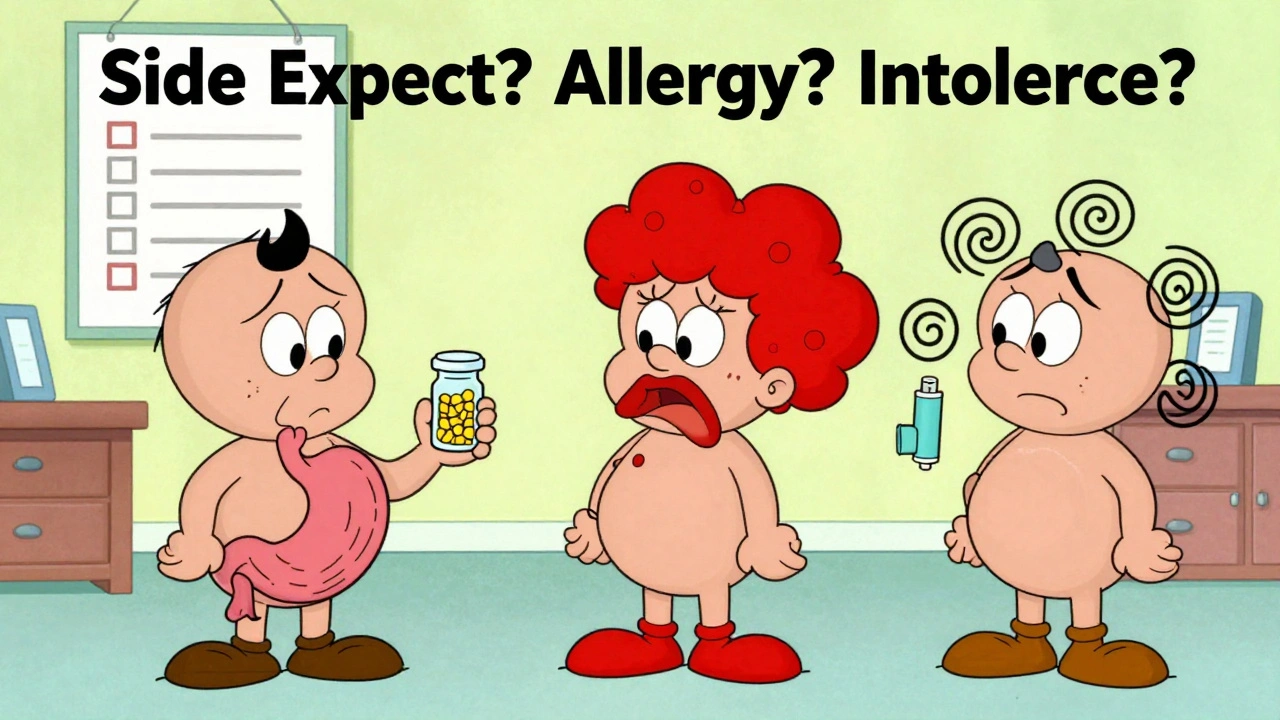
When you take a new medication, your body might react - but not all reactions are the same. You might feel nauseous, get a rash, or have trouble breathing. But which one is a normal side effect, which is a true allergy, and which is just your body being extra sensitive? Confusing these can lead to unnecessary fear, worse treatments, or even dangerous mistakes. Many people think they’re allergic to penicillin because they got sick once, but only 1% of those people actually are. The rest? They had a side effect or intolerance - and they’re missing out on safer, more effective drugs because of it.
What Is a Side Effect?
A side effect is a known, predictable reaction to a drug that has nothing to do with your immune system. It’s the drug doing exactly what it’s supposed to do - just in a way you didn’t want. For example, antidepressants like SSRIs can cause drowsiness or nausea. NSAIDs like ibuprofen often upset your stomach. These aren’t surprises; they’re listed in the drug’s package insert for a reason.Side effects usually show up soon after you start the medicine, and they often get better over time. Your body adjusts. If you take metformin for diabetes and get diarrhea at first, eating it with food cuts that risk by 60%. If you feel dizzy on blood pressure meds, your doctor might lower the dose. Side effects are dose-dependent - take more, and the reaction gets worse. Take less, and it fades.
Common side effects include:
- Nausea or vomiting (25-30% of NSAID users)
- Drowsiness (40% of first-gen antihistamines)
- Dizziness (15% of SSRI users)
- Headache, dry mouth, constipation
These aren’t dangerous in most cases - just annoying. And they’re not allergies. You won’t go into shock. You won’t break out in hives. You won’t stop breathing. Your immune system isn’t involved at all.
What Is a True Allergic Reaction?
A drug allergy is your immune system overreacting to a medication like it’s a virus or poison. This is rare - only 5-10% of all bad drug reactions are true allergies. But when it happens, it can be life-threatening.True allergic reactions happen fast - usually within minutes to an hour after taking the drug. Symptoms include:
- Hives (raised, itchy red welts on the skin)
- Swelling of the lips, tongue, or face (angioedema)
- Wheezing or trouble breathing
- Drop in blood pressure
- Loss of consciousness
If you’ve ever needed epinephrine (an EpiPen) after taking a medication, you had a true allergic reaction. That’s not a side effect. That’s an emergency. These reactions can get worse each time you’re exposed. Even a tiny amount can trigger a severe response.
There are also delayed allergic reactions that show up days later - like a widespread rash, fever, or organ inflammation (called DRESS syndrome). These are serious too. DRESS has a 10% death rate if not caught early. Doctors diagnose these with blood tests, skin tests, and sometimes a controlled drug challenge.
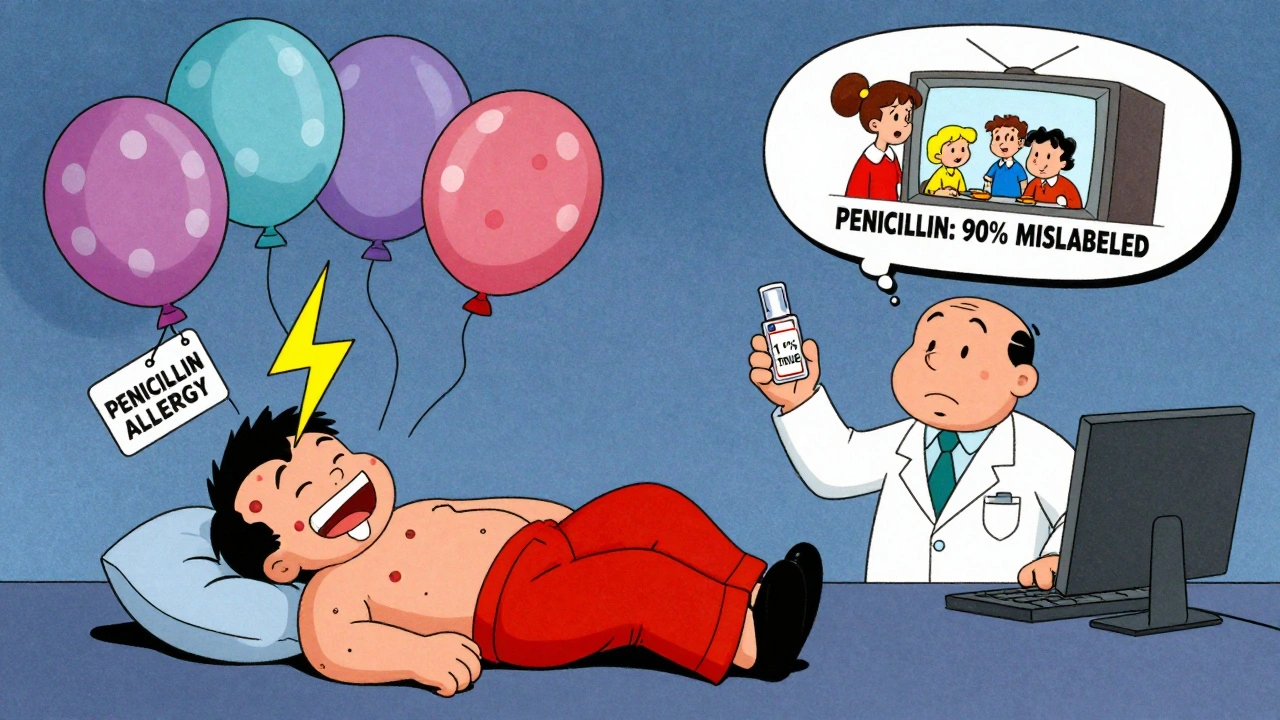
Penicillin is the classic example. About 10% of Americans say they’re allergic to it. But when tested, only 1% actually are. The rest? They had nausea, diarrhea, or a mild rash - side effects, not allergies. Yet because they think they’re allergic, they get stronger, costlier, riskier antibiotics. That leads to 30% higher rates of C. diff infections and 50% higher MRSA rates.
What Is Drug Intolerance?
Intolerance is the gray area. It’s not an allergy. It’s not a typical side effect. It’s your body being unusually sensitive to a drug’s normal action. You get a reaction at a dose that most people handle fine.For example, codeine is meant to relieve pain. But some people metabolize it too quickly - turning it into morphine faster than usual. That leads to vomiting, dizziness, or even breathing problems - even at a normal dose. This isn’t an allergy. It’s genetics. About 7% of Caucasians have this gene variation.
Another common case: aspirin and other NSAIDs. About 7% of adults with asthma develop nasal polyps and wheezing after taking them. This is called aspirin-exacerbated respiratory disease (AERD). It’s not IgE-mediated. It’s not an allergy. But it’s real. And it means you can’t take aspirin, ibuprofen, or naproxen. You can, however, take celecoxib - a COX-2 inhibitor - without issue.
Intolerance is often misunderstood. People say, “I can’t take this pill - it makes me sick.” But if the same reaction happens every time, and it’s not hives or swelling, it’s likely intolerance. Your body can’t handle the dose, even if it’s correct.
How to Tell Them Apart: A Quick Guide
Here’s how to quickly sort out what kind of reaction you had:
| Feature | Side Effect | Allergic Reaction | Intolerance |
|---|---|---|---|
| Immune system involved? | No | Yes | No |
| Onset time | Hours to days | Minutes to 1 hour (or 2-3 days for delayed) | Usually within hours |
| Common symptoms | Nausea, dizziness, headache, fatigue | Hives, swelling, wheezing, low blood pressure | Exaggerated side effects - vomiting, asthma flare, dizziness |
| Gets worse with repeat use? | Often improves | Yes - can become life-threatening | Usually yes |
| Can you try again? | Maybe - with dose adjustment or timing | No - avoid completely | Maybe - switch to a different drug in the same class |
| Testing available? | No | Yes - skin tests, blood tests, challenge | Usually no - diagnosis by exclusion |
Why This Matters: Real Consequences
Mixing these up isn’t just confusing - it’s costly and dangerous. The CDC estimates that 10% of Americans wrongly think they’re allergic to penicillin. That leads to:
- More use of broad-spectrum antibiotics like vancomycin or clindamycin
- Higher risk of deadly infections like C. diff and MRSA
- Longer hospital stays - on average, 1.2 extra days
- $1.2 billion wasted annually in unnecessary care
One patient told her doctor she was allergic to penicillin because she got sick after taking it as a kid. She avoided all antibiotics for 15 years. When she finally got tested, she wasn’t allergic at all. She’s taken amoxicillin eight times since - no problems.
On the flip side, someone who truly had anaphylaxis after sulfa drugs needs to avoid all sulfa-based meds forever. Mislabeling that as a “side effect” could kill them.
What Should You Do?
If you’ve had a bad reaction to a medication, don’t just label it “allergy.” Write down:
- What drug you took
- What symptoms you had
- How long after taking it they started
- How you treated them
- Whether you’ve taken it again since
Then talk to your doctor. If you had:
- Swelling, hives, trouble breathing, or needed epinephrine → see an allergist
- Nausea, dizziness, headache → talk to your doctor about dose or timing
- Reactions to multiple NSAIDs or asthma flare-ups → ask about intolerance
Many hospitals now offer drug allergy clinics. The CDC recommends testing for anyone with a penicillin allergy label. The test is simple: skin test, then a small oral dose under supervision. Results in 2-3 hours. You walk out knowing the truth.
Don’t let a vague memory from 10 years ago keep you from the best treatment. You don’t need to suffer through side effects. You don’t need to avoid life-saving drugs. You just need to know what really happened - and get the right diagnosis.
What’s New in 2025?
Technology is catching up. In 2023, the FDA launched a program that uses AI to scan over a million electronic health records every month to spot mislabeled allergies. Hospitals using smart EHR systems have cut allergy mislabeling by 55%.
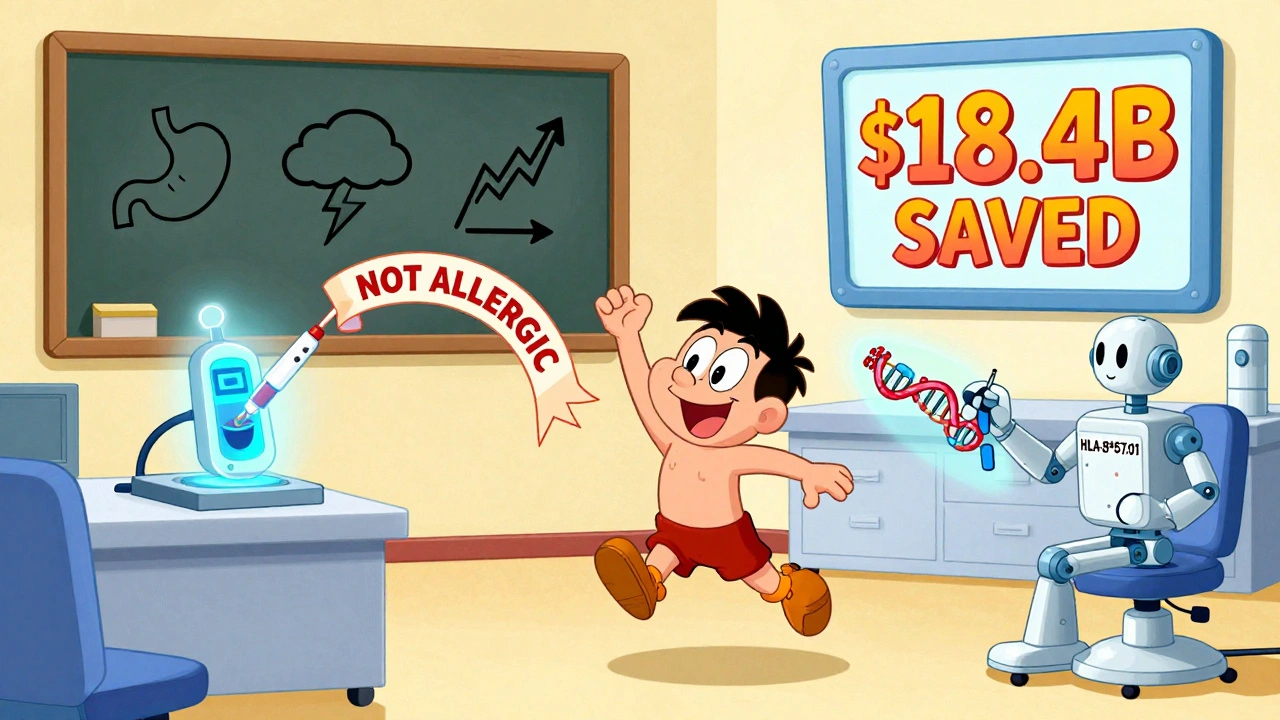
A new point-of-care penicillin test is in development - it’ll give results in 15 minutes instead of 3 hours. And researchers are testing genetic screens to predict who’s likely to have intolerances before they even take a drug. For example, screening for the HLA-B*57:01 gene prevents deadly reactions to the HIV drug abacavir in 99% of cases.
By 2030, experts estimate that fixing just the penicillin allergy mislabeling problem could save the U.S. healthcare system $18.4 billion a year. That’s not just money - it’s fewer infections, shorter hospital stays, and better outcomes for millions.
Can a side effect turn into an allergy?
No. A side effect is a direct pharmacological reaction - your body reacts to the drug’s chemistry. An allergy is an immune response. One doesn’t turn into the other. But you can have both at different times - for example, you might get nausea (side effect) from a drug, and later develop hives (allergy) to the same drug. That’s two separate reactions, not one evolving into the other.
If I had a rash after taking a drug, is that an allergy?
Not necessarily. A mild, flat, non-itchy rash that appears days later could be a delayed side effect or a viral rash coinciding with the medication. A raised, itchy, spreading rash - especially with swelling or breathing issues - is more likely allergic. Only a doctor can tell the difference. Don’t assume - get checked.
Can I outgrow a drug allergy?
Yes, especially with penicillin. About 80% of people who had a true penicillin allergy in childhood lose it over 10 years. That’s why testing is so important. If you were labeled allergic 15 years ago, you might be perfectly safe to take it now - if you get tested.
Is it safe to take a drug I was told I’m allergic to if I haven’t had a reaction in years?
No - not without testing. Even if you haven’t reacted in 10 years, your immune system may still remember the drug. A mild reaction in the past can lead to a life-threatening one later. Always get evaluated by an allergist before trying it again.
What should I do if I think I’m allergic to a medication?
Don’t just avoid it. Write down the exact symptoms and timing. Then ask your doctor for a referral to an allergist. Most side effects can be managed. Most true allergies can be confirmed - or ruled out - with simple tests. You deserve the safest, most effective treatment - and that starts with knowing exactly what happened to your body.
jagdish kumar
Everything is a conspiracy anyway.
Yasmine Hajar
I remember my cousin took amoxicillin and broke out in hives-she was told it was 'just a side effect' for years. Turns out she was allergic. Now she carries an EpiPen. Don't gamble with your body.
Rebecca Braatz
This is the kind of info we NEED more of in mainstream medicine. So many people are walking around with mislabeled allergies and it’s costing lives. Kudos for breaking it down so clearly-this should be mandatory reading for every high school health class.
Rachel Bonaparte
Of course the pharmaceutical industry wants you to think your reaction was 'just a side effect'-it keeps you buying more pills. They don’t want you knowing that 99% of 'allergies' are actually misdiagnosed side effects because then they’d have to reformulate drugs or admit their testing is flawed. The FDA's AI program? Please. It’s just PR to make us feel safe while they keep pushing generics with untested fillers. I’ve seen patients develop full-blown anaphylaxis after being told they were 'fine' for years. It’s not science-it’s profit-driven negligence.
And don’t get me started on how they market penicillin alternatives as 'premium' when they’re just cheaper to produce and more profitable. That $1.2 billion waste? That’s not waste-it’s a business model. You think your doctor is helping you? They’re just following the algorithm fed to them by Big Pharma’s lobbyists. Wake up.
Pavan Kankala
They’re all just trying to control us. Even the word 'allergy' is a construct. Your body knows what’s real. You just need to listen.
Ashley Elliott
Thank you for this. I had no idea about the difference between intolerance and allergy-I just thought 'if it makes me sick, I'm allergic.' This changed how I talk to my doctor.
Michael Feldstein
Great breakdown. One thing I’d add-sometimes side effects feel like allergies because they’re intense. I had terrible nausea on metformin, thought I was allergic, but after adjusting timing and eating with it, it vanished. Don’t panic. Track it. Talk to your doc.
Augusta Barlow
Why do we even trust doctors anymore? They read from scripts written by drug reps. The whole system is rigged. That 'AI program'? It’s probably just flagging people who complain too much. My aunt got labeled allergic to ibuprofen because she got a headache-now she can’t take anything for her arthritis. They’re just trying to sell you something else.
zac grant
From a pharmacogenomics standpoint, the HLA-B*57:01 screening for abacavir is the gold standard for preemptive intolerance detection. We’re moving toward precision prescribing-where genotyping informs first-line therapy selection. The future isn’t trial-and-error; it’s predictive. The FDA’s initiative is just the tip of the iceberg. We’re entering an era where adverse event mapping via EHRs will reduce polypharmacy risks by up to 40% in high-risk cohorts.
Jordan Wall
Wow, this is *so* enlightening 😍 I mean, I literally just learned that intolerance ≠ allergy… and I have a PhD? 😅 Also, the 1.2 billion wasted? That’s more than my rent. Who’s paying for this? 🤔
Libby Rees
Clear, accurate, and necessary. Thank you for taking the time to write this. Many people misunderstand these terms, and the consequences can be severe.
michael booth
Excellent resource. This should be shared with every primary care provider. The penicillin mislabeling epidemic is a public health failure that’s entirely preventable.
Jenny Rogers
It is a matter of profound ethical concern that the medical establishment continues to propagate such pervasive diagnostic ambiguity. The conflation of pharmacological side effects with immunological hypersensitivity constitutes a systemic failure of clinical literacy, which, in turn, perpetuates the commodification of patient fear. One must question the epistemic authority of institutions that prioritize procedural efficiency over epistemological rigor.
Chad Handy
I’ve been taking ibuprofen for 20 years. Never had a problem. Then one day I got a rash. Now I’m terrified of every pill. My doctor says it’s probably intolerance. But what if it’s an allergy? What if I die next time? I don’t sleep anymore. I read forums. I Google symptoms. I’m not the same person I was before.
Shofner Lehto
My sister was told she was allergic to penicillin as a kid because she got a stomachache. She avoided it for 12 years. Got tested last year-zero allergy. Took it for a sinus infection. Fine. Now she’s mad she wasted so much time being scared. Don’t let fear make your decisions. Get tested.