Medication Travel Checker
Check Your Medication's Legality
Important: Always carry original prescription containers and a doctor's letter.
Use the U.S. State Department Medication Check Tool for official verification.
More than half of American adults take prescription medications daily. When you’re planning a trip - whether it’s a weekend getaway or a month-long adventure abroad - your meds don’t take a vacation. But neither do the risks. Losing your pills, dealing with time zones, or accidentally bringing a banned drug into another country can turn a dream trip into a nightmare. The good news? With the right prep, you can avoid almost all of it.
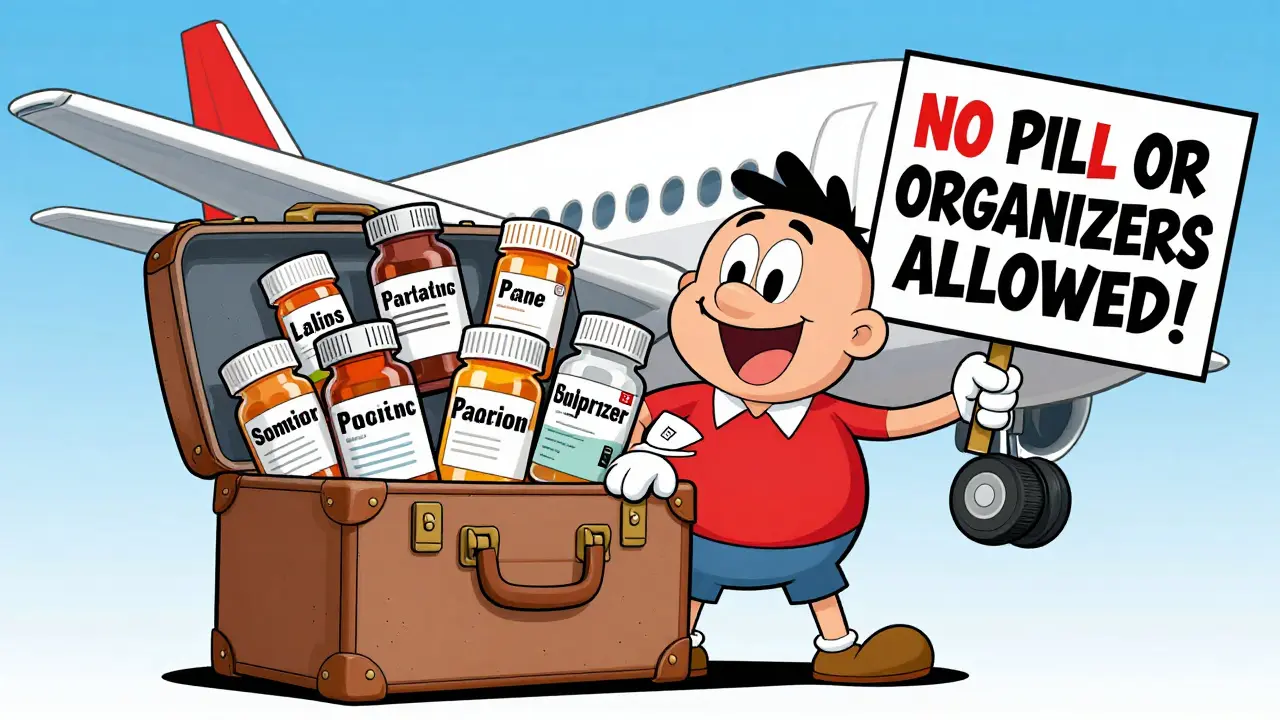
Keep Medications in Original Containers
Never transfer your pills into pill organizers or random bottles before you leave. The TSA and every major airline require medications to be in their original pharmacy-labeled containers. This isn’t just a suggestion - it’s a rule. Why? Because security agents need to instantly verify what you’re carrying. A bottle labeled "Lisinopril 10mg" with your name, the pharmacy’s logo, and the prescribing doctor’s info tells them everything they need to know.Same goes for international travel. Customs officers in countries like Japan, South Korea, or Singapore don’t speak English, but they understand pharmacy labels. If your meds aren’t in original bottles, you risk being detained, fined, or even arrested. There’s no gray area here. Even if you’ve traveled for years without issue, one random inspection can change everything.
Bring More Than You Think You’ll Need
Plan for delays. Flights get canceled. Baggage gets lost. You might end up stuck in a hotel for an extra week because of weather or illness. That’s why experts recommend bringing a 7- to 14-day supply beyond your exact trip length.For example: if you’re going to Italy for 10 days, pack 17 to 24 days’ worth of medication. This isn’t overkill - it’s insurance. Northwestern University’s travel safety team says this is the single most common mistake travelers make. And it’s not just about running out. Some medications, like insulin or thyroid pills, can’t be easily refilled overseas. Even if you find a local pharmacy, they won’t fill a U.S. prescription. The CDC confirms: "Overseas pharmacies cannot refill U.S.-based prescriptions."
Pro tip: Ask your pharmacy for a 90-day supply before you leave. Most insurance plans allow early refills - often 5 days ahead. Call ahead. Don’t wait until the day before your trip.
Know What’s Allowed in Your Destination Country
This is where most people get caught off guard. Just because a medication is legal in the U.S. doesn’t mean it’s legal elsewhere. The U.S. State Department reports that 67% of countries restrict at least one common American medication.Here’s what’s often banned:
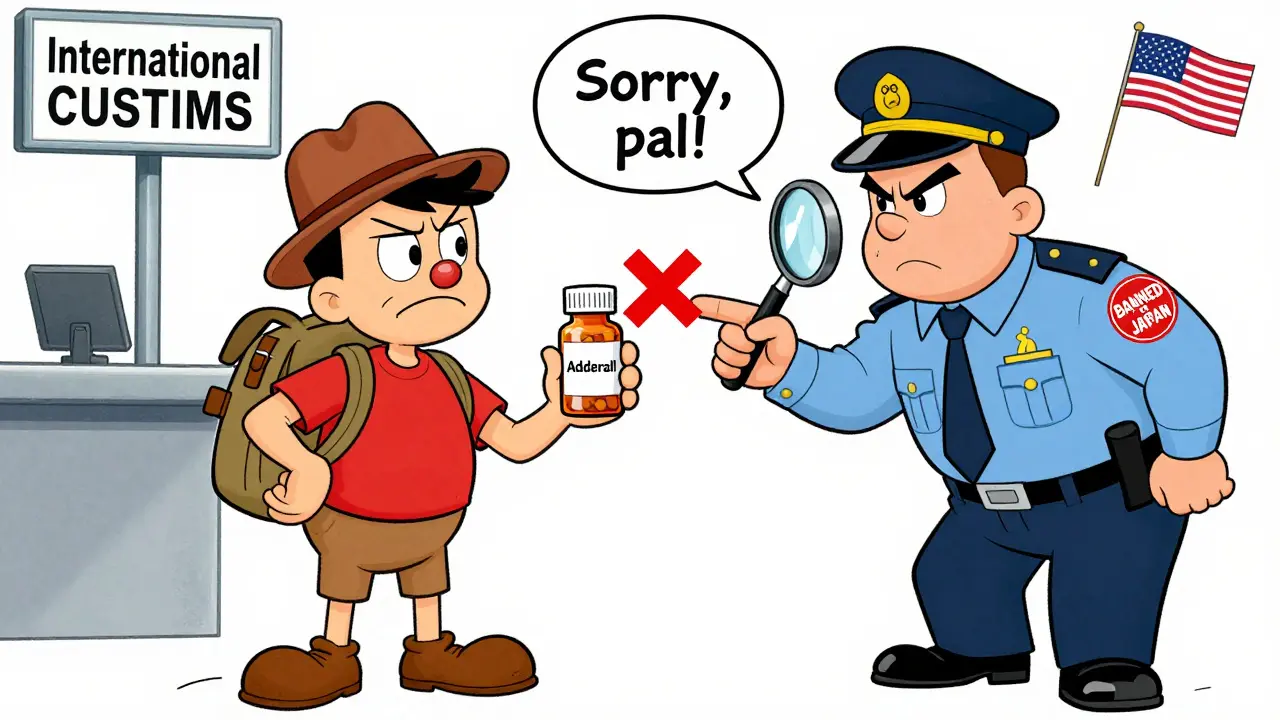
- Adderall - Illegal in Japan, Singapore, and over 40 other countries
- Ambien - Banned in South Korea, Thailand, and the UAE
- Sudafed (pseudoephedrine) - Restricted in 28 countries, including Australia and Germany
- Codeine - Controlled in Japan, Saudi Arabia, and most of Southeast Asia
- Birth control pills - Banned in some Middle Eastern countries unless you have a doctor’s note
Don’t guess. Check. Use the U.S. State Department’s Medication Check Tool (launched March 2023). Just type in your medication name and destination - it tells you if it’s allowed, restricted, or banned. If you’re flying with Emirates or Qatar Airways, check their websites too. Some airlines require advance approval for controlled substances.
Carry Documentation - Even If You Think You Don’t Need It
Bring a copy of your prescription. Bring a letter from your doctor. Don’t assume your pharmacy label is enough.The letter should include:
- Your full name and date of birth
- Diagnosis (e.g., "hypertension," "ADHD")
- Medication names, dosages, and frequency
- Reason for use
- Doctor’s contact info and signature
For injectables like insulin or Ozempic, this letter is non-negotiable. TSA and international customs will ask for it. And if you’re traveling to the EU, many countries accept U.S. prescriptions if you have this letter - but not without it.
Pro tip: Print two copies. Keep one in your carry-on, one in your wallet. If you’re stopped, you’ll need it fast.
Handle Liquids, Shots, and Refrigerated Meds Correctly
TSA lets you bring liquids over 3.4 ounces - including insulin, liquid antibiotics, or oral suspensions - as long as you declare them at security. Put them in a separate clear plastic bag. Don’t hide them. Tell the agent: "I have medication liquids." They’ll screen them separately. No problem.For refrigerated meds like insulin, you need a cooler. Not a regular lunchbox. Use a pharmaceutical-grade cooling pack that maintains 36°F-46°F for 48+ hours. These are sold online or at pharmacies. Some travelers use insulated bags with frozen gel packs - but make sure they’re not dripping. Wet bags cause delays.
And never, ever check your meds. Always keep them in your carry-on. Checked luggage can be lost, delayed, or exposed to extreme temperatures. One traveler lost their entire month’s supply of antidepressants in Dubai when their bag was rerouted. They ended up in the ER.
Adjust for Time Zones Without Risk
Time zone changes mess with your schedule. Taking your pill 6 hours late? That’s fine for most meds. But doubling up? That’s dangerous.WebMD’s rule: "It’s usually safe to take your medicine 1-2 hours early or late. Don’t double up."
For example: If you take a daily blood pressure pill at 8 a.m. Eastern Time and fly to London (5-hour time difference), you can take it at 1 p.m. London time (8 a.m. Eastern). No need to adjust on day one. Wait until you’ve settled in. Then slowly shift your schedule over a couple days.
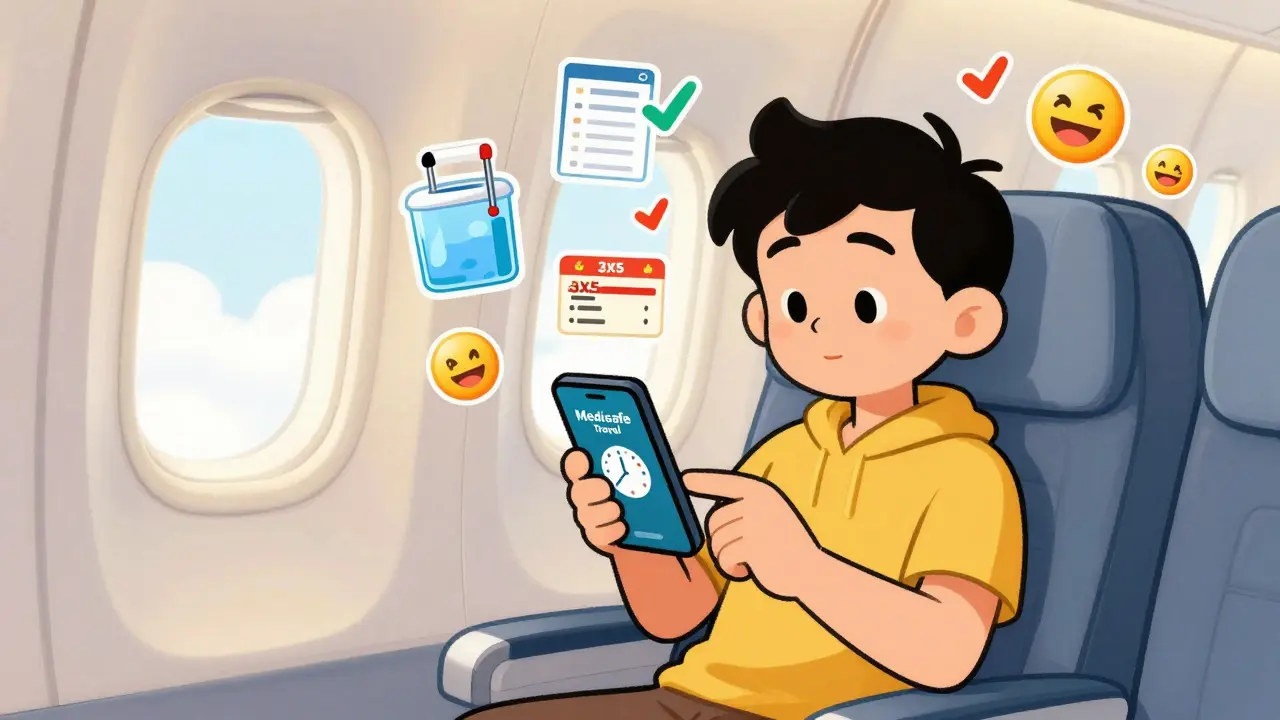
Use your phone alarms - set one for home time, one for local time. Apps like Medisafe Travel (rated 4.7/5 by over 12,000 users) can remind you in both time zones and even translate pill names into local languages.
Prepare for Side Effects and Emergencies
Travel stresses your body. Jet lag, new food, different water, lack of sleep - these can trigger side effects you’ve never had before. A migraine pill might make you dizzy. An antibiotic might cause nausea. You need a plan.Before you leave:
- Ask your doctor: "What side effects should I watch for while traveling?"
- Bring over-the-counter meds for common issues: anti-diarrheal, antihistamines, pain relievers, anti-nausea pills
- Know where the nearest pharmacy or clinic is at your destination
- Carry a small card with your medical conditions, meds, and allergies in the local language
One traveler in Thailand developed severe nausea from antibiotics. She had no idea how to ask for help. She ended up using Google Translate to type "I need anti-nausea medicine" - and found a pharmacy. Don’t be that person. Print a 3x5 card with your meds and symptoms in the local language. Many pharmacies and hospitals in tourist areas have staff who speak English, but don’t count on it.
What to Do If Something Goes Wrong
If your meds are lost, stolen, or confiscated:- Call the nearest U.S. embassy or consulate immediately. They have emergency medical contacts.
- Don’t try to buy meds locally unless you’re certain they’re safe and legal.
- If you’re in a country where your med is banned, ask the embassy for help finding a legal alternative.
- For insulin or life-saving meds, contact your pharmacy back home - they may be able to wire a prescription to a local pharmacy with a doctor’s approval.
Remember: The U.S. government cannot get you banned meds. They can’t override foreign laws. But they can help you find safe alternatives.
Final Checklist Before You Go
- ☑ All meds in original bottles with labels
- ☑ 7-14 extra days’ supply
- ☑ Prescription copies + doctor’s letter
- ☑ Checked medication legality in destination country (U.S. State Dept tool)
- ☑ Refrigerated meds in proper cooler
- ☑ Liquid meds in separate clear bag, ready to declare
- ☑ Phone alarms set for home and local time
- ☑ Emergency card with meds and allergies in local language
- ☑ All meds in carry-on - never checked luggage
Traveling with medication isn’t complicated - but it’s easy to skip steps when you’re busy. Take two hours before your trip to check this list. It’s the difference between a smooth journey and a hospital visit in a foreign country.
Can I bring my prescription meds in a pill organizer when traveling?
No. TSA and international customs require all prescription medications to be in their original pharmacy-labeled containers. Pill organizers are not allowed for prescription drugs unless you keep the original bottles with you. Some travelers use pill organizers for over-the-counter meds, but never for prescriptions. Always keep your name, dosage, and pharmacy info visible.
What if my medication is banned in the country I’m visiting?
If your medication is banned, do not bring it. Even with a prescription, you risk detention, fines, or arrest. Contact your doctor before your trip to find a legal alternative. Some countries allow similar drugs under different names. The U.S. embassy can help you identify approved substitutes. Never rely on online pharmacies or local street vendors - counterfeit meds are common.
Can I ship my medication ahead to my hotel?
No. Shipping medication internationally is illegal in most countries and violates U.S. Customs rules. Even if you think it’s "for personal use," customs will seize it. Some countries, like Japan and Australia, have strict penalties for importing prescription drugs without prior approval. Always carry your meds with you in your carry-on.
Do I need to declare my meds at airport security?
Yes - but only if they’re liquids over 3.4 ounces. Place them in a separate clear plastic bag and tell the TSA agent: "I have medication liquids." For solid pills, you don’t need to declare them unless asked. However, if you have injectables or controlled substances, it’s wise to volunteer your doctor’s letter proactively. It speeds things up.
How do I handle insulin during a long flight?
Keep insulin in your carry-on, stored in a pharmaceutical-grade cooler that maintains 36°F-46°F. Most airlines allow you to bring ice packs as long as they’re not fully frozen (to avoid liquid restrictions). You can also ask the flight crew for a small fridge - many long-haul flights have medical refrigerators for passengers. Never check insulin. Heat and pressure changes can ruin it.
Michael Ochieng
I just got back from Japan and I can't believe how chill customs was when I showed my original bottles with Lisinopril. They didn't even ask for a letter, but I had one anyway. Seriously, just do the prep work. It's not that hard.
Also, if you're bringing Adderall? Don't. I saw a guy get detained for it in Tokyo. His wife cried. Don't be that guy.
Dan Adkins
It is imperative that one adheres strictly to the regulatory frameworks governing pharmaceutical transport across international jurisdictions. The failure to comply with these protocols constitutes a flagrant disregard for sovereign legal authority and may result in dire consequences, including but not limited to incarceration. One must not underestimate the gravity of this matter.
Erika Putri Aldana
Why are we even doing this? Like, who cares if you get caught with Sudafed in Germany? Just buy it there. They don't even check. I did it 3 times. No big deal. 😒
Grace Rehman
They say 'never check your meds' like it's a law from the gods
But what if your carry-on gets gate-checked because the plane is full?
What if you're in a 12-hour layover and your bag gets lost?
What if your 'pharmaceutical-grade cooler' melts in the cargo hold?
None of this is real safety. It's just fear dressed up as advice.
We're not preparing for travel. We're preparing for a dystopian airport hellscape.
And we're told to be grateful for the checklist.
Meanwhile, people in other countries take their meds in plastic bags and live.
Maybe the real danger isn't the pills.
It's the paranoia.
And the people selling you the paranoia.
And the $80 insulated cooler you didn't need.
And the doctor's letter that no one ever reads.
And the 37 apps that remind you to take your blood pressure pill in 5 different time zones.
Just breathe.
And maybe don't fly with 24 days of insulin.
But also... do. Because why risk it?
Ugh. I hate this world.
Jerry Peterson
Just had a friend get stopped in Dubai because their bottle had a sticker from a different pharmacy. They had the original bottle in their suitcase but were carrying a refill in a plastic container. They thought it was fine. It wasn't. Took 4 hours to sort it out. Don't be that guy. Keep it all in the original. Even if it's ugly.
Siobhan K.
For anyone who thinks 'I'll just buy it there' - please stop. I worked in a pharmacy in Thailand for six months. We had a guy come in asking for Adderall because his 'American doctor' said it was fine. He didn't know it was a Class A controlled substance there. We had to call the police. He cried. He was 19. Don't be him. Don't be the reason someone loses their job over your ignorance.
Brian Furnell
Regarding refrigerated meds: the thermal conductivity of the insulating matrix must be below 0.03 W/m·K to maintain the 36°F–46°F range during transit, particularly under ambient thermal gradients exceeding 35°C. Most consumer-grade coolers (e.g., Yeti, Coleman) fail to meet this threshold beyond 24 hours due to phase-change inefficiencies in gel-pack thermodynamics. I recommend the MedCool Pro 48, which utilizes vacuum-insulated panels with phase-change material (PCM) rated at 4.2°C latent heat capacity - validated per ISO 13485 standards. Also, never use dry ice - CO2 sublimation alters cabin pressure differentials and triggers FAA Class 9 hazardous material protocols. Consult your airline’s medical logistics department 72 hours pre-departure. I’ve compiled a spreadsheet.
Meina Taiwo
Original bottles only. No exceptions. Done.
Adrian Thompson
They’re all just trying to control you. TSA? State Dept? Pharmacies? They want you to think you need a letter, a cooler, 24 pills, and a doctor’s signature just to get to Bali. Meanwhile, people in Europe just carry their meds in their pocket. No one cares. This is all about power. They want you dependent. They want you scared. Don’t fall for it. I took my Xanax in a Ziploc to Mexico. No one said a word. They’re just selling fear to sell you gear.
Southern NH Pagan Pride
did u know that the state dept tool is run by the same people who made the covid travel bans? they’re tracking your meds to build a database for the next phase. i got my insulin in a plastic bag and they didn’t even scan it. why? because they already knew i was coming. they have your name. they have your rx. they have your blood type. they know when you’re sleeping. don’t be the one who brings the letter. be the one who breaks the system.
Orlando Marquez Jr
While I concur with the majority of the procedural recommendations delineated herein, I must respectfully submit that the implicit assumption of universal compliance with U.S. pharmaceutical norms may inadvertently marginalize travelers from non-Western jurisdictions who operate under divergent regulatory paradigms. A more globally inclusive framework might facilitate smoother cross-border pharmacological transit.
Theo Newbold
Let’s be real. The real problem isn’t the meds. It’s the fact that your doctor doesn’t know what’s in your prescription bottle. I once got a bottle labeled ‘Lisinopril’ that had 10mg pills but the label said 20mg. I called the pharmacy. They said ‘oops, typo.’ I had to take 10 pills a day to get my dose. No one checks. No one cares. So why are we all stressing over labels? The system is broken. You’re just being told to jump through hoops so they don’t have to fix anything.
Jay lawch
Every single thing in this post is a lie. The TSA doesn’t care about your bottle. The State Department doesn’t track your meds. The ‘medication check tool’? It was made by a guy in Nebraska who works for a pharmaceutical lobbying group. I’ve been to 47 countries. I’ve never had a problem with my Adderall in a pill organizer. The only reason they want you to use original bottles is so they can scan your name and link it to your insurance records. They’re building a global pharmaceutical surveillance network. You think this is about safety? No. It’s about control. They want to know who’s taking what, when, and where. And they want you to pay $120 for a cooler that does nothing. Don’t be a sheep. Take your meds in your pocket. Trust me. I’ve been doing it for 15 years. No one’s ever asked. No one ever will. The fear is manufactured. The rules are optional. The system is rigged.
Christina Weber
If you're not carrying a doctor's letter with your diagnosis, medication names, dosage, and signature, you're not just irresponsible-you're endangering yourself and others. There is no excuse for not doing this. You're not too busy. You're just lazy. And if you think 'I'll just buy it there' because you're too lazy to plan, you deserve to be arrested. This isn't a suggestion. It's basic human responsibility. Print the letter. Do it now. Don't wait. You're not special. Your meds aren't special. But your life is. Act like it.
Cara C
Hey, I know this sounds like a lot, but you got this. I used to panic every time I flew with insulin. Then I made a little card with my meds in Spanish and kept it in my wallet. I got lost in Mexico City once and asked a lady for help. She read my card and took me to a pharmacy. She didn’t speak English. But she understood the words. You don’t need to be perfect. You just need to be prepared. And you’re already ahead of 90% of people by reading this. Breathe. You’re gonna be okay.
Michael Ochieng
Also, if you're going to Europe and have insulin? Ask the airline for a medical fridge on long flights. I did it on Emirates and they gave me one in first class. No one else knew. Just ask nicely. They’re used to it. Don’t be shy.