When you take a pill for high blood pressure or an antibiotic, chances are it was made in China or India. These two countries produce over 80% of the world’s active pharmaceutical ingredients (APIs) and nearly half of all generic drugs sold in the U.S. But here’s the thing: manufacturing quality isn’t the same in both places - and the FDA knows it.
Why FDA Monitoring Matters More Than You Think
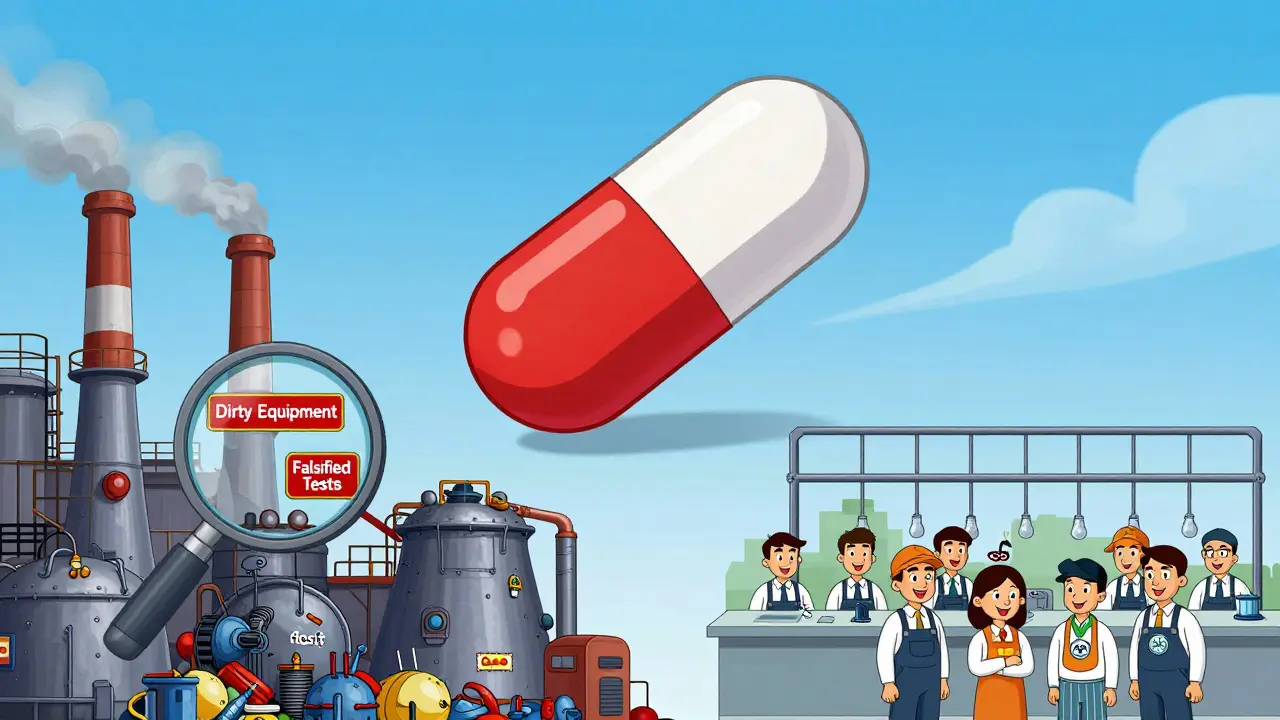
The FDA doesn’t just inspect drug factories for fun. Every inspection is a checkpoint between you and a potentially dangerous medicine. In 2023, 37% of Chinese pharmaceutical facilities faced import alerts from the FDA - meaning the agency blocked shipments because of safety violations. In contrast, only 18% of Indian facilities got flagged. That’s not a small difference. It’s the difference between a drug being safe to take and being pulled off shelves. These alerts aren’t just paperwork. They’re red flags for things like dirty equipment, falsified test results, or poor storage conditions. In one case, a Chinese plant was found to be using unapproved solvents to clean machinery - a practice that can leave toxic residues in pills. Indian plants, while not perfect, have fewer of these issues because their compliance systems are built into daily operations.India’s Edge: Compliance Built Into the System
India has over 100 FDA-approved drug manufacturing plants. China has 28. That’s not a typo. India leads by more than 250% in certified capacity. Why? Because India’s pharmaceutical industry learned early that compliance isn’t optional - it’s the price of entry to Western markets. Companies like Dr. Reddy’s, Sun Pharma, and Cipla didn’t just build factories; they built quality cultures. They trained staff on FDA 21 CFR Part 211 regulations. They installed digital monitoring systems to catch errors before they reach the bottle. Bain & Company’s 2024 report found that Indian manufacturers use digital tools to eliminate human mistakes across production lines - something still rare in many Chinese plants. FDA inspection reports from 2020 to 2023 show Indian facilities received 30% fewer Form 483 observations - the official notices of violations - than Chinese ones. That’s not luck. It’s systemic.China’s Scale vs. China’s Risk
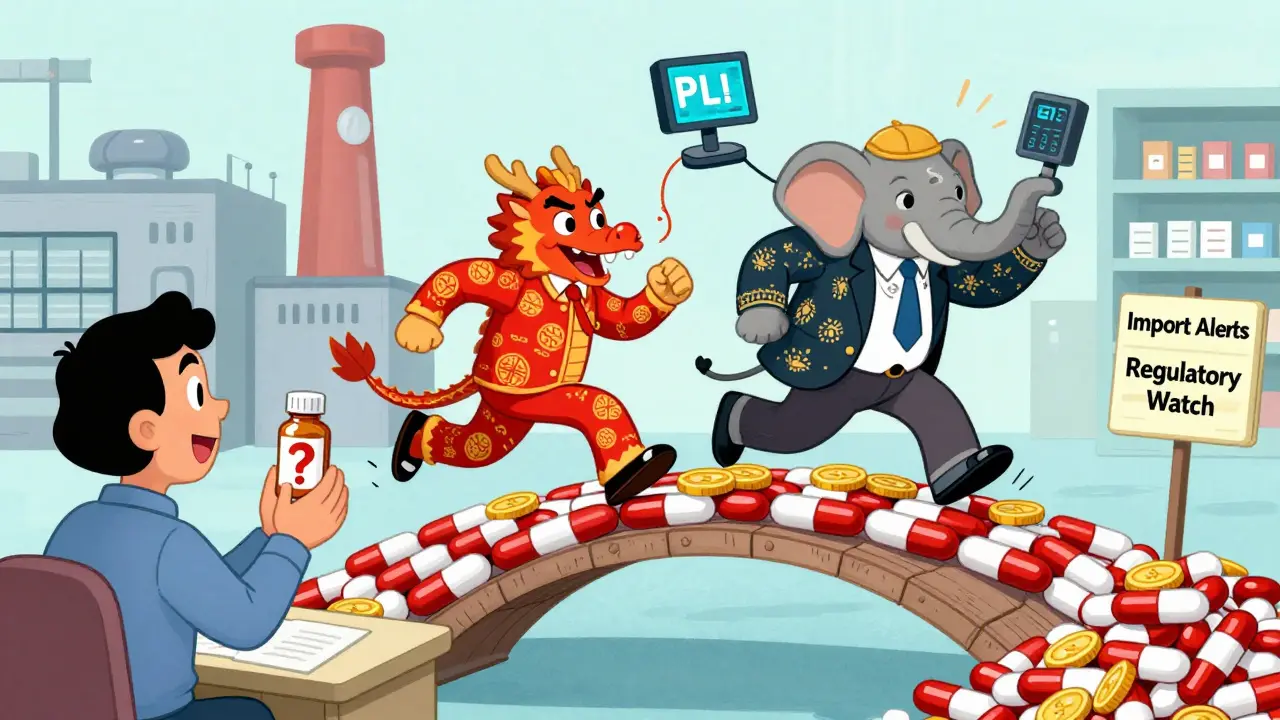
China makes more APIs than anyone else. It controls roughly 80% of the global supply of raw ingredients for common drugs like antibiotics, blood pressure meds, and painkillers. That’s power. But power comes with risk. China’s manufacturing ecosystem is massive, centralized, and cost-driven. Many factories are owned by state-backed conglomerates focused on output, not oversight. Smaller suppliers - who make up a big chunk of the market - often lack the resources to meet international standards. The result? Inconsistent quality. The FDA has responded by ramping up inspections and import restrictions. In 2023, nearly 4 out of 10 Chinese facilities were under some form of regulatory watch. That’s why global drugmakers are shifting. The “China+1” strategy isn’t a buzzword - it’s a survival tactic. Companies are adding India as a backup to avoid being stuck if a Chinese plant gets shut down.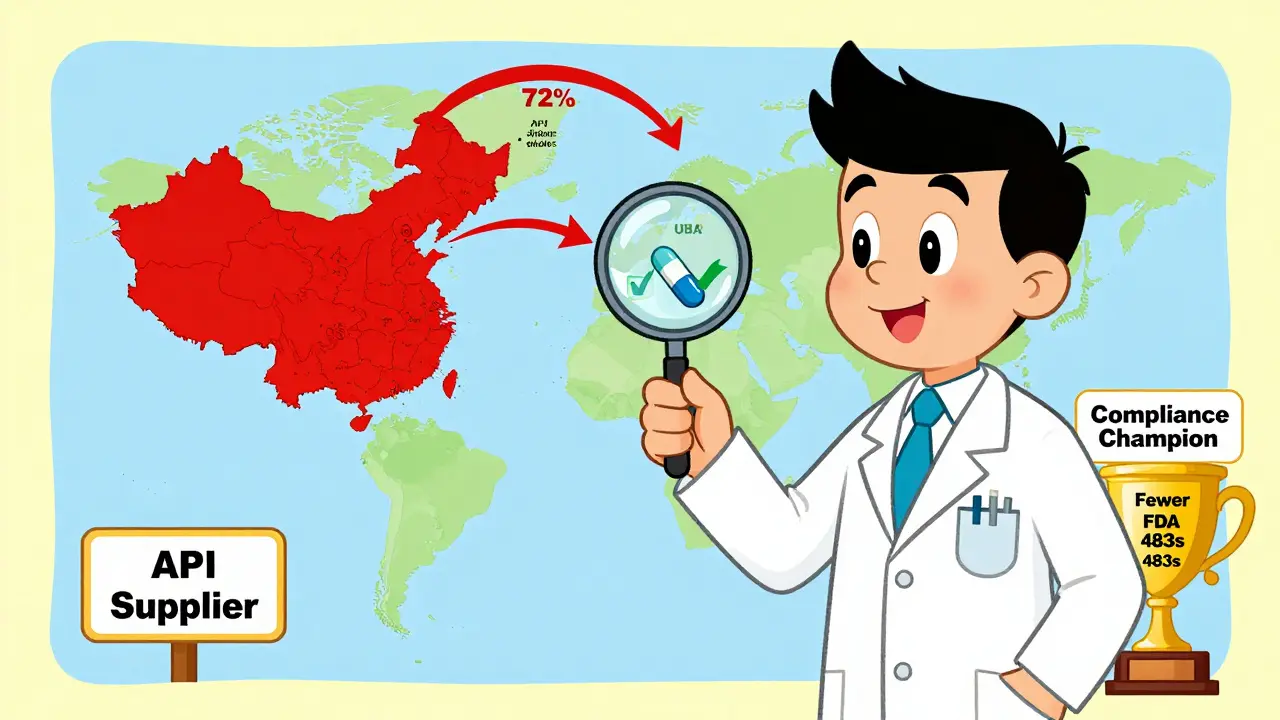
The Hidden Problem: India Depends on China
Here’s the twist: India, despite its compliance strengths, is deeply dependent on China. In 2024, 72% of India’s bulk drug ingredients - the raw materials for its generics - came from China. That’s up from 66% just two years earlier. Think of it like this: India builds the medicine, but China builds the engine. If China cuts off supply - whether for political reasons, a factory shutdown, or a quality failure - India’s entire export machine could stall. One U.S. pharmaceutical sourcing executive told Bain & Company: “We’re trying to fix a single point of failure in our supply chain.” That’s why India’s government is pouring $3 billion into production-linked incentives (PLIs) to boost domestic API manufacturing. The goal? Reduce that 72% dependency to under 40% by 2030. It’s a race against time.What Happens When You Choose One Over the Other?
If you’re a drugmaker deciding where to outsource:- Choose India if you need reliable compliance for U.S. or EU markets. You’ll pay slightly more, but you’ll avoid costly recalls, FDA delays, and reputational damage. Your audit schedule will be lighter, and your supply chain will be more predictable.
- Choose China if you’re making low-cost drugs for markets with looser regulations. You’ll save on price - but you’ll need to do more testing, more inspections, and more oversight yourself. It’s cheaper upfront, riskier long-term.
The Future: Who Wins?
India’s export potential is massive. Bain & Company projects its pharmaceutical exports could hit $350 billion by 2047 - up from $27 billion today. That growth hinges on two things: reducing API imports from China and moving into higher-value products like biosimilars and cell therapies. China’s future is more uncertain. While it’s investing heavily in biopharmaceuticals - with a projected 19.3% annual growth rate in that sector - its generic API dominance is eroding. By 2030, its share of the global outsourced pharma market could drop from 25% to 15%. Meanwhile, India is expected to pick up 20-30% of that lost share. The real winner? The patient. As supply chains become more resilient and quality improves, fewer people will get sick from bad medicine. That’s the goal.What You Should Know as a Consumer
You don’t need to know where your pill was made. But you should know this: if your medicine is a generic, it’s likely from one of these two countries. And the difference in quality matters. The FDA doesn’t guarantee every pill is perfect - but it does guarantee that drugs from compliant factories get tested more often. If your drug comes from a company that sources from India, it’s statistically more likely to meet U.S. safety standards. Don’t assume “Made in India” means better. Don’t assume “Made in China” means worse. But do know that the system behind the label - the inspections, the regulations, the quality checks - is what really decides if your medicine is safe.Why does the FDA inspect drug factories in China and India?
The FDA inspects foreign drug factories because over 80% of the active ingredients in U.S. medicines come from outside the country. These inspections ensure that drugs meet the same safety and quality standards as those made in the U.S. Without these checks, contaminated, ineffective, or improperly labeled drugs could reach American patients.
Is Indian-made medicine safer than Chinese-made medicine?
On average, yes - but it depends on the manufacturer. Indian facilities have fewer FDA violations and more approved plants than Chinese ones. In 2023, only 18% of Indian drugmakers faced import alerts compared to 37% of Chinese ones. That’s because Indian companies have spent decades aligning with U.S. and EU standards. But not all Indian factories are equal - and some Chinese plants are now meeting high standards too.
Why does India rely on China for drug ingredients?
India has focused on turning imported raw materials into finished generic drugs - a high-value, low-cost business model. China, meanwhile, became the world’s lowest-cost producer of APIs. It’s cheaper and faster for Indian companies to import APIs from China than to build their own large-scale production. But this creates risk: if China cuts off supply, India’s drug exports could collapse.
What is the "China+1" strategy in pharma manufacturing?
The "China+1" strategy means companies avoid putting all their manufacturing eggs in one basket. Instead of relying only on China, they add a second country - usually India - as a backup. This reduces supply chain risk. If a Chinese factory shuts down due to an FDA alert or political tensions, companies can switch production to India without losing output.
Are biosimilars better made in China or India?
China currently leads in biopharmaceutical production, with a 19.3% annual growth rate in that sector since 2015. India is catching up fast, with its biosimilars market projected to hit $12 billion by 2025. But China still has the edge in complex biologics because of its heavy state investment in R&D. India’s strength is in making these drugs cheaper and faster - if it can reduce its dependence on Chinese raw materials.
John O'Brien
Yo I just took my blood pressure med this morning and I had to double check the bottle because I read this article and now I’m paranoid
Paul Taylor
Look I get it India’s got better compliance numbers but lets not ignore the fact that China’s been upgrading fast like crazy in the last five years and a lot of those FDA alerts are from small mom and pop shops that shouldn’t even be exporting anyway the big players like Sinopharm and CSPC are now ISO certified and have real QA teams not just guys with clipboards
Also the whole narrative that India’s some golden child of pharma ignores how they’re still 72% dependent on China for APIs which is wild if you think about it they’re building houses on sand and pretending the foundation’s solid
And don’t even get me started on how the FDA’s inspection process is biased toward English speaking countries and the language barrier in China means a lot of violations get misreported or exaggerated
Plus the cost difference is insane you think a US company is gonna pay 30% more for Indian made pills when they can get the same thing from China for half the price if they do their own batch testing
And honestly the idea that patients are safer because it’s made in India is just marketing BS the pill doesn’t care where it was made it cares if the batch passed QC and that’s something you can do anywhere if you’re serious about it
I’ve worked in pharma logistics for 12 years and I’ve seen plants in both countries that are spotless and plants that look like they were built in a garage
The real problem isn’t geography its corporate accountability and the fact that most generic manufacturers are squeezed to the bone by insurance companies and PBMs so they cut corners wherever they can
So blaming China or India is just distracting from the real issue which is that our entire drug pricing system incentivizes risk not safety
And don’t even get me started on how the FDA only inspects like 5% of foreign facilities each year so the stats they publish are basically lottery numbers
Also the whole China+1 thing is just a hedge not a solution if you’re really serious about supply chain resilience you need to bring some API production back to the US or EU not just swap one foreign supplier for another
And why is no one talking about the fact that India’s PLI scheme is mostly just corporate welfare with zero transparency on who’s actually getting the money
And the biosimilars thing is a red herring China’s got way more experience in biologics manufacturing and their R&D spending is triple India’s
So yeah India’s got better compliance scores but that doesn’t mean they’re the answer and China’s not the villain
It’s all just a complex mess of economics politics and corporate greed and we’re pretending we can solve it with country flags
Kegan Powell
Man I just sat here thinking about how we’ve outsourced our health to two countries and now we’re playing detective to figure out who’s better at not poisoning us
It’s like we traded control for cheapness and now we’re surprised when things go wrong
And the saddest part is we know this
We’ve known for decades that drug manufacturing is a global game but we keep acting like it’s a national one
Why do we think a pill made in Mumbai is safer than one made in Shanghai just because the paperwork looks prettier
It’s not about location it’s about culture
And the culture of compliance doesn’t come from a government policy it comes from people who care enough to check the numbers twice
That’s why some Indian plants are stellar and some Chinese ones are too
It’s not about flags it’s about the guy in the lab coat who won’t let a batch leave because the pH is off by 0.1
And we should be cheering for those people wherever they are
Not blaming nations
Not playing geopolitics with medicine
Because when you’re on the other side of that pill bottle
You don’t care where it came from
You just want it to work
And that’s the real win
April Williams
So let me get this straight you’re telling me that the U.S. government lets 37% of Chinese drug factories ship pills to Americans and you think that’s okay
Are you serious right now
China is literally poisoning our children with toxic solvents in their meds and you’re sitting here comparing compliance stats like it’s a sports game
And India’s just some innocent victim when they’re the ones stealing all the raw materials from China and acting like they’re the good guys
It’s a scam
A global scam
And the FDA is in on it
They’re letting this happen because they’re paid off
Or they’re too lazy
Or both
And you people are just here debating which country’s lying better
Wake up
suhail ahmed
As an Indian pharma guy I’ve seen both sides
Yes we’ve got more FDA approvals but we’re still running on fumes when it comes to APIs
Every time there’s a lockdown in China our factories go silent for weeks
We’re not heroes we’re middlemen with fancy labels
And yeah our quality systems are better but only because we had no choice
When the US and EU shut the door we had to learn the rules or die
But now we’re stuck
Can’t make our own APIs
Can’t afford to build them
And the government’s PLI scheme is just paper promises
Real money? Gone to politicians
Real factories? Still waiting
So while you all cheer for India
We’re just trying not to collapse
And yeah China’s a problem
But we’re the ones holding the bag
Candice Hartley
This made me check my blood pressure med label 😅
Andrew Clausen
The article misrepresents the data. The FDA does not publish facility-level compliance rates by country. The 37% and 18% figures cited are not statistically valid because they conflate import alerts with facility violations. Import alerts can be triggered by a single batch, not an entire plant. Additionally, the number of FDA-approved facilities does not correlate with compliance quality. Many Indian facilities are approved for specific products only, while Chinese facilities often hold broader approvals. The claim that India has 'built a quality culture' is anecdotal and unsupported by peer-reviewed studies. The 30% reduction in Form 483s is misleading without context on inspection frequency or sample size. Furthermore, the assertion that 'India leads by more than 250% in certified capacity' is a semantic trick-India has more facilities, but China produces more volume. The data in this piece is cherry-picked to fit a narrative. This is not journalism. It’s propaganda.
Anjula Jyala
Let’s cut the fluff
India’s compliance edge is a myth
The FDA audits are theater
They send inspectors who speak broken Hindi
They get shown clean rooms built for the visit
The real production lines are in the back
Same in China
Both are playing the same game
Only difference is India charges more
And pretends they’re ethical
Meanwhile the API supply chain is a single thread
China makes the core
India bottles it
And the FDA doesn’t even test the raw material
They test the final product
So if the API is toxic
It doesn’t matter if the tablet looks perfect
Everyone’s lying
And you’re all drinking the Kool-Aid
Kirstin Santiago
I’ve been on both sides of this
My dad worked in a pharma lab in Ohio
My cousin works in a plant in Hyderabad
They both care about the same thing
Getting the dose right
Not the flag on the bottle
So maybe the real story isn’t China vs India
It’s that we’ve forgotten how to care about the people making our medicine
And that’s the real risk
Kathy McDaniel
i just took my med and now im worried 😅 maybe i should switch brands? idk lol
Marian Gilan
China and India are both fronts for the globalist cabal
They’re not even making the drugs
The real production is in underground labs in Eastern Europe
And the FDA? They’re owned by Big Pharma
Those inspection reports? Fabricated
Every single one
They want you to think it’s a China vs India thing
But it’s a distraction
The real danger is the microchips embedded in the pills
They track your biometrics
And send data to the WHO
And the WHO works with the UN
And the UN works with the Bilderberg Group
They’re controlling your blood pressure
So you stay docile
And you keep buying
And you never ask why
Wake up
Desaundrea Morton-Pusey
Why are we even letting China make our medicine
This is national security
They’re our enemy
And we’re feeding them our healthcare
It’s treason
India’s fine but they’re still a dirty third world country
At least we should be making this stuff here
Or in Canada
Not in some foreign land
My grandpa fought in WWII for this
And now we’re outsourcing our pills
Pathetic
Murphy Game
Let’s be real
This whole article is a PR campaign
Written by a Bain consultant
Who got paid by an Indian pharma lobby
China’s not the villain
India’s the puppet
And the FDA? They’re the stage manager
Everyone’s acting
The only truth is that no one’s in control
And we’re all just waiting for the next recall
And when it happens
They’ll blame China
Then they’ll blame India
Then they’ll blame the patient
For not reading the label
And that’s the real tragedy
Harry Henderson
Enough with the blame games
Let’s fix this
Invest in US API production
Subsidize innovation
Build real domestic capacity
Stop outsourcing our health
India’s great but it’s not a solution
China’s efficient but it’s not safe
We need to take back control
Not swap one dependency for another
Our lives are worth more than cheap pills
Time to wake up and build
astrid cook
India’s not better
They’re just better at lying
Their compliance is a performance
They train staff to say the right things
They clean the floors before inspectors come
They hide the dirty labs
And then they charge you extra for it
Meanwhile China’s just being honest
They’re cheap
They’re fast
They’re risky
At least they don’t pretend to be saints
India? They’re the snake oil salesman with a white coat
And you’re all buying it