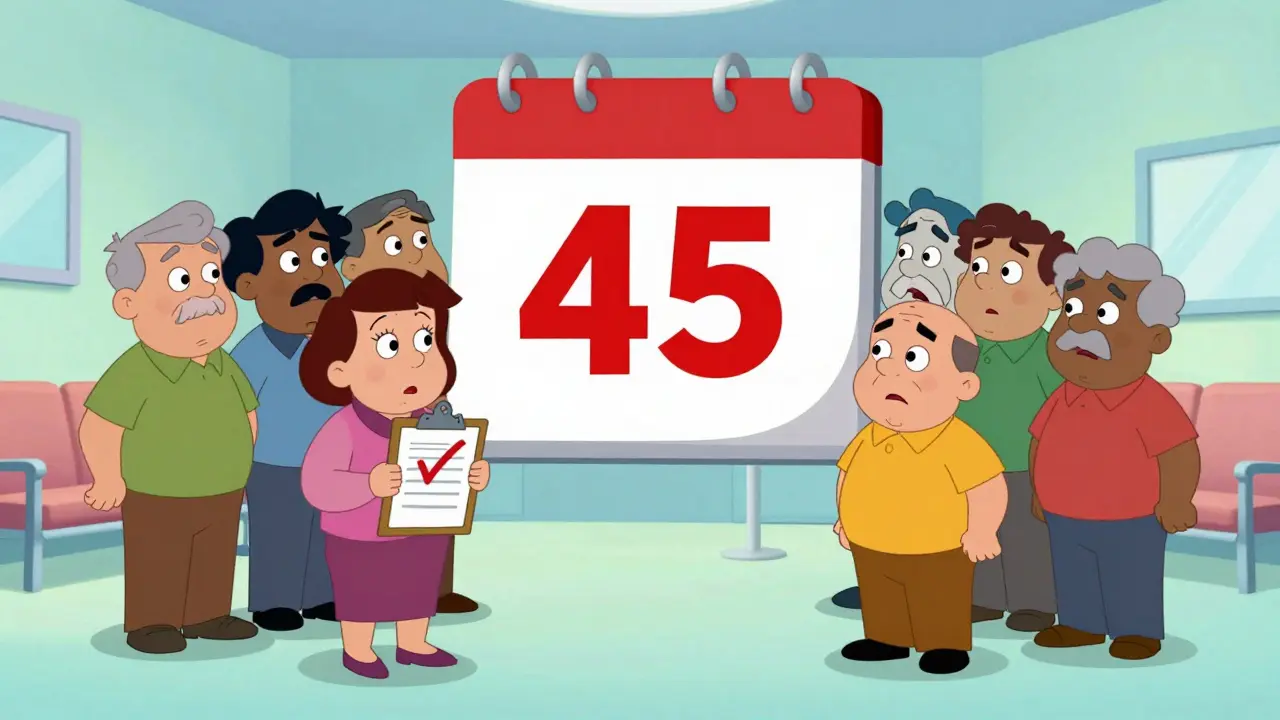
Colorectal cancer (CRC) used to be a disease that mostly affected older adults. That changed dramatically in the last decade. Today, we are seeing a sharp rise in cases among people under 50, forcing major health organizations to rewrite the rulebook on prevention and treatment. If you have been putting off your screening because you think you are "too young," it is time to rethink that assumption.
The landscape of Colorectal Cancer is the third most common cancer in the United States, with over 153,000 new cases diagnosed annually has shifted from reactive treatment to proactive prevention. This article breaks down exactly when you need to get screened, which test is right for you, and what happens if cancer is found-specifically focusing on modern chemotherapy regimens that save lives.
Why Screening Guidelines Changed: The Age 45 Rule
For years, the standard advice was to start screening at age 50. In 2021, the U.S. Preventive Services Task Force (USPSTF) lowered that starting age to 45 for average-risk adults. This wasn't a random decision; it was driven by hard data showing a 2.2% annual increase in CRC incidence among adults under 50 between 1995 and 2019.
The American Cancer Society had already recommended starting at 45 in 2018, but the USPSTF update created a unified national standard. Here is what this means for you:
- Ages 45-49: Grade B recommendation (moderate certainty of net benefit).
- Ages 50-75: Grade A recommendation (high certainty of substantial net benefit).
- Ages 76-85: Individualized decision-making based on health status and prior screening history.
If you fall into the high-risk category-meaning you have inflammatory bowel disease, a family history of CRC, or genetic syndromes like Lynch syndrome-you likely need to start even earlier, often before 45. In these cases, stool-based tests are usually not enough; a colonoscopy is the preferred method.
Choosing Your Screening Method: Pros and Cons
You have options, and the "best" test depends on your comfort level, access to care, and risk profile. Let’s look at the five primary modalities approved by major health bodies.
| Method | Frequency | Invasiveness | Key Benefit | Key Drawback |
|---|---|---|---|---|
| Colonoscopy | Every 10 years | High (requires prep/sedation) | Detects AND removes polyps during same procedure | Bowel prep discomfort; small perforation risk (1 in 1,000-1,500) |
| Flexible Sigmoidoscopy | Every 5 years | Moderate | Less prep than colonoscopy | Only checks distal colon; misses right-sided cancers |
| Fecal Immunochemical Test (FIT) | Annually | None (at home) | Easy, non-invasive, low cost | Lower sensitivity; requires annual adherence |
| Multi-target Stool DNA (sDNA-FIT) | Every 3 years | None (at home) | Higher sensitivity (92%) than FIT alone | More false positives; higher cost |
| CT Colonography | Every 5 years | Low (no sedation) | Excellent visualization without scope insertion | Radiation exposure; cannot remove polyps |
Colonoscopy remains the gold standard because it offers both detection and prevention. Studies show it reduces CRC incidence by 67% and mortality by 65%. However, the prep is notoriously unpleasant. Surveys indicate that 74% of patients cite the bowel preparation as the worst part of the experience. Despite this, 89% say they would do it again because they trust the results.
If you hate the idea of a scope, stool-based tests like FIT are a valid alternative. They are less sensitive, meaning you might miss some cancers, but they are far more accessible. Adherence rates for FIT can reach 67% in safety-net systems compared to 42% for colonoscopy. Just remember: if your FIT result is positive, you still need a follow-up colonoscopy.

Understanding Chemotherapy Regimens for Colorectal Cancer
If screening detects cancer, or if symptoms lead to a diagnosis, treatment typically involves surgery followed by chemotherapy. Understanding the chemo regimen is crucial for managing expectations and side effects. Chemotherapy for CRC is rarely a one-size-fits-all approach; it depends heavily on the stage of the cancer and specific genetic markers.
For Stage III colon cancer (where cancer has spread to nearby lymph nodes), adjuvant chemotherapy is standard. The goal here is to kill any microscopic cells left behind after surgery. The most common backbone regimen is called FOLFOX or CAPOX.
- FOLFOX: Combines 5-fluorouracil (5-FU), leucovorin, and oxaliplatin. It is given via an IV pump over 46 hours, repeated every two weeks for about three to six months.
- CAPOX: Uses oral capecitabine instead of IV 5-FU, combined with oxaliplatin. This allows for shorter clinic visits but can cause hand-foot syndrome (redness, pain, and blistering on palms and soles).
Oxaliplatin is the key drug that adds significant benefit over 5-FU alone, but it also brings specific side effects like peripheral neuropathy (tingling or numbness in hands and feet). Doctors monitor this closely because severe nerve damage can become permanent.
For Stage IV (metastatic) colorectal cancer, the goals shift toward controlling growth and extending life. Regimens are more aggressive and often include targeted therapies alongside chemo. Common combinations include:
- FOLFIRI: Irinotecan plus 5-FU and leucovorin. Often used if the patient previously received FOLFOX.
- Targeted Agents: Drugs like Bevacizumab (Avastin) or Cetuximab (Erbitux) may be added. These target blood vessel growth or specific proteins on cancer cells. Crucially, Cetuximab only works if the tumor does NOT have a mutation in the KRAS gene. Genetic testing of the tumor is now mandatory before starting these drugs.
Rectal cancer treatment differs slightly. Because the rectum is in a tight space, doctors often use chemoradiation (chemo + radiation) before surgery to shrink the tumor, making removal easier and preserving sphincter function.

Barriers to Care and How to Overcome Them
Knowing you should get screened is different from actually getting it done. Several barriers stand in the way:
- Capacity Constraints: Many safety-net hospitals report wait times exceeding 60 days for colonoscopies. Dr. David Lieberman noted that expanding screening to younger ages could strain endoscopy capacity. If you are waiting too long, ask your doctor about stool-based tests as a bridge.
- Insurance Confusion: Under the Affordable Care Act, preventive screenings are covered at no cost. However, if a polyp is removed, the visit becomes "therapeutic" rather than "preventive," and you might face copays. Always call your insurance provider to confirm coverage details before scheduling.
- Anxiety and Discomfort: Fear of the procedure or the prep is real. Patient navigators can help explain each step. Studies show that team-based care models reduce no-show rates by 42% simply by providing better support and communication.
If you are African American, you face a higher risk-20% higher incidence and 40% higher mortality than White Americans. Screening is even more critical for you. The American College of Gastroenterology emphasizes colonoscopy as the preferred method for this demographic due to its superior detection rates.
Future Directions: What’s Next in CRC Care?
The field is moving fast. By 2027, the market for CRC screening tests is projected to hit $4.2 billion, driven largely by newer technologies. One exciting development is blood-based biomarker tests. The Guardant SHIELD test, presented at ASCO GI 2023, showed 83% sensitivity for CRC detection in a large trial. While not yet a standalone replacement for colonoscopy, these liquid biopsies could serve as excellent triage tools.
Artificial Intelligence is also entering the room. AI-assisted colonoscopy systems like GI Genius (approved by the FDA in 2021) use real-time imaging to highlight polyps that the human eye might miss. Studies show these systems increase adenoma detection rates by 14%, potentially catching more pre-cancerous lesions.
Finally, researchers are working on "precision screening." Instead of a blanket "every 10 years" rule, future guidelines may use genetic, environmental, and lifestyle data to personalize intervals. This could reduce unnecessary procedures by 30% while maintaining high safety standards.
At what age should I start screening for colorectal cancer?
If you are at average risk, current guidelines recommend starting screening at age 45. If you have a family history of colorectal cancer, inflammatory bowel disease, or known genetic syndromes like Lynch syndrome, you may need to start earlier, often 10 years before the youngest relative's diagnosis age or at age 40, whichever comes first. Consult your doctor for a personalized timeline.
Is colonoscopy really necessary if I take a stool test?
Stool tests like FIT or sDNA-FIT are effective screening tools, but they are not diagnostic. If your stool test result is positive, you must follow up with a colonoscopy to determine the cause. Colonoscopy is the only method that can both detect and remove precancerous polyps during the same procedure, preventing cancer before it starts.
What are the common side effects of FOLFOX chemotherapy?
Common side effects of FOLFOX include fatigue, nausea, diarrhea, and mouth sores. The drug oxaliplatin specifically causes peripheral neuropathy, which feels like tingling, numbness, or burning in the hands and feet. This sensation can be worsened by cold temperatures. Most side effects are manageable with medication, but severe neuropathy may require dose adjustments.
How much does a colonoscopy cost with insurance?
Under the Affordable Care Act, preventive colonoscopies are covered at 100% with no out-of-pocket cost for most plans. However, if polyps are found and removed, the procedure is considered therapeutic, and you may be responsible for copays or deductibles. Always verify with your insurance provider beforehand to avoid surprise bills.
Can blood tests replace colonoscopy for screening?
Currently, no blood test is approved as a standalone replacement for colonoscopy in routine screening. While emerging tests like Guardant SHIELD show promise with high sensitivity, they are primarily used for detecting recurrence in known cancer patients or as part of multi-cancer early detection research. Colonoscopy remains the gold standard for definitive screening and prevention.