Buying medication from an unverified source is like playing Russian roulette with your health. With the rise of sophisticated counterfeit drugs, a professional-looking website or a polished storefront isn't enough to prove a pharmacy is legitimate. The only way to know for sure is to check the source of truth: the state regulatory boards. If a pharmacy isn't licensed, the risk of receiving contaminated or fake medication skyrockets, turning a simple prescription into a dangerous gamble.
| Method | Best For | Cost | Authority |
|---|---|---|---|
| State Board Lookup | Quick, official local checks | Free | Legal Primary Source |
| NABP Verify | Multi-state practitioners | $59/year | National Monitoring |
| IPLC Compact | Cross-state pharmacy work | Varies | Interstate Agreement |
What Exactly Are State Pharmacy Boards?
Think of State Pharmacy Boards is a regulatory agency established by state legislation to oversee the practice of pharmacy within its specific jurisdiction. These boards aren't just administrative offices; they are the frontline defenders of public health. Since the first board started in Massachusetts back in 1878, the system has grown to 56 regulatory bodies across the U.S., including territories like Puerto Rico and Guam.
Their main job is to make sure that the people handling your meds-pharmacists and technicians-are actually competent and ethical. As of 2023, these boards regulate around 350,000 pharmacists and 300,000 technicians. They handle everything from issuing licenses and renewals to investigating complaints and handing out disciplinary actions. When you verify a license, you're checking if the state has given that professional the "green light" to operate legally.
How to Verify a Pharmacy License Step-by-Step
Verifying a license is usually a fast process, but you need to be precise. Most boards have moved to online systems, with 48 of the 56 jurisdictions offering web-based lookups. Here is the general process for performing a verify pharmacy licenses check:
- Find the official state board website: Search for the "[State Name] Board of Pharmacy." Make sure you are on a ".gov" site to avoid phishing scams.
- Navigate to the "License Verification" or "Lookup" section: This is typically found in the main menu or a prominent button on the homepage.
- Enter the required details: Most systems require at least a name or a license number. For example, the Maryland Board of Pharmacy allows searches by name, license number, city, or zip code.
- Use "Less is More" for search terms: If you enter too many specific details (like a middle initial that isn't on file), you might get zero results. Start with just the last name and first name.
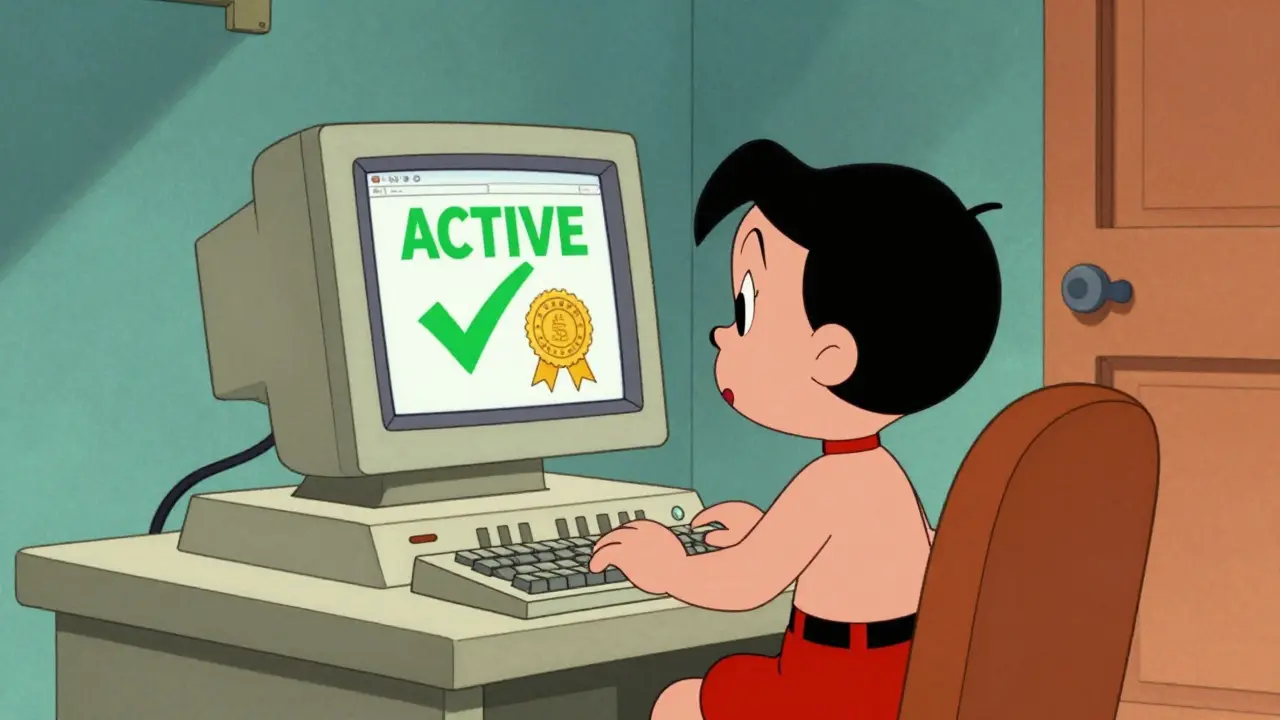
- Analyze the status: Look for the word "Active." If you see "Suspended," "Revoked," or "Probation," the pharmacy or practitioner is not currently authorized to operate normally.
- Check the expiration date: An "Active" status is useless if the license expired yesterday. Ensure the date is in the future.
In the District of Columbia, for instance, the system is very strict about complete names. If you provide partial information, you'll likely get inaccurate results, so double-check your spelling against the pharmacy's official signage or website.
The Danger of the "Verification Gap"
While these systems are helpful, they aren't perfect. There is a known issue called the "update lag." For example, some users on Reddit have reported that Maryland can take up to three weeks to update a license status after an exam is passed. More dangerously, some experts, including Dr. Susan Cornell, have noted that these systems often lack real-time updates. This means a practitioner could be under active investigation or have had their license suspended, but the website still shows them as "Active" for a few days.
According to a cross-profession analysis by the Federation of State Medical Boards, pharmacy boards are about 15% slower at updating disciplinary actions than medical boards, averaging about 14.3 days. This gap is where counterfeit drug operations often hide-they might use a license that was valid a month ago but has since been revoked.
Comparing State Lookups vs. NABP Verify
If you are a pharmacy owner or a healthcare provider working across state lines, checking 10 different state websites is a nightmare. That's where NABP Verify is a national license monitoring service launched in 2020 by the National Association of Boards of Pharmacy comes in. Unlike the free state lookups, this is a paid service ($59/year) that provides a digital badge to certify compliance.
The big difference is the scope. State boards are the legal primary source-they are the ultimate authority. NABP Verify is a convenience tool. It allows for ongoing monitoring and a centralized view, which is why some independent pharmacy owners have reported reducing their credentialing time from 14 days down to just 3 days when expanding into new states.
Spotting Red Flags and Counterfeit Drug Risks
Why does all this matter? Because counterfeit drugs are becoming harder to spot. A rogue pharmacy might display a fake license number on their website to trick you. If you plug that number into a state board's verification system and find it doesn't exist, or belongs to a different pharmacy in another state, you've just avoided a potential medical disaster.
Watch out for these warning signs:
- The pharmacy claims to be licensed but refuses to provide a license number.
- The license number provided doesn't match the name of the pharmacy on the state board's official site.
- The pharmacy is located in a different state than the one they claim to be licensed in.
- The "Active" status has expired, and they claim they are "just waiting for the renewal to process."
Remember, 47% of disciplinary actions against pharmacists involve practicing with an invalid or expired license. If they can't keep their paperwork in order, they likely aren't following strict safety protocols for handling your medications.
Modernizing the Process: The IPLC and LVE
The industry is trying to close the gaps. The Interstate Pharmacy Licensure Compact (or IPLC) is a game-changer for practitioners, allowing them to work in multiple participating states without applying for a separate license in each. As of late 2023, 23 states have joined this compact.
Additionally, the License Verification Exchange (LVE) has been adopted by 68% of regulatory boards. This creates a more unified ecosystem, making it easier for boards to share data and for the public to get faster answers. The goal is for 90% of boards to have real-time updates by 2025, which would effectively kill the "verification gap" and make it much harder for counterfeit drug distributors to masquerade as legitimate pharmacies.
Is it free to verify a pharmacy license?
Yes, for the general public, searching the online database of a state pharmacy board is almost always free. Some states may charge a small fee only if you request a formal, notarized verification letter for legal or employment purposes.
What should I do if a pharmacy's license shows as "Suspended"?
Do not fill a prescription at that pharmacy. A suspended license means the state has found a significant issue with the pharmacy's practice. You should contact the state pharmacy board immediately to report your concerns and find a different, fully licensed provider.
Can I trust third-party verification websites?
No. You should always use the state board's ".gov" website or a recognized national body like the NABP. Third-party sites may have outdated information or could be operated by the very pharmacies trying to deceive you.
Why can't I find a pharmacy in the database even though they say they are licensed?
First, try searching by only the last name to account for spelling variations. If that fails, check if they are using a "Doing Business As" (DBA) name that differs from their legal licensed name. If you still find nothing, it is a major red flag that the pharmacy may be operating illegally.
How often should I verify my pharmacy's license?
For regular patients, checking once a year is usually enough. However, if you are switching to a new pharmacy or buying a high-cost medication from an online source, you should verify the license immediately before making the purchase.
Next Steps for Patients and Providers
If you're a patient, make it a habit to check the board of pharmacy website whenever you try a new medication provider. If you notice a discrepancy, don't just ignore it-report it to the state board. Your report could prevent others from receiving dangerous counterfeit drugs.
For pharmacy owners and hiring managers, avoid relying solely on an employee's word or a photocopy of a license. Use "primary source verification," which means going directly to the state board website. This is the gold standard for credentialing and is required by the majority of hospitals and retail chains to ensure patient safety.