That burning sensation rising up your chest is more than just annoying; it disrupts your day, ruins your sleep, and makes eating a chore. You’re not alone in dealing with this. Millions of people reach for over-the-counter (OTC) heartburn medications non-prescription drugs designed to neutralize or reduce stomach acid to relieve symptoms of gastroesophageal reflux disease (GERD) and occasional heartburn every single week. But walking down the pharmacy aisle can feel overwhelming. Do you grab the chalky tablets? The pills that take hours to work? Or the ones doctors used to prescribe exclusively?
Choosing the wrong medication won’t just waste your money; it might leave you in pain or expose you to unnecessary health risks. Understanding the difference between antacids, H2 blockers, and proton pump inhibitors (PPIs) is the key to finding real relief without side effects.
Antacids: The Quick Fix for Occasional Burn
If you just ate a spicy taco and feel that familiar sting starting, you need speed. That’s where antacids are alkaline compounds that chemically neutralize existing stomach acid through immediate reaction come in. They don’t stop your body from making acid; they simply cancel out the acid already sitting in your stomach.
The mechanism is straightforward chemistry. Ingredients like calcium carbonate (found in Tums), magnesium hydroxide (Milk of Magnesia), and aluminum hydroxide raise the pH level in your stomach almost instantly. Most users feel relief within 30 to 120 seconds. However, this effect is fleeting. The relief typically lasts only 30 to 60 minutes because your stomach continues producing acid as soon as the antacid moves on.
| Ingredient | Brand Examples | Key Benefit | Potential Side Effect |
|---|---|---|---|
| Calcium Carbonate | Tums, Rolaids | Fastest acting, adds dietary calcium | Rebound acid hypersecretion in 30% of users |
| Magnesium Hydroxide | Milk of Magnesia | Laxative effect helps bloating | Diarrhea if overused |
| Aluminum Hydroxide | Alternagel | Constipating effect balances magnesium | Constipation, phosphate binding |
Antacids are best for infrequent heartburn-say, once a week or less. They are cheap, widely available, and require no special timing. Just chew or swallow them when symptoms hit. But beware of taking them with other medications. Because they change stomach acidity, they can interfere with the absorption of drugs like antibiotics or thyroid medication. Always wait at least two hours between taking an antacid and any other prescription drug.
H2 Blockers: Moderate Relief for Predictable Episodes
What if you know heartburn is coming? Maybe you have a big dinner planned, or you tend to get symptoms after lunch. In these cases, Histamine-2 (H2) blockers are medications that reduce acid secretion by competitively inhibiting histamine H2 receptors on parietal cells in the stomach lining offer a smarter strategy. Unlike antacids, H2 blockers don’t neutralize acid; they tell your stomach to produce less of it.
This class of drugs, including famotidine (Pepcid AC), cimetidine (Tagamet HB), and nizatidine (Axid AR), takes longer to kick in-usually 60 to 180 minutes. However, the payoff is duration. One dose can provide relief for 8 to 12 hours. This makes H2 blockers ideal for preventing nighttime heartburn or managing symptoms that occur one or two times a week.
Here’s the catch: H2 blockers lose effectiveness if you use them continuously for more than two or three weeks. Your body adapts to the blockade, a phenomenon known as tachyphylaxis. If you find yourself needing Pepcid every night for a month, it’s time to switch strategies or see a doctor. Also, be cautious if you take blood thinners like warfarin or anti-seizure medications like phenytoin, as H2 blockers can interact dangerously with these drugs.

PPIs: Heavy-Duty Suppression for Frequent Sufferers
For those experiencing heartburn two or more days a week, mild measures often fail. This is where Proton Pump Inhibitors (PPIs) are potent acid-suppressing drugs that irreversibly inhibit the H+/K+ ATPase enzyme system in gastric parietal cells, reducing acid production by 90-98% enter the picture. OTC options include omeprazole (Prilosec OTC), esomeprazole (Nexium 24HR), and lansoprazole (Prevacid 24HR).
PPIs are the most effective tools in the OTC arsenal, but they are also the most misunderstood. They do not provide immediate relief. In fact, it can take 24 to 72 hours of consistent daily use to reach full effect. Why? Because PPIs target the "proton pumps" inside your stomach cells. These pumps are only active when you eat. By taking a PPI before breakfast, you trap the active pumps and shut them down for up to 24 hours.
Timing is everything with PPIs. You must take them 30 to 60 minutes before your first meal of the day. Taking them after food renders them nearly useless. Furthermore, FDA guidelines strictly limit OTC PPI use to 14 consecutive days. If your symptoms persist beyond that window, you need medical evaluation. Long-term unsupervised use carries risks, including increased susceptibility to Clostridium difficile infection, hip fractures due to reduced calcium absorption, and potential vitamin B12 and magnesium deficiencies.
How to Choose the Right Medication
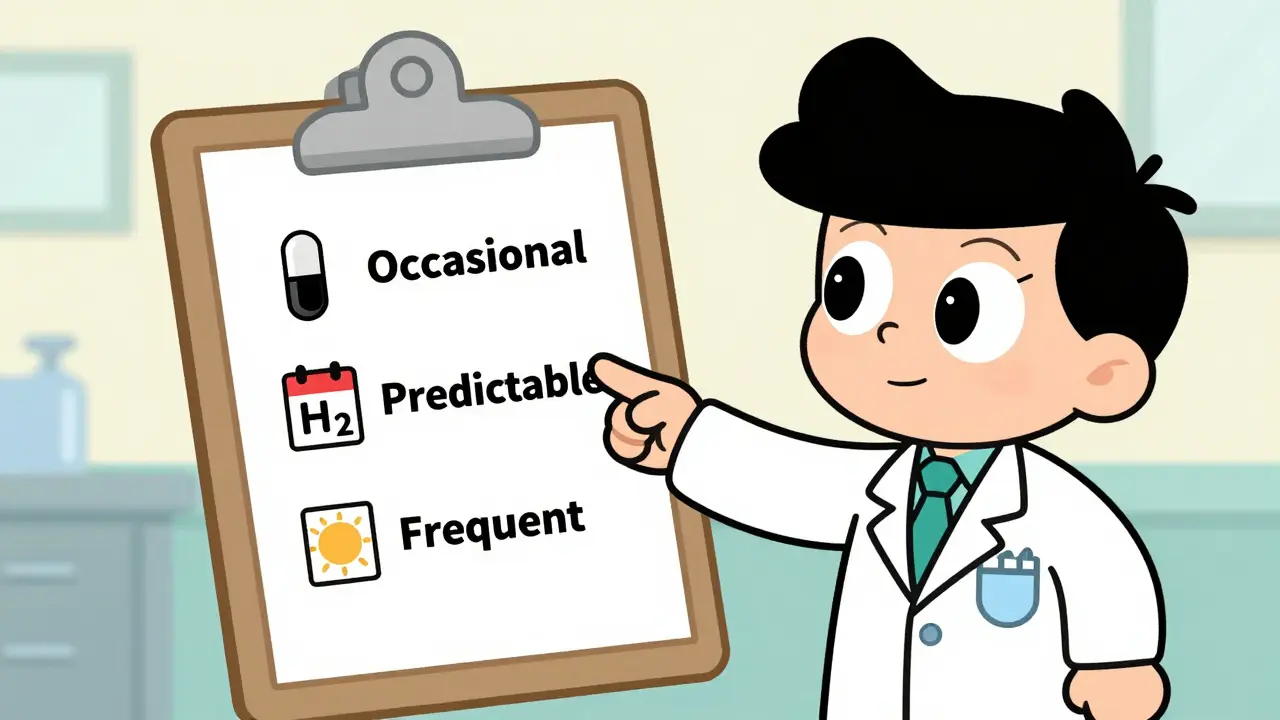
Selecting the right OTC heartburn medication depends entirely on your symptom frequency and pattern. There is no single "best" drug for everyone. Use this decision framework to guide your choice:
- Occasional Heartburn (<1 time/week): Stick with antacids. They are safe, cheap, and solve the problem immediately without affecting your long-term health. Chew them at the onset of symptoms.
- Predictable Episodic Heartburn (1-2 times/week): Try H2 blockers. Take them 60-90 minutes before the meal that usually triggers your symptoms. This prevents the acid surge rather than fighting it afterward.
- Frequent Heartburn (≥2 days/week): Consider PPIs for a strict 14-day course. Take them daily before breakfast. If symptoms resolve, taper off slowly. If they return, consult a gastroenterologist.
Many patients combine therapies for breakthrough symptoms. For example, using a PPI for baseline control during the day and keeping an antacid on hand for sudden flare-ups. However, always space antacids and PPIs by at least two hours to ensure proper absorption of the PPI.
Safety Warnings and Red Flags
While OTC medications are generally safe, misuse can lead to serious complications. The FDA has issued multiple safety communications regarding PPI overuse. Key warnings include:
- Kidney Health: Long-term PPI use (>1 year) is associated with a 23% increased risk of chronic kidney disease. Regular monitoring is advised for frequent users.
- Infection Risk: Reduced stomach acid lowers your body’s natural defense against bacteria. This increases the risk of community-acquired pneumonia and gastrointestinal infections like C. diff.
- Nutrient Deficiencies: Stomach acid is crucial for absorbing magnesium, calcium, and vitamin B12. Chronic suppression can lead to deficiencies, causing fatigue, bone weakness, and neurological issues.
Never ignore "alarm symptoms" such as difficulty swallowing, unintentional weight loss, vomiting blood, or black/tarry stools. These are not signs of simple heartburn but may indicate ulcers, esophageal damage, or even cancer. Stop self-medicating and seek immediate medical attention if these occur.
Can I take antacids and PPIs together?
Yes, but you must separate them by at least two hours. Antacids can interfere with the absorption of PPIs if taken simultaneously. Many patients use PPIs for long-term control and keep antacids on hand for occasional breakthrough symptoms, ensuring they do not overlap their dosing times.
Why isn't my Prilosec working immediately?
PPIs like Prilosec (omeprazole) are not designed for immediate relief. They work by shutting down acid-producing pumps in the stomach lining, a process that requires 24 to 72 hours of consistent daily dosing to reach maximum effect. For instant relief, use an antacid while waiting for the PPI to build up in your system.
Is it safe to use H2 blockers every night?
Short-term nightly use is generally safe, but H2 blockers lose effectiveness after 2-3 weeks of continuous use due to receptor adaptation. If you find yourself needing them every night for more than a few weeks, consult a doctor. Long-term reliance may mask underlying conditions like GERD that require different treatment.
What are the side effects of long-term PPI use?
Long-term PPI use (more than 14 days without medical supervision) increases the risk of Clostridium difficile infection, hip fractures, kidney disease, and deficiencies in magnesium, calcium, and vitamin B12. The FDA recommends limiting OTC PPI use to 14-day courses unless directed by a physician.
When should I see a doctor for heartburn?
Seek medical advice if you experience heartburn more than twice a week despite OTC treatment, have difficulty swallowing, unintended weight loss, persistent nausea, vomiting, or black/tarry stools. These symptoms may indicate severe GERD, ulcers, or other serious gastrointestinal conditions requiring prescription therapy or endoscopy.