Medication errors kill about 7,000 people in the U.S. every year, and half of chronic disease patients don't take their meds as prescribed. The gap between what a doctor prescribes and what actually happens in your living room is often filled by one person: your pharmacist is a healthcare professional who translates complex pharmaceutical data into actionable daily routines. But unless you ask for specific tools, that translation might be rushed or incomplete. This guide shows you exactly what to request from your pharmacy to turn a quick pill hand-off into a clear plan for staying healthy.
The Core Value of Pharmacist-Provided Resources
Doctors focus on diagnosing the disease; pharmacists focus on managing the treatment. While a physician might explain why you need an inhaler, a pharmacist explains how to shake it, breathe in, and hold your breath for ten seconds. This distinction matters because 87% of patients report greater clarity on administration techniques when taught by a pharmacist compared to a doctor. According to a 2022 study in the Journal of the American Pharmacists Association, this precision reduces user error significantly. When you request detailed materials, you are asking for this specific expertise, not just a repeat of the prescription label.
The foundation for these materials comes from federal laws like the Omnibus Budget Reconciliation Act of 1990 (OBRA '90), which mandated counseling for Medicaid beneficiaries. Today, all 50 states require some form of patient counseling, but the depth varies. By proactively requesting structured information, you ensure you receive the full benefit of the Joint Commission of Pharmacy Practitioners' (JCPP) 2025 standards, which emphasize "person-centered" care rather than just legal compliance.
Essential Written Handouts to Ask For
Verbal instructions fade quickly. Written materials serve as a reference when you are confused or sick. Do not settle for the generic leaflet stapled to your bag. Instead, request customized documents that address your specific regimen. Here is what should be included:
- Medication Name and Purpose: Not just the brand name, but the generic name and a plain-English explanation of what it treats.
- Dosage and Schedule: Exact times, amounts, and duration. If you take pills at 8 AM and 8 PM, get a printed schedule that fits your actual daily routine, not just a standard clock time.
- Missed Dose Protocol: Clear steps on what to do if you forget a dose. Does it matter if it's been 4 hours? 12 hours? Get this in writing.
- Storage Requirements: Some drugs need refrigeration; others must stay away from moisture. A simple sticker or note prevents accidental spoilage.
- Side Effect Management: Which side effects are normal, which are dangerous, and what to do about each. Avoid vague warnings like "may cause dizziness." Ask for specifics on how to mitigate them.
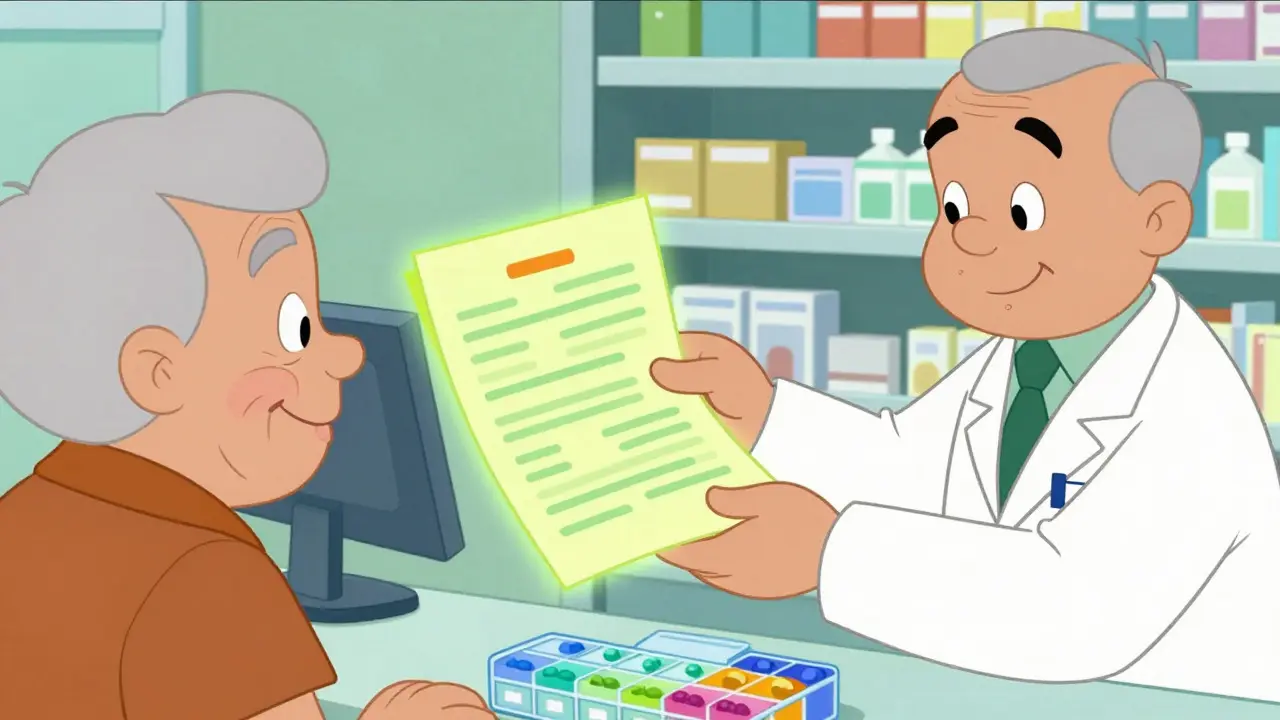
Resources like the Patient Education Reference Center (PERC) offer over 15,000 evidence-based handouts in English and Spanish. Many independent pharmacies use similar databases to print personalized sheets. If your pharmacist looks surprised when you ask for a custom printout, ask if they have access to digital libraries like UpToDate or Epocrates, which allow them to generate tailored PDFs for your specific drugs.
Visual Aids and Demonstration Tools
Reading isn't enough for devices. Inhalers, insulin pens, and eye drops require muscle memory. In a 2023 survey, 76% of patients who received visual aids demonstrated proper technique, compared to only 41% of those who received only verbal instructions. When picking up new equipment, request a demonstration with a return-demonstration session. This means you show the pharmacist how you would use it, and they correct your form before you leave the counter.
For elderly patients or those with low vision, ask for large-print labels or color-coded organizers. The American Association of Diabetes Educators recommends that phone numbers and critical alerts be written in numerals rather than text for easier scanning. If you have limited health literacy, don't hesitate to ask for materials written at a 6th-grade reading level. Only 35% of current pharmacy handouts meet this standard, so you may need to specifically request simplified language.
Addressing Barriers: Language, Cost, and Lifestyle
Education fails if it doesn't fit your life. If you work night shifts, a standard "take with food" instruction might be confusing. Ask your pharmacist to help you build a schedule that aligns with your meals and sleep patterns. Similarly, financial barriers are a major reason for non-adherence. Yet, only 18% of patients report that pharmacists discussed lower-cost alternatives, even though 62% needed them. Proactively ask: "Are there generic versions? Are there coupons or manufacturer savings cards?" Getting this advice in writing helps you compare options later.
Language also plays a huge role. With 80 million U.S. adults having limited health literacy, and many more being non-native English speakers, requesting materials in your preferred language is crucial. PERC offers Spanish versions for 92% of common medications. If you speak another language, check if your pharmacy has access to translated resources or community health workers who can assist. The JCPP’s 2025 guidelines stress that understanding must be confirmed, not assumed.
Digital Resources and Follow-Up Support
Paper is static; digital tools are dynamic. Many modern pharmacies integrate with platforms like UpToDate Patient Education, used by 85% of U.S. teaching hospitals. These platforms offer videos, interactive quizzes, and updated information. Ask if your pharmacy can send you a link to a video demonstrating your specific medication. Video content is particularly effective for procedural tasks like injecting insulin or using a nebulizer.
Furthermore, ask for documentation. Under ASHP guidelines, counseling should be recorded in your medical record. This ensures that if you switch doctors or pharmacies, your history of education and preferences travels with you. It also provides a baseline for future conversations. If you feel confused after a visit, call back within 48 hours. Most pharmacists welcome follow-up questions and will clarify points that were missed during the initial rush.
| Feature | Pharmacist-Provided | Physician-Provided | Online/Digital Only |
|---|---|---|---|
| Focus Area | Administration & Adherence | Disease Context & Diagnosis | General Information |
| Personalization Level | High (Routine-specific) | Moderate (Condition-specific) | Low (Generic) |
| Technical Instruction | Excellent (Inhalers, Injections) | Fair | Variable (Video-dependent) |
| Cost Guidance | Direct & Immediate | Limited | None |
| Follow-up Access | Easy (Phone/Chat) | Difficult (Appointment needed) | Self-directed |
The 7 Essential Questions Framework
To make the most of your interaction, prepare these seven questions endorsed by the American Society of Health-System Pharmacists (ASHP). Write them down before you go to the pharmacy:
- What is this medication for?
- How and when should I take it?
- What should I do if I miss a dose?
- What side effects should I expect, and which ones mean I should stop taking it?
- How will I know if it's working?
- How should I store it?
- Is there anything else I need to know about interactions or lifestyle changes?
Asking these questions signals to the pharmacist that you are an active participant in your care. It shifts the dynamic from passive receipt of information to collaborative problem-solving. If the answers seem too fast, ask them to slow down or write the answer down. You are entitled to understand your own treatment plan.
Frequently Asked Questions
Do I have to pay extra for patient education materials?
No. Basic counseling is required by law in all 50 states. Printed handouts and demonstrations are part of the service fee you already pay for dispensing. However, specialized digital subscriptions or premium consultations might vary, but core educational materials should be free.
What if my pharmacist rushes through the counseling?
This is common in high-volume chain pharmacies where average counseling time is under two minutes. To combat this, ask for written materials instead of verbal explanations. You can read them at home at your own pace. Alternatively, consider visiting an independent pharmacy or scheduling a dedicated Medication Therapy Management (MTM) appointment, which Medicare Part D plans are increasingly covering starting in 2026.
Are online drug guides reliable enough?
They are good for general info but lack personalization. They don't know your other medications, allergies, or lifestyle. Use them as a backup, but always verify with your pharmacist who can check for drug-drug interactions specific to your profile. A 2024 study showed that pharmacist-led interpretation doubles the effectiveness of standard medication guides.
How do I get materials in a language other than English?
Ask directly. Major resources like PERC and UpToDate offer content in over 18 languages. If your local pharmacy doesn't have it, they can often order it or direct you to community health resources. Make sure to specify your preferred language when you first register for services.
Should I bring my old prescriptions to the pharmacy?
Yes, always. Bring all bottles, including OTC meds and supplements. This allows the pharmacist to check for interactions and provide comprehensive education on how new drugs fit into your existing regimen. It prevents duplicate therapies and ensures your education materials reflect your total medication load.